The Magadi Test: When Sovereignty Must Become Capability
Kenya wants more value from its minerals. The harder question is whether it can transform a century-old industrial system without destroying the value already embedded inside it.
On this page
- A Lake Becomes a Balance Sheet
- The Seduction of Value Addition
- Three Disputes Hiding Inside One Headline
- What the Courts Have, and Have Not, Said
- The Corporation's Burden
- The State's Burden
- The County's Burden
- The Community Is Not a Footnote
- Sovereignty Is an Operating Capability
- What Happens at 6:00 a.m. the Morning After Tata?
- The Magadi Transformation Compact
- The Question Kenya Should Be Asking
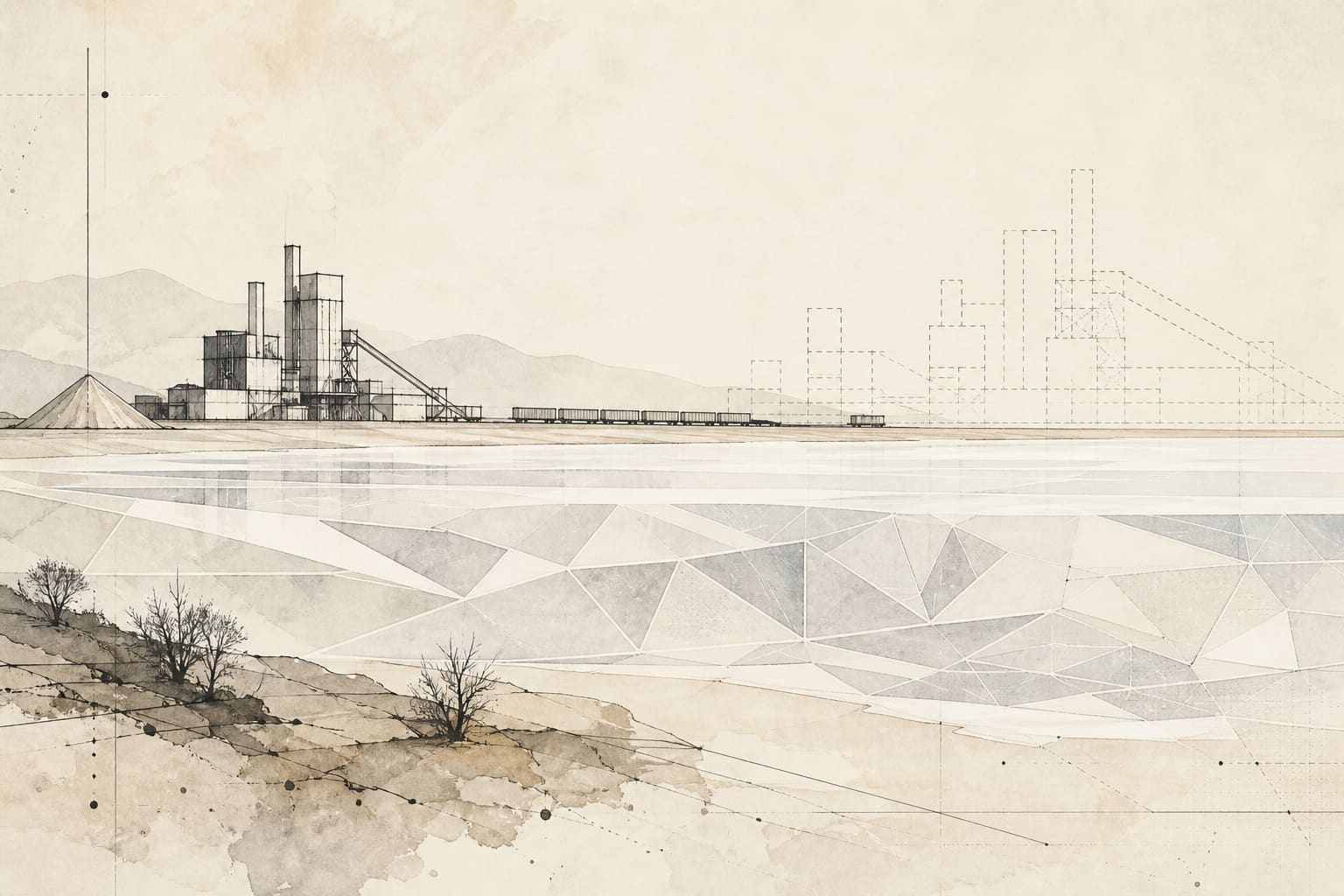
Conceptual editorial image, not a documentary photograph and not an allegation against any person or company. Ivory ground with mineral-industrial geometry suggesting Lake Magadi, processing, logistics and unrealised downstream plants.
A Lake Becomes a Balance Sheet
Begin at the lake. Not with a ministry letter. Not with a stock-exchange filing. With the pale geometry of an alkaline basin in Kajiado, where trona is lifted from the water’s edge, carried into a plant, and turned into soda ash, the industrial powder that makes glass, detergents, chemicals and water-treatment inputs possible somewhere else.
Follow the chain outward: processing plant, railway and logistics, port, export market. Then widen the frame again: worker, household, local supplier, county government, national regulator, Treasury, court, multinational board, prospective successor, proposed downstream factory that does not yet exist, and the generation that will inherit whatever decision is made this season.
Who owns the future value of a mineral?
The mineral can sit in one geography while its value, risk, authority and consequences sit in entirely different places. That is the Magadi problem in one sentence. Kenya is right to demand more value from its minerals. It must be equally right about evidence, law, institutional process and transition.
The Magadi question is not whether Kenya should choose sovereignty or investment. It is whether sovereignty can become institutional capability.
The Seduction of Value Addition
A circulating political thread identifies a legitimate industrial-policy problem: Kenya earns export income from soda ash but captures too little of the downstream value available from glass, chemicals and other manufactured products. That diagnosis is not frivolous.
01
Trona
Lake mineral feedstock
02
Soda ash
Already processed industrial input
03
Glass
Deeper downstream
04
Chemicals
Deeper downstream
05
Detergents & water treatment
Deeper downstream
Overlay across the chain: value · jobs · skills · tax · foreign exchange · capital · environmental cost
But Magadi is not simply loading untouched earth onto ships. Trona is extracted and processed into industrial soda ash before export. Kenya’s real challenge is therefore not the complete absence of processing; it is the failure to build sufficiently deep downstream industries around an existing processed input.
“Stop exporting raw minerals” is a compelling slogan. “Construct a competitive glass and chemical manufacturing ecosystem” is a demanding industrial programme. The second requires reliable energy, water, rail and port logistics, technical skills, environmental approvals, patient capital, competitive production costs, credible buyers and disciplined project execution. A new investor can promise value addition. That does not mean it can finance or deliver it. Mineral ownership is not automatically mineral value capture. Value addition is not accomplished by merely replacing one concessionaire with another.
Three Disputes Hiding Inside One Headline
The controversy is easier to govern when separated into three distinct questions that the headline collapses into one.
Industrial policy
Is Kenya capturing enough value from soda ash through downstream manufacturing, local enterprise and capability?
Regulatory compliance
Has the operator met licensing, royalty, reporting, community, labour, procurement and environmental obligations?
Intergovernmental fiscal governance
What is lawfully owed, and what falls within national rather than county authority?
Magadi
Collapsing the three produces a false political binary: defending due process becomes “defending foreign exploitation”; supporting value addition becomes “supporting arbitrary expropriation”; questioning Tata’s performance becomes “opposing investment”; questioning the replacement process becomes “opposing sovereignty.” Kenya should reject all four propositions. Foreign investment does not create immunity from regulation. State sovereignty does not create immunity from due process.
What the Courts Have, and Have Not, Said
What the public record supports
- Industrial soda-ash operations at Lake Magadi date to 1911.
- Tata Chemicals acquired the Magadi plant in December 2005; renamed 2006.
- 2025 national soda-ash exports: about 254,780 tonnes worth about KSh7.36 billion.
- Ministry suspended operations on 28 July 2026 amid disputed allegations.
- High Court declined interim relief on 7 August without deciding the merits.
- Court of Appeal (Oct 2025) quashed the county’s approximately KSh17.4bn demand approach.
- President announced replacement companies and glass/chemical plants (3 September 2026).
What the public record does not yet establish
- That Tata operated Magadi from 1911.
- That the county demand is an established debt.
- That suspension proved regulatory breaches on the merits.
- That announced successors are financed, qualified and conflict-cleared.
- That Kenya exports completely unprocessed ore.
- That replacement will necessarily yield greater public value.
- Independent verification of ~500 employees / ~30,000 beneficiaries as census facts.
| Claim or implication | Verdict | What the evidence shows |
|---|---|---|
| “Tata Chemicals Magadi has operated at Lake Magadi since 1911.” | Needs correction | Industrial operations date to 1911. Tata Chemicals acquired the Magadi plant in 2005; renamed Tata Chemicals Magadi in 2006. |
| “Tata is being pushed out because Kenya wants value addition.” | Partly true, incomplete | The President connected replacement to glass and chemical plants. The July suspension also involved disputed licensing, royalties, reporting, community, employment, procurement and environmental questions. |
| “The government has established that Tata owes royalties and is non-compliant.” | Not established | Government alleges unresolved obligations. Tata disputes and says it demonstrated compliance. High Court interim ruling did not decide the merits. |
| “Tata owes Kajiado County approximately KSh17.45 billion.” | Misleading | Disputed county demand. Court of Appeal (Oct 2025) quashed the approach as arbitrary and unlawful. Supreme Court (June 2026) allowed more time to appeal, not a merits debt finding. |
| “Kenya exported about 254,780 tonnes of soda ash worth KSh7.4 billion in 2025.” | Supported, with qualification | Economic Survey 2026: 254,779.6 tonnes worth KSh7.36 billion. National trade figures, not casually an audited Tata-only result. |
| “Kenya is merely exporting an unprocessed raw mineral.” | Misleading | Trona is processed into soda ash. Missing value addition is deeper downstream manufacturing. |
| “About 350,000 tonnes annually, with more than 95% exported.” | Only partly supported | Company statement: exports more than 350,000 tonnes annually. Official 2025 national exports are lower (~254,780). “More than 95%” not independently established in material reviewed. |
| “More than 600 people work at Magadi.” | Not supported by latest company disclosure | Tata’s 17 August statement referred to approximately 500 employees. |
| “The suspension proves Tata violated the law.” | Incorrect | High Court declined interim relief because suspension had taken effect and interests were balanced. Judge expressly left merits undecided. |
| “Two replacement companies and downstream plants are ready.” | Announced, not demonstrated | Political announcement. As of 4 September, Tata’s filing still recognised the Ministry’s 28 July letter. Investors, criteria, financing and transition plan were not disclosed in the reviewed record. |
“Tata Chemicals Magadi has operated at Lake Magadi since 1911.”
- Verdict
- Needs correction
- What the evidence shows
- Industrial operations date to 1911. Tata Chemicals acquired the Magadi plant in 2005; renamed Tata Chemicals Magadi in 2006.
“Tata is being pushed out because Kenya wants value addition.”
- Verdict
- Partly true, incomplete
- What the evidence shows
- The President connected replacement to glass and chemical plants. The July suspension also involved disputed licensing, royalties, reporting, community, employment, procurement and environmental questions.
“The government has established that Tata owes royalties and is non-compliant.”
- Verdict
- Not established
- What the evidence shows
- Government alleges unresolved obligations. Tata disputes and says it demonstrated compliance. High Court interim ruling did not decide the merits.
“Tata owes Kajiado County approximately KSh17.45 billion.”
- Verdict
- Misleading
- What the evidence shows
- Disputed county demand. Court of Appeal (Oct 2025) quashed the approach as arbitrary and unlawful. Supreme Court (June 2026) allowed more time to appeal, not a merits debt finding.
“Kenya exported about 254,780 tonnes of soda ash worth KSh7.4 billion in 2025.”
- Verdict
- Supported, with qualification
- What the evidence shows
- Economic Survey 2026: 254,779.6 tonnes worth KSh7.36 billion. National trade figures, not casually an audited Tata-only result.
“Kenya is merely exporting an unprocessed raw mineral.”
- Verdict
- Misleading
- What the evidence shows
- Trona is processed into soda ash. Missing value addition is deeper downstream manufacturing.
“About 350,000 tonnes annually, with more than 95% exported.”
- Verdict
- Only partly supported
- What the evidence shows
- Company statement: exports more than 350,000 tonnes annually. Official 2025 national exports are lower (~254,780). “More than 95%” not independently established in material reviewed.
“More than 600 people work at Magadi.”
- Verdict
- Not supported by latest company disclosure
- What the evidence shows
- Tata’s 17 August statement referred to approximately 500 employees.
“The suspension proves Tata violated the law.”
- Verdict
- Incorrect
- What the evidence shows
- High Court declined interim relief because suspension had taken effect and interests were balanced. Judge expressly left merits undecided.
“Two replacement companies and downstream plants are ready.”
- Verdict
- Announced, not demonstrated
- What the evidence shows
- Political announcement. As of 4 September, Tata’s filing still recognised the Ministry’s 28 July letter. Investors, criteria, financing and transition plan were not disclosed in the reviewed record.
Two replies circulating beside the Magadi thread also need correction. The claim that the collapse of KOKO Networks cost Kenya “over one million jobs” is false. Contemporary reporting referred to approximately 700 direct employees, while much larger figures described customers or households affected by loss of the service (AP News; Business Daily; The Star). The Financial Times headline of 30 January 2026 likewise described insolvency and household service loss, not a million direct jobs. The Garissa gypsum suspension also began in August 2023 rather than being simply a 2024-2025 anti-mining intervention; the ILO assessment and subsequent reporting connect it substantially to insecurity, violent confrontations, land disputes and inter-clan conflict (The Star). Claims that the ban was designed to create gypsum-import opportunities require separate evidence.
Allegation-evidence matrix
Separate claim from finding
| Issue | Allegation / question | Source type | Counter-position | Status | Decision relevance | Verification required | Possible remedy |
|---|---|---|---|---|---|---|---|
| Royalties | Unresolved royalty obligations | Official allegation | Tata asserts payment evidence / compliance | Disputed | Cure vs revoke gate | Independent royalty ledger | Pay, escrow or adjudicate |
| Licence status | Licensing failures connected to suspension | Official allegation | Company cites application / compliance record | Disputed | Legal power to suspend or reinstate | Current legal position determination | Cure or decline licence |
| Export reporting | Export-reporting discrepancies | Official allegation | Company declarations submitted | Disputed | Sanctions vs cure | Government-company reconciliation | Correct and sanction if variance proved |
| Community agreement | Community-development commitments unmet | Official allegation | Company lists programmes and beneficiaries | Evidence gap | Social legitimacy | Beneficiary verification | Recovery plan with measurable outcomes |
| Employment | Local-employment preference shortfalls | Official allegation | ~500 employees disclosed by company | Disputed | Mining Act local preference | Workforce skills-gap analysis | Succession and apprenticeship plan |
| Local leadership | Insufficient Kenyan technical leadership | Analytical inference / policy claim | Not independently mapped in reviewed record | Evidence gap | Capability transfer | Senior-role nationality and skills map | Binding succession milestones |
| Procurement | Local procurement shortfalls | Official allegation | Company supplier record not publicly audited here | Evidence gap | Local enterprise linkages | Local-procurement expenditure audit | Supplier-development targets |
| Environmental compliance | Environmental requirements unmet | Official allegation | Company monitoring records asserted | Disputed | Handover liability | Independent baseline | Remediation plan and bond |
| County land rates | Approximately KSh17.45bn owed to Kajiado County | Disputed county claim | Court of Appeal quashed demand approach (Oct 2025) | Judicial / disputed | Intergovernmental fiscal question | Merits determination if appeal proceeds | Do not treat as established debt |
| Downstream investment | Replacement plants will deliver glass/chemicals | Political announcement | Bankability not demonstrated publicly | Evidence gap | Industrial-policy credibility | Capex, finance, offtake, schedule | Milestones with sanctions |
| Successor capability | Two companies ready to replace Tata | Political announcement | Identities and diligence not disclosed | Evidence gap | Revoke-and-retender integrity | Beneficial ownership, finance, conflicts | Transparent competitive process |
Royalties
- Allegation / question
- Unresolved royalty obligations
- Source type
- Official allegation
- Counter-position
- Tata asserts payment evidence / compliance
- Status
- Disputed
- Verification required
- Independent royalty ledger
Licence status
- Allegation / question
- Licensing failures connected to suspension
- Source type
- Official allegation
- Counter-position
- Company cites application / compliance record
- Status
- Disputed
- Verification required
- Current legal position determination
Export reporting
- Allegation / question
- Export-reporting discrepancies
- Source type
- Official allegation
- Counter-position
- Company declarations submitted
- Status
- Disputed
- Verification required
- Government-company reconciliation
Community agreement
- Allegation / question
- Community-development commitments unmet
- Source type
- Official allegation
- Counter-position
- Company lists programmes and beneficiaries
- Status
- Evidence gap
- Verification required
- Beneficiary verification
Employment
- Allegation / question
- Local-employment preference shortfalls
- Source type
- Official allegation
- Counter-position
- ~500 employees disclosed by company
- Status
- Disputed
- Verification required
- Workforce skills-gap analysis
Local leadership
- Allegation / question
- Insufficient Kenyan technical leadership
- Source type
- Analytical inference / policy claim
- Counter-position
- Not independently mapped in reviewed record
- Status
- Evidence gap
- Verification required
- Senior-role nationality and skills map
Procurement
- Allegation / question
- Local procurement shortfalls
- Source type
- Official allegation
- Counter-position
- Company supplier record not publicly audited here
- Status
- Evidence gap
- Verification required
- Local-procurement expenditure audit
Environmental compliance
- Allegation / question
- Environmental requirements unmet
- Source type
- Official allegation
- Counter-position
- Company monitoring records asserted
- Status
- Disputed
- Verification required
- Independent baseline
County land rates
- Allegation / question
- Approximately KSh17.45bn owed to Kajiado County
- Source type
- Disputed county claim
- Counter-position
- Court of Appeal quashed demand approach (Oct 2025)
- Status
- Judicial / disputed
- Verification required
- Merits determination if appeal proceeds
Downstream investment
- Allegation / question
- Replacement plants will deliver glass/chemicals
- Source type
- Political announcement
- Counter-position
- Bankability not demonstrated publicly
- Status
- Evidence gap
- Verification required
- Capex, finance, offtake, schedule
Successor capability
- Allegation / question
- Two companies ready to replace Tata
- Source type
- Political announcement
- Counter-position
- Identities and diligence not disclosed
- Status
- Evidence gap
- Verification required
- Beneficial ownership, finance, conflicts
The Corporation's Burden
Tata must demonstrate more than technical legal compliance. A corporation cannot claim legitimacy only because it employs people, pays some taxes or operates a hospital. The question is whether its total economic, environmental and social contribution is proportionate to the value and privilege it receives.
Legal licence is not social legitimacy. Local employment, supplier development and downstream manufacturing should be strategic obligations, not public-relations lists. Community programmes that report approximately 30,000 beneficiaries are company claims; they require outcome measurement. Royalty calculations should have been reconciled before dispute escalated. Country risk should have been priced into strategy, not discovered in a suspension letter.
The state must test whether the corporation deserves to stay. The corporation must test whether it has earned the legitimacy to stay.
Tata Group Board worksheet
Record dissent before you lock a recommendation
- What evidence supports your decision?
- What remains disputed?
- Which institution has legal authority?
- Is the intervention proportionate?
- What is reversible?
- What becomes irreversible?
- Who receives the upside?
- Who bears the downside?
- What conflicts could distort this decision?
- What implementation capacity has actually been demonstrated?
- What is the strongest argument against your position?
- What new evidence would make you reopen the decision?
Enter the board mirror in the Corporate Governance Console: Tata Group Board Review.
The State's Burden
A developmental state is entitled to impose obligations on those who profit from its natural resources. Kenya’s Mining Act requires employment preference for the local community and Kenyan citizens, and provides for community development agreements. These are not acts of hostility towards investment. They are conditions under which investment earns legitimacy.
At the same time, the Fair Administrative Action Act requires administrative action to be lawful, reasonable, efficient and procedurally fair. Any public selection of a successor should follow the applicable mineral-rights, contracting and procurement framework, with transparency, competitive fairness and conflict controls. The quality of the replacement process may matter as much as the identity of the replacement investor.
Political commitment before evidence
Why it may matter: Announcing successors before public diligence can lock institutions into a path.
Supporting concern: Presidential announcement preceded disclosed investor evaluation.
Possible rebuttal: Political direction can still be followed by lawful tender and verification.
Regulator-political authority blur
Why it may matter: Statutory enforcement and industrial-policy transformation need distinct evidence trails.
Supporting concern: Suspension framed as compliance; replacement framed as value addition.
Possible rebuttal: A developmental state may pursue both if each rests on lawful process.
Information asymmetry
Why it may matter: Workers and communities cannot test claims they cannot see.
Supporting concern: Royalty and licence files are not in a public allegation-evidence matrix.
Possible rebuttal: Lawful confidentiality limits may exist; they should be explained plainly.
Transition-risk blindness
Why it may matter: Operating systems outlast corporate names.
Supporting concern: Public continuity owners for water, wages and environment remain unclear.
Possible rebuttal: A published continuity protocol would rebut this concern.
Licence-as-legitimacy
Why it may matter: Legal permission is not the same as social legitimacy.
Supporting concern: Corporate communication emphasises compliance documentation.
Possible rebuttal: Measurable local capability and community outcomes can rebuild legitimacy.
Factory-promise bias
Why it may matter: Downstream plants require finance, markets and execution, not slogans.
Supporting concern: Glass and chemical plants announced without disclosed bankability.
Possible rebuttal: Published feasibility, offtake and construction milestones would rebut.
Pattern language here is diagnostic, not an accusation of misconduct. Run the Magadi panel fixture in Decision Review, stress-test compound risk in Risk Simulator, and load the Team Participation and Decision Journal records.
Government Review Panel worksheet
Record dissent before you lock a recommendation
- What evidence supports your decision?
- What remains disputed?
- Which institution has legal authority?
- Is the intervention proportionate?
- What is reversible?
- What becomes irreversible?
- Who receives the upside?
- Who bears the downside?
- What conflicts could distort this decision?
- What implementation capacity has actually been demonstrated?
- What is the strongest argument against your position?
- What new evidence would make you reopen the decision?
The County's Burden
The approximately KSh17.45 billion figure is a disputed county demand, not an established Tata liability. The Court of Appeal ruled in Tata’s favour in October 2025 and rejected the county’s approach as arbitrary and unlawful. The Supreme Court subsequently allowed a procedural extension; it did not issue a merits judgment declaring the amount payable.
Counties are entitled to pursue lawful revenue. They are not entitled to collapse fiscal expectation into proved debt by repetition. Intergovernmental authority must be clarified rather than performed.
The Community Is Not a Footnote
A right to extract creates a corresponding obligation to sustain relationships.
In a relational conception of governance, expressed through ideas such as utu, the right to extract value carries a corresponding duty to sustain relationships. That duty applies to Tata. It also applies to the national government, the county government and any replacement investor. Host communities must be treated as stakeholders in the operating system, not recipients of philanthropy.
Public Commons Lens
Who carries the consequence?
Does the actor with the most power also carry the most consequence? This explorer does not rank communities or individuals.
- Benefit sought
- Wages, skills, occupational continuity
- Risk carried
- Redundancy, unpaid arrears, skill atrophy
- Decision power
- Low formal power over concession decisions
- Information access
- Limited access to licence and royalty files
- Transition exposure
- High, immediate livelihood shock
- Accountability route
- Labour law, collective bargaining, continuity protocol
Continue into Public Participation: Magadi Transformation Compact, Magadi challenges, listening prompts, accountability commitments, and lived geography.
Sovereignty Is an Operating Capability
Transition risk is itself a public-governance problem. An incumbent should not be retained simply because disruption is costly, that would reward dependency and discourage reform. But disruption must be priced before it is imposed.
A. Verified cure & reopen
- Main strength
- Preserves jobs, exports, services and operating knowledge
- Main hazard
- Could preserve an inadequate historic model or excuse serious breaches
- Evidence required
- Independent compliance findings, remedy schedule, financial security, monitoring
B. Magadi Transformation Compact
- Main strength
- Combines continuity with enforceable downstream and local-content obligations
- Main hazard
- Complex negotiation may delay action or produce ceremonial commitments
- Evidence required
- Bankable plan, board approvals, financing proof, milestones, sanctions
C. Revoke & competitively re-tender
- Main strength
- Resets the concession and value proposition
- Main hazard
- Litigation, continuity, capture and execution risks
- Evidence required
- Final legal basis, liability plan, transparent tender, qualified bidders, transition finance
D. Time-bound suspension pending verification
- Main strength
- Preserves regulatory leverage while evidence is assembled
- Main hazard
- Asset deterioration, lost markets, employee hardship, decision drift
- Evidence required
- Fixed end date, preservation budget, continuity controls, mandatory decision gate
Option D is only defensible as a tightly governed bridge. Option B offers the best potential balance when the compact is enforceable rather than ceremonial. Option C may become necessary where serious breaches are independently established, but it should not precede proof that a capable, transparent and better alternative exists. The disciplined sequence is: Preserve → Verify → Decide → Transform or Transfer → Monitor → Reopen when evidence changes.
Scenario aid, not prediction
Qualitative transition-risk banding
Top drivers: Successor readiness (inverted); Financing certainty (inverted); Community-service disruption
Most vulnerable stakeholder: Magadi residents dependent on water and health continuity
Most irreversible assumption: That export markets, plant condition and community services can be restored after a long vacuum
Evidence to obtain next: Successor financing proof, beneficial ownership and a published continuity protocol
Scenario aid, not prediction. Outputs support deliberation rather than automate a decision.
Map power, information and exposure in the Influence Map, without treating influence as wrongdoing.
What Happens at 6:00 a.m. the Morning After Tata?
Operational continuity
What happens at 6:00 a.m. the morning after Tata?
Mark each item. A concession can be reassigned in law faster than an industrial ecosystem can be rebuilt in reality.
Who maintains plant safety?
Who supplies community water?
Who pays employees?
Who assumes contractor obligations?
Who holds inventory?
Who services export contracts?
Who preserves machinery?
Who controls environmental systems?
Who manages railway and logistics interfaces?
Who carries historic liabilities?
Who funds transition?
Who maintains records?
Who deals with an environmental incident?
What happens if the successor never reaches financial close?
Identified 0 · Unclear 0 · No plan 0 · Unset 14
A concession can be reassigned in law faster than an industrial ecosystem can be rebuilt in reality.
The Magadi Transformation Compact
Kenya does not have to choose between preserving the status quo and executing an abrupt expulsion. A governed transformation can proceed through verification, continuity, enforceable industrial obligations, community compact, environmental handover and transparent successor selection.
Transformation Compact worksheet
Build obligations, not a compliance score
This worksheet is not the Civic Compact. Open the Living Constituency Commons to endorse safeguarded priorities.
Compact completeness: 0 of 27 obligations selected. Never treat this as a compliance score.
Open Magadi Civic CompactThis worksheet does not write into the Civic Compact. Shape safeguarded priorities in the Living Constituency Commons: Open the Magadi Transformation Compact.
The Question Kenya Should Be Asking
The Magadi dispute should not end with the simplistic conclusion that Tata is either an innocent victim or an exploitative foreign company. Both possibilities obscure the central governance responsibility.
The government must prove its allegations, exercise the correct authority, protect legitimate public interests and disclose how a successor would outperform the incumbent. Tata must account for whether a strategically important mineral operation has produced adequate local capabilities, economic linkages, community legitimacy and environmental stewardship.
Kenya should demand more from its minerals. It should also demand more from the machinery through which those demands are made. The real test at Magadi is therefore not whether the country can remove one investor. It is whether the country can demonstrate that what follows is more lawful, more capable, more productive, more transparent and more valuable to the people who inherit the consequences.
Sovereignty is not merely the power to say no. Sovereignty is the capability to build what comes next.
Related ThePortal work on corporate governance simulation, real business in policy, African knowledge systems, and decision quality sits beside this case. Industrial policy is also a theme of Corporate Participation and the Living Constituency Commons.
Watch what happens next
Accountability tracker
Editorial tracker for future updates, not a live government feed. Status values: OPEN, VERIFYING, CONFIRMED, DISPUTED, DELIVERED, MISSED, SUPERSEDED.
| Claim | Commitment | Owner | Status |
|---|---|---|---|
| Regulatory determination | Independent findings published | Mining authority | OPEN |
| Royalty reconciliation | Ledger verified; undisputed paid | Fiscal desk | OPEN |
| Court proceedings | Merits milestones disclosed | Courts / parties | VERIFYING |
| Successor identities | Named with capacity evidence | Selecting authority | OPEN |
| Beneficial ownership | Public disclosure | Selecting authority | OPEN |
| Selection route | Legal route and criteria published | Selecting authority | OPEN |
| Investment financing | Proof of funds / offtake | Prospective investors | OPEN |
| Glass-plant commitment | Bankable milestones | Operator / successor | OPEN |
| Chemical-plant commitment | Bankable milestones | Operator / successor | OPEN |
| Employee continuity | Named continuity protocol | Transition desk | OPEN |
| Community-service continuity | Water/health transfer agreement | Transition desk | OPEN |
| Environmental baseline | Independent report published | Environmental desk | OPEN |
| Transition plan | Asset, liability and service owners | Panel / Cabinet | OPEN |
Sources and status
Primary timeline anchors used in this educational case: industrial operations from 1911; Tata acquisition December 2005 / rename 2006; Court of Appeal judgment, 24 October 2025 (contemporaneous Business Daily report); Supreme Court procedural extension reported June 2026; Ministry suspension, 28 July 2026 (Tata Chemicals Regulation 30 intimation); High Court interim ruling, 7 August 2026; presidential announcement and Economic Survey export figures, early September 2026; company exchange disclosure, 4 September 2026. National soda-ash export totals (254,779.6 tonnes; KSh7.36 billion in 2025) are reported from the 2026 Economic Survey via Business Daily and listed among KNBS reports. Live case: facts may evolve after 4 September 2026.
Enter the Magadi governance simulation → Decision Review. Explore who carries the consequence → Public Commons Lens.
From reading to civic action
Magadi is a live educational case on sovereignty, value addition, evidence and transition risk. Run the Corporate Governance simulation, or shape Magadi priorities in the Living Constituency Commons Civic Compact. Outputs support deliberation; they do not determine liability or certify public value.
Improve this article
Ask a question, suggest a correction, submit a source, share experience, or propose a topic. Contact details stay private. Publicly consequential allegations need editorial review.