Mzungu Research vs Mwafrika Research: Who Holds the Knowledge?
The footnote, the fingerprint and the African argument about what counts as knowing.
On this page
- Which Room Contains the Researcher?
- The Footnote and the Fingerprint
- What Formal Research Does Exceptionally Well
- What Apprenticeship Knows Under Pressure
- When Consequence Becomes Peer Review
- Six Questions. Two Laboratories.
- Every Small Business Is Already Running Experiments
- But the Workshop Can Be Wrong
- And the Report Can Be Blind
- Who Gets to Call What Knowledge?
- From Research Subject to Knowledge Partner
- The Commons as a Knowledge Meeting Place
- Before the Dashboard, There Was the Baraza
- The Same Problem Is Sitting in the Boardroom
- The Living Research Cycle
- What Have You Learned That We Have Not Yet Learned to See?
- Questions Worth Holding
Conceptual editorial image, not a documentary claim about any named person. Left: formal inquiry materials on a desk, notebook, marked pages, pen, bound thesis under cool light. Right: apprenticeship practice in a workshop, hands, tools, metal, warm shafts of light. Central question: who holds the knowledge when research and lived craft meet?
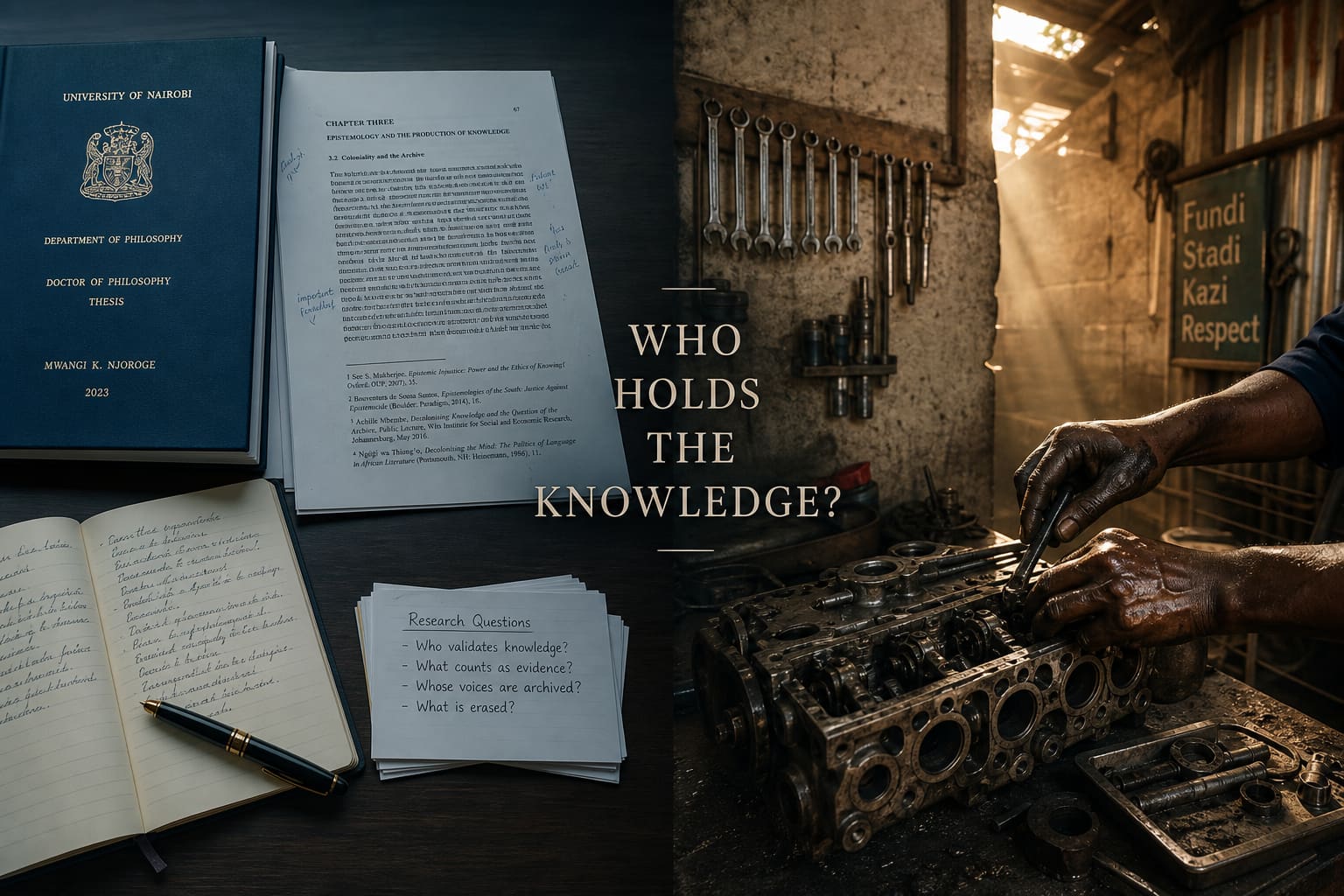
Who is the researcher: the person who studies the world, or the person who has learned to read it by living inside it?
Before that question hardens into a slogan, hold two rooms in mind. They belong to the same morning. They smell of different kinds of seriousness.
Which Room Contains the Researcher?
Morning. A doctoral candidate stands before a panel.
On the table: a thesis bound in institutional blue; highlighted journal articles; annotated questionnaires; statistical output still warm from the printer; a bottle of water nobody is drinking. A professor asks the question that hangs over every honest defence:
How did you establish validity?
The candidate takes a breath. Sampling. Reliability. Theory. Method. Limitations. Every claim must survive interrogation. Knowledge, here, is not merely possessed. It must explain itself.
Cut.
Same morning. Across Nairobi, along an industrial road where metal shutters are being rolled upward, an apprentice bends over an engine. Oil darkens his fingers. A radio crackles somewhere behind him. A spanner strikes concrete. The engine coughs, then dies.
The fundi does not give a lecture. He tilts his head.
Sikiza tena.
Listen again. The apprentice turns the key. The engine coughs differently this time. Nothing is written down. Nothing is peer-reviewed. Nothing is footnoted. But something is being learned under the pressure of a machine that refuses elegant theory.
Which room contains the researcher?
Leave the question hanging. It is not as simple as it sounds.
Left: university defence table, thesis, panel, controlled light. Right: jua kali workshop, oil, tools, warm dust. Illustrative characters only.
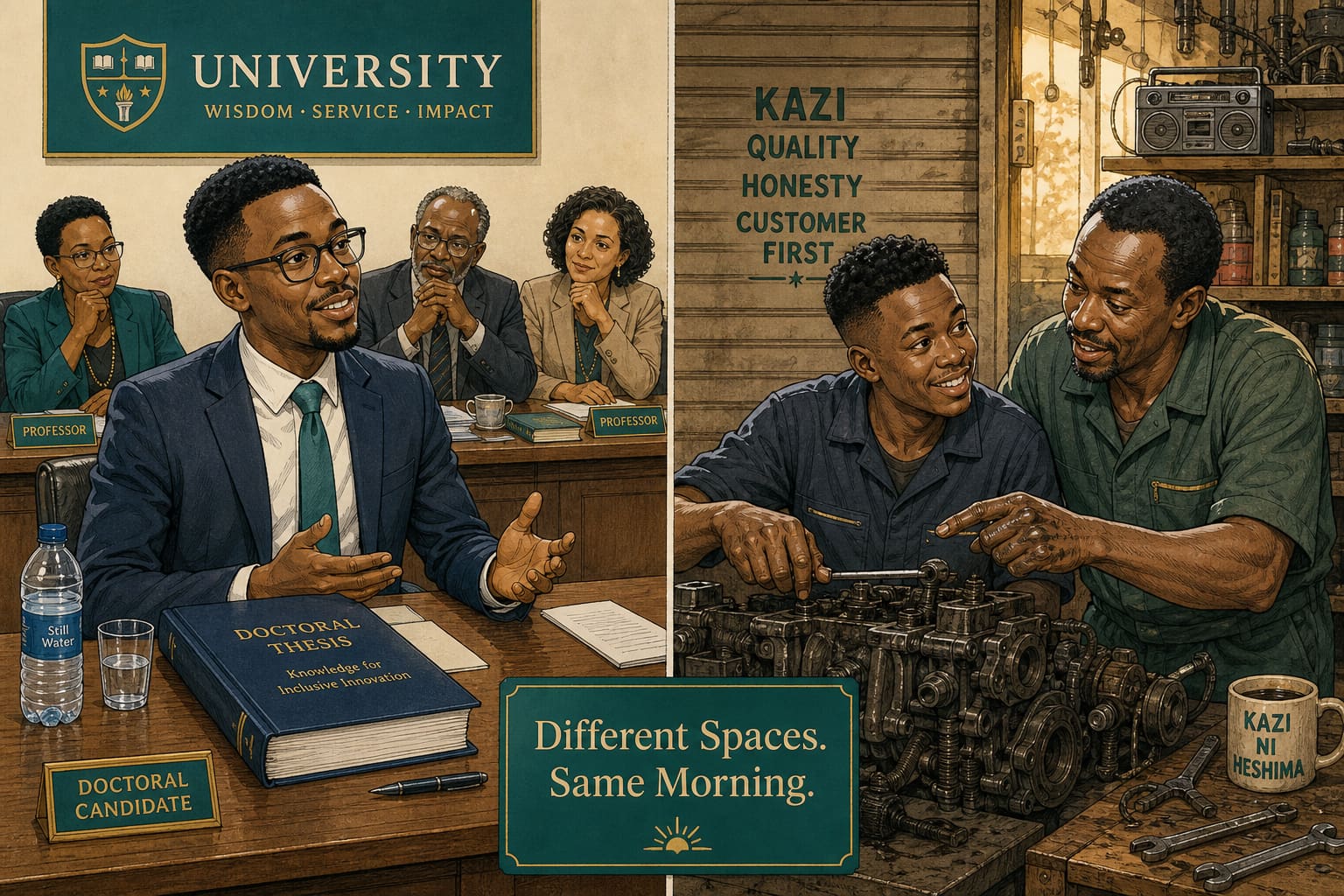
“Mzungu Research” and “Mwafrika Research,” as used here, are deliberately provocative analytical metaphors, not racial absolutes. Africa has deep formal intellectual traditions; African universities produce rigorous scholarship; European and other Western crafts have long run on apprenticeship. Not every practitioner holds reliable knowledge. Not every academic is detached from practice. The real contrast is between two tendencies in knowing: knowledge formalized through inquiry and knowledge embodied through practice.
The Footnote and the Fingerprint
The academic leaves a footnote. The apprentice leaves a fingerprint. One says: here is where my claim came from. The other says, metaphorically: I have touched this problem before.
Do not confuse touch with truth. A fingerprint can be wrong. A confident hand can inherit a bad habit. What the fingerprint marks is not automatic correctness, it marks experiential density: years of pattern recognition that may sit in the body before they sit in language.
Philosophers of knowledge call much of this tacit knowledge, know-how that is difficult to fully articulate, yet consequential in action. The fundi who hears a bearing failing before the apprentice knows there is a sound worth hearing is not performing magic. He is reading a signal his training has taught him to notice. The mama mboga who rejects one tomato and accepts another is not “guessing.” She is compressing weather, payday, school calendars and yesterday’s unsold stock into a decision that may take thirty seconds.
The footnote makes knowledge traceable. The fingerprint makes knowledge experiential. One creates an explicit chain of reasoning strangers can inspect. The other may encode judgment that disappears when the expert leaves, or when the WhatsApp chat is deleted.
What Formal Research Does Exceptionally Well
Do not caricature the university. Give it its strongest case.
Imagine a researcher studying a difficult societal problem, say, why a public service fails differently across neighbouring wards. She reviews prior scholarship. She questions her assumptions. She constructs an instrument. She defines variables. She samples carefully. She gathers evidence. She tests interpretations. She documents limitations. She submits conclusions to scrutiny that may arrive as Reviewer Two at midnight.
This matters because formal research allows knowledge to travel beyond one person’s memory; to be inspected by strangers; to accumulate; to be contradicted; to survive generations; to distinguish impression from tested explanation. A society that cannot make claims explicit cannot argue about them honestly.
The genius of formal research is not that the researcher cannot be wrong. It is that the method leaves enough footprints for somebody else to ask where she went wrong.
What Apprenticeship Knows Under Pressure
Now enter lived apprenticeship, not as folklore, but as inquiry conducted where mistakes have costs.
The mechanic hears the bearing. The farmer kneels, touches soil, looks west. Not every cloud means rain. Not every dry week means drought. Years of observation live inside a decision that may take half a minute. The artisan knows the weld either holds or it does not; the chair either stands square or rocks; the customer either returns smiling, or carrying the product back.
And before Nairobi has fully decided to wake, crates are already moving. Tomatoes knock softly against timber. A sack lands. Coins change hands. A woman presses one tomato with her thumb, rejects another, calculates without reaching for Excel, remembers yesterday’s rain, tomorrow’s school fees and the customer who always buys more on Friday. A spreadsheet would see quantities. She sees a week.
Illustrative market scene before dawn: crates, tomatoes, coins, a trader reading evidence the form never named.
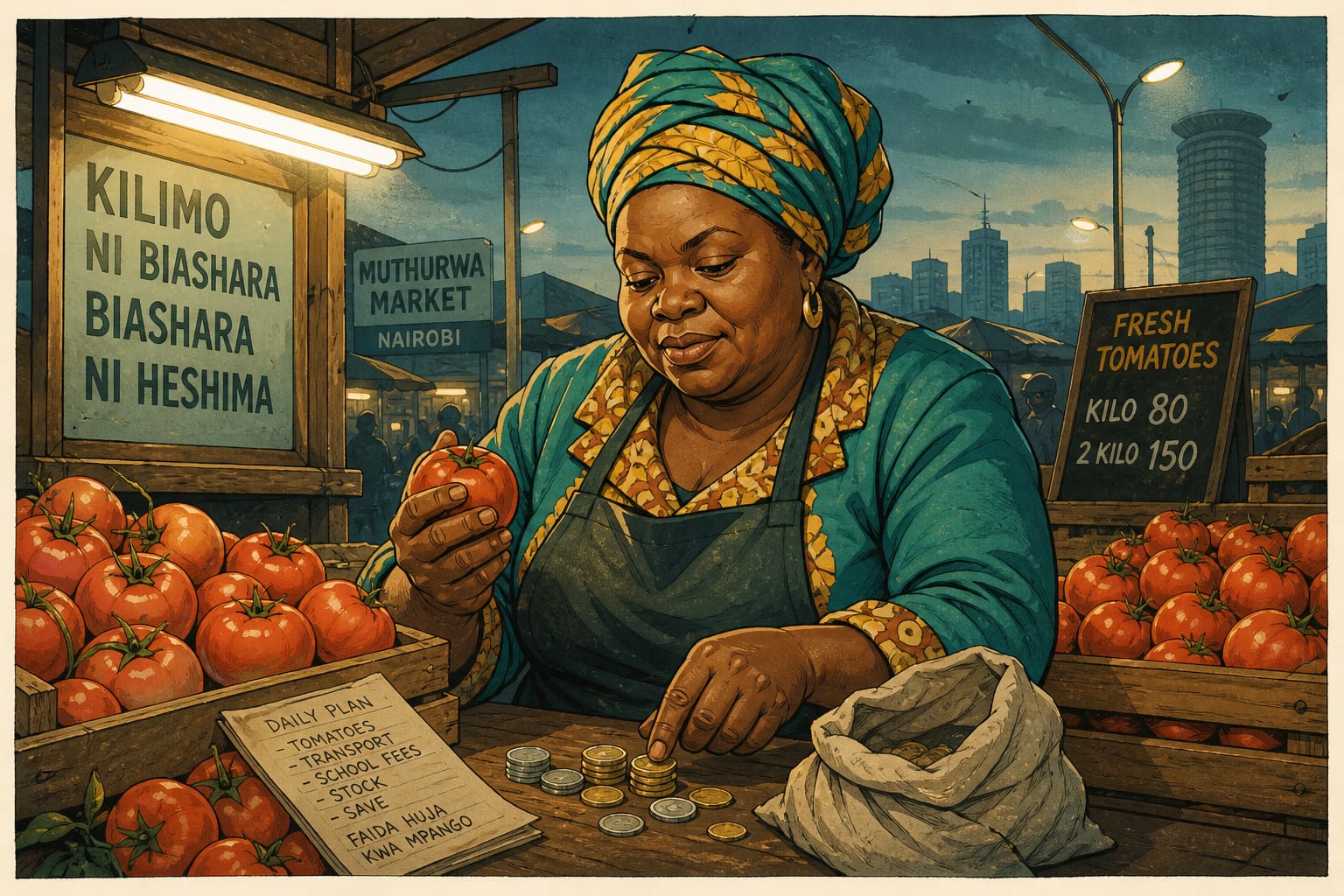
She does not call yesterday’s unsold stock a dataset. Rain is evidence. Payday is evidence. School opening is evidence. The customer who said “Kesho” is evidence. Tomorrow’s inventory is a hypothesis. This is inquiry under the pressure of consequence.
When Consequence Becomes Peer Review
In the university, a weak claim may encounter Reviewer Two. In the workshop, the weak claim may return on a tow truck. In the market, it may come back as unsold stock. On the farm, it may arrive as an empty harvest. Inside an SME, it may appear as Friday’s cash balance.
Left: academic peer review with red marks. Right: workshop consequence as a returned machine. Illustrative only.
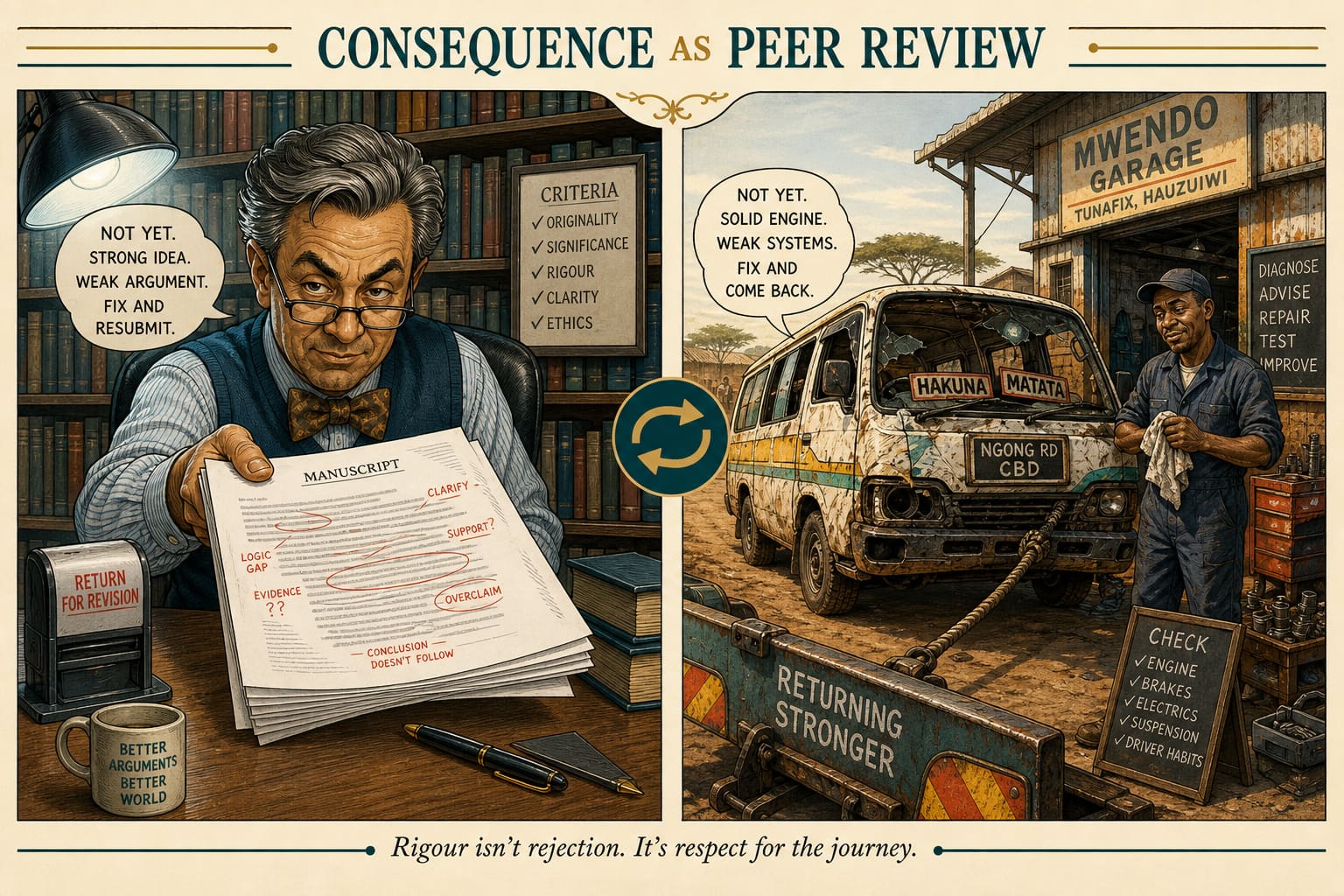
Reality can be an unforgiving reviewer. It does not care how elegantly the hypothesis was phrased.
But consequence is powerful without being sufficient. A practice may appear to work because of coincidence, survivorship bias, hidden variables, short observation periods, selection effects, unsafe assumptions or inherited superstition. The business that “always worked this way” may have been protected by conditions that are already shifting.
Experience deserves respect. It does not deserve immunity from interrogation.
Six Questions. Two Laboratories.
Perspective analysis begins with axes, not slogans. Ask the same six questions of both rooms and the contrast becomes usable without becoming a cage.
| Question | Formal / academic inquiry | Apprenticeship / lived inquiry |
|---|---|---|
| Who? | Researcher, scholar, analyst, institution | Practitioner, artisan, entrepreneur, elder, worker, community |
| What? | Explicit and documented knowledge | Embodied, contextual and practical knowledge |
| Where? | University, laboratory, formal field study, institution | Workshop, shamba, marketplace, home, enterprise, neighbourhood |
| When? | Defined research cycle | Continuously, through practice |
| Why? | Explain, test, theorize, inform policy | Solve, survive, improve, produce, adapt |
| How? | Method, measurement, documentation, scrutiny | Observation, imitation, experimentation, feedback, consequence |
Reality crosses the columns constantly. The doctoral candidate who apprenticed in a clinic before writing methods chapters already lives in both laboratories. The fundi who sketches failure patterns in a notebook is inching toward documentation. The point is not purity. The point is visibility.
Every Small Business Is Already Running Experiments
Watch an SME owner change price, package size, supplier, payment terms, opening hours, location, a WhatsApp message, the product mix. Those are interventions. Customer responses are observations. Cash flow is feedback. Repeat purchases are signals. Business closure is sometimes the brutal termination of an experiment.
The SME owner may never write “Methodology” at the top of a page. Yet every trading day asks the same research question: What happens if I do this differently?
The missing layer is capture. Much SME intelligence disappears inside heads, WhatsApp chats, notebooks, habits and people who eventually leave. The challenge is not to replace experiential intelligence with binders. The challenge is to capture it without killing it, to make learning transferable without turning craft into bureaucracy.
But the Workshop Can Be Wrong
Do not romanticize lived wisdom. “We have always done it this way” can be inheritance or trap. Superstition can dress as experience. Undocumented assumptions can travel as certainty. Practitioners may fail to isolate causes. Knowledge can remain trapped in one expert. Practices that work in one alley may fail three streets away. Resistance to evidence can wear the costume of authenticity.
A scar proves that something happened. It does not always prove why it happened.
That line should land. Trauma is data. It is not a complete causal model. Communities can be wrong about themselves. Elders can be wrong about the young. Markets can punish the right idea for the wrong reason. Respect for practice is not the same as surrender to practice.
And the Report Can Be Blind
Now reverse the camera. Researchers arrive with questionnaires. A trader answers Question 17. There is no space on the form for the thing she actually thinks matters. The researcher thanks her. The box is ticked. She has participated. Or has she?
Clipboard checkboxes on one side; a trader’s unspoken consequential answer outside the form on the other.
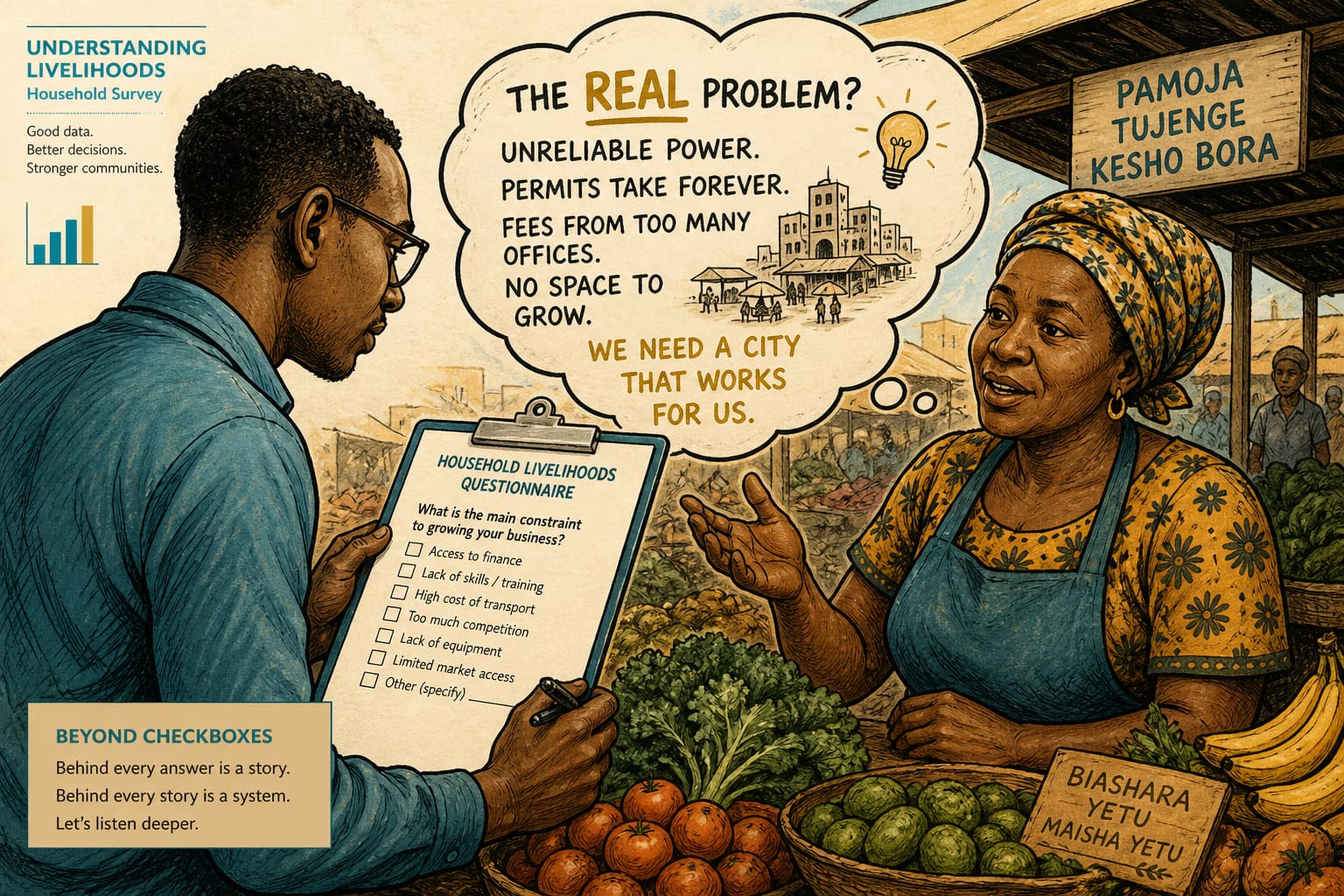
Formal inquiry fails when questions are defined far from lived reality; when teams measure what is convenient instead of consequential; when abstraction strips context; when research extracts stories and returns only PDFs; when publication incentives reward novelty over usefulness; when recommendations arrive after circumstances have shifted; when citizens are converted into data points and then forgotten.
Sometimes the researcher arrives with such a beautifully designed question that nobody notices it is the wrong question.
Who Gets to Call What Knowledge?
Epistemology becomes politics the moment institutions decide whose knowing counts.
Who gets called the expert?
Who gets the grant?
Who gets the microphone?
Who gets cited?
Who supplies the data?
Who interprets it?
Who writes the recommendation?
And who is still standing in the sun when the workshop closes?
Do not answer with ideological certainty. Credentials matter. Standards matter. Peer review matters. But institutions also determine whose knowledge becomes visible, and whose remains unpaid fieldwork for someone else’s career. Power does not invent truth. It does decide which truths get rooms, titles and budgets.
From Research Subject to Knowledge Partner
The conventional participation model often looks like this: institution asks → citizen responds → expert interprets → report is written → decision is made. The citizen is a respondent. The community is a sample. The report is the product.
An alternative sequence is harder and more honest: citizen observes → community records → patterns emerge → experts interrogate → institutions contribute → people deliberate → commitments form → outcomes are tracked → learning returns to the commons.
Public participation changes the moment the citizen is no longer treated merely as a source of answers, but as a producer of questions, evidence and interpretation. That shift is not anti-expert. It is anti-extraction.
This is also where ThePortal’s intellectual architecture enters, not as a slogan layered onto African thought, but as an institutional attempt to host that meeting. In From Ethnic Geography to Convivial Democracy, the argument turned toward shared systems as democratic starting points. Here the question is adjacent: whose knowing is allowed to shape those systems?
The Commons as a Knowledge Meeting Place
ThePortal’s Public Participation Portal, the Living Constituency Commons, is framed around lived geography, shared challenges, community listening, Civic Compacts, evidence, safeguards and shared accountability. Do not oversell the software. Position the commons as a potential knowledge meeting place: a room where different kinds of evidence can become visible to one another without one pretending to be the other.
01
Lived evidence
What people experience in streets, markets, clinics, farms and homes, patterned by place and time.
02
Administrative evidence
What institutions record in budgets, registers, permits, service logs and official reports.
03
Technical evidence
What disciplined professional or scientific inquiry establishes under method and scrutiny.
04
Deliberative evidence
What becomes visible when perspectives encounter one another, and disagreement is made productive.
Lived evidence without administrative and technical evidence can become unchallengeable anecdote. Technical evidence without lived and deliberative evidence can become beautifully wrong. The commons does not crown a winner. It stages the encounter, then asks what commitments follow. That is why pathways such as shared challenges, community listening, Civic Compacts and accountability matter as civic infrastructure, not as decorative buttons.
The value of a commons is not that one kind of knowledge defeats another. It is that different kinds of knowledge become visible to one another.
Before the Dashboard, There Was the Baraza
Do not romanticize traditional institutions. Explore the baraza as an intellectual technology of hearing, witnessing, questioning, memory, disagreement and collective interpretation. People gathered. Claims were made in public. Memory was social. Disagreement had a face.
What happens when that logic meets contemporary digital infrastructure? The answer is not “put the baraza online.” Ceremony uploaded is still ceremony. The deeper possibility is to make institutional listening recursive rather than ceremonial: hearing that returns, revises, tracks commitments and admits when the first hearing missed the point.
A dashboard that never returns to the people who supplied its meaning is not listening. It is harvesting.
The Same Problem Is Sitting in the Boardroom
ThePortal’s Governance Console centres decision review, risk patterns and deliberative governance for a reason that is not only civic. The same epistemology problem sits under fluorescent light in corporate rooms.
A board receives dashboards, management accounts, risk registers, PowerPoint decks and consultant reports. Meanwhile, the frontline employee knows which workaround has become normal; which customer complaint keeps returning; which supplier is quietly becoming dangerous; which KPI is encouraging dysfunctional behaviour; which “temporary” exception became the actual process six months ago.
Upper: executives and dashboards. Lower: sticky-note workarounds and customer complaints. Illustrative corporate scene.
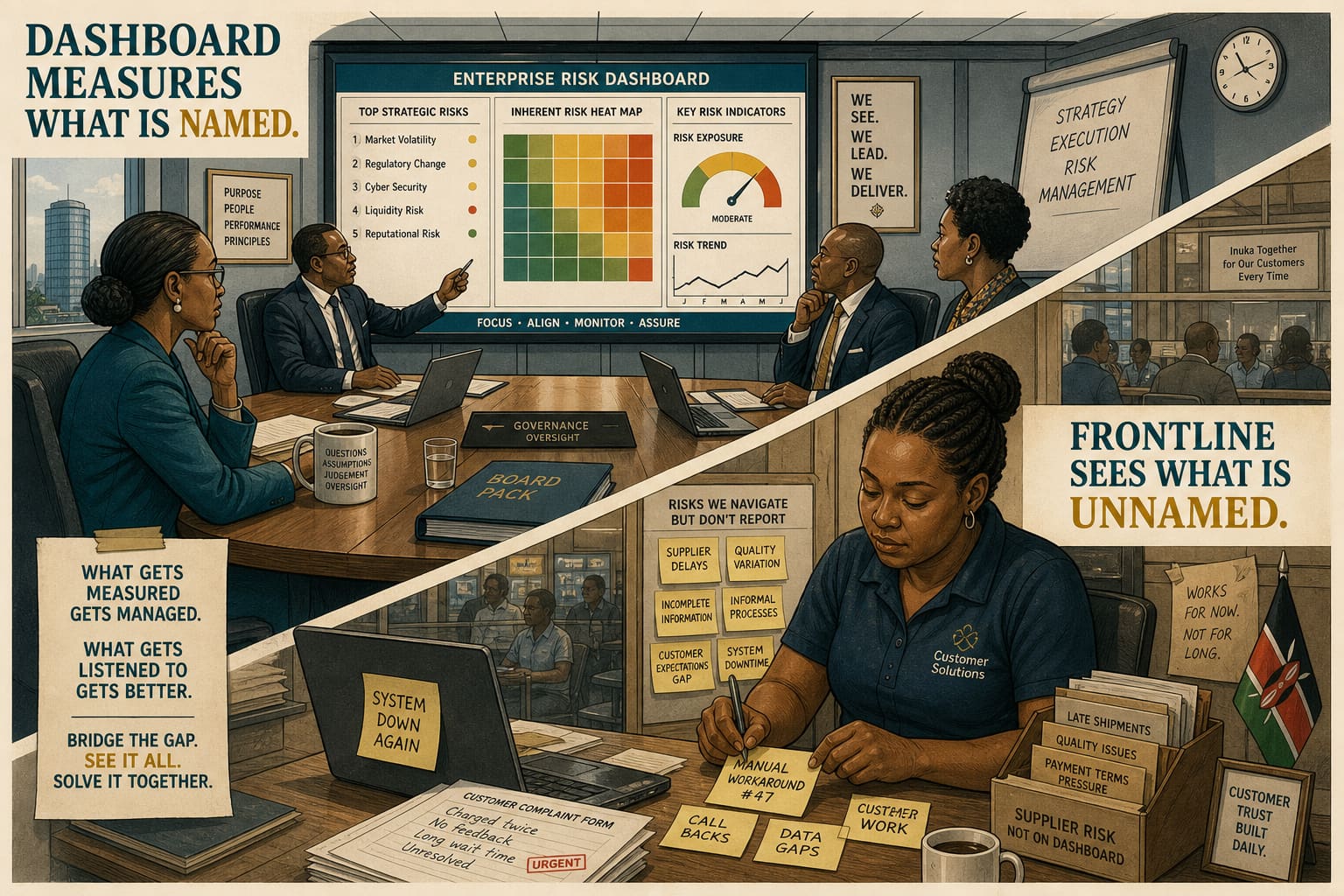
The dashboard shows what the organization has learned to measure. The frontline often sees what the organization has not yet learned to name.
Deliberative governance is partly the craft of seating those two knowledges at the same table, before the exception becomes culture, and before the KPI becomes theatre. Explore decision review not as software worship, but as a discipline: make the reasoning visible enough to challenge.
The Living Research Cycle
Do not conclude “Mwafrika good, Mzungu bad.” Build something better: a cycle that joins workshop, university, enterprise, baraza and institution without forcing any of them to pretend they are the others.
01
Observe
What is actually happening?
02
Ask
What do we not yet understand?
03
Do
What can we try?
04
Experience
What happened?
05
Reflect
What surprised us?
06
Explain
What might account for the result?
07
Test
Does the explanation survive repetition?
08
Document
What knowledge must leave one head?
09
Challenge
Who sees this differently?
10
Share
How does learning enter the commons?
11
Adapt
What should we do differently now?
The question is not whether lived experience should replace evidence. Lived experience is evidence. The real question is how rigorously we listen to it, test it, combine it and learn from it.
What Have You Learned That We Have Not Yet Learned to See?
Return to the doctoral student. Return to the apprentice. Perhaps the thesis defence is ending. Perhaps the engine finally starts. The panel has tested one researcher. The machine has tested another. Neither has the whole truth.
One has learned how to make knowledge explain itself. The other has learned how to make knowledge work. Africa needs institutions capable of doing both, a thesis on one table, an engine on another, and a knowledge commons large enough to seat them both.
Perhaps we have spent too long entering communities and asking only, “What is your opinion?” What if the more powerful question were:
What have you learned that we have not yet learned to see?
And then: what does your community know that no formal report has yet captured?
Questions Worth Holding
For readers, and for answer engines, here are the essay’s working clarifications, stated plainly.
What is apprenticeship research?
In this essay it is a descriptive concept: knowledge produced through observation, demonstration, repeated practice, experimentation and feedback. It is not presented as a fixed academic research category.
Can lived experience be evidence?
Yes. It still needs triangulation, testing and contextual interpretation, just as survey answers and administrative records do.
What is tacit knowledge?
Know-how that people can use well before they can fully explain it, pattern recognition that often lives in practice before it lives in prose.
Is indigenous knowledge the same as apprenticeship knowledge?
No. They can overlap. Indigenous knowledge names historically rooted communal ways of knowing. Apprenticeship knowledge names how skill is learned through guided practice. One should not collapse the other.
Why does lived knowledge matter for public participation?
Because citizens are not only respondents. They can produce questions, evidence and interpretation, especially about what reports have not yet learned to see.
Can practical knowledge replace academic research?
No. The argument is complementarity: consequence and method, fingerprint and footnote, workshop and library.
How can governments combine citizen knowledge and formal evidence?
Hold four streams in view together, lived, administrative, technical and deliberative, and make them visible to one another before commitments harden.
From reading to civic action
Lived experience is evidence, and it still needs interrogation. Use the commons to surface shared challenges and listen before institutions decide alone.
Improve this article
Ask a question, suggest a correction, submit a source, share experience, or propose a topic. Contact details stay private. Publicly consequential allegations need editorial review.