The Kenya Sugar Belt: Leasing, Capability and the Ledger Nobody Can See
Kenya leased four collapsing state sugar mills instead of selling them. The harder question is not lease versus keep, it is whether leasing has produced verified capability: transparent terms, reliable farmer and worker payment, and enforceable performance.
On this page
- Four Mills, One Belt, Many Ledgers
- The Lease, Not the Sale
- Three Questions Hiding Inside "Leasing Works"
- What the Record Supports, and Does Not Yet Establish
- The Lessee's Burden
- The State's Burden
- The Worker's Burden
- The Farmer Is Not a Footnote
- Capability Is a Verified System, Not an Announcement
- What Happens at Farmer Payday, at the Mill Gate?
- The Sugar Belt Capability Compact
- The Question Kenya Should Be Asking
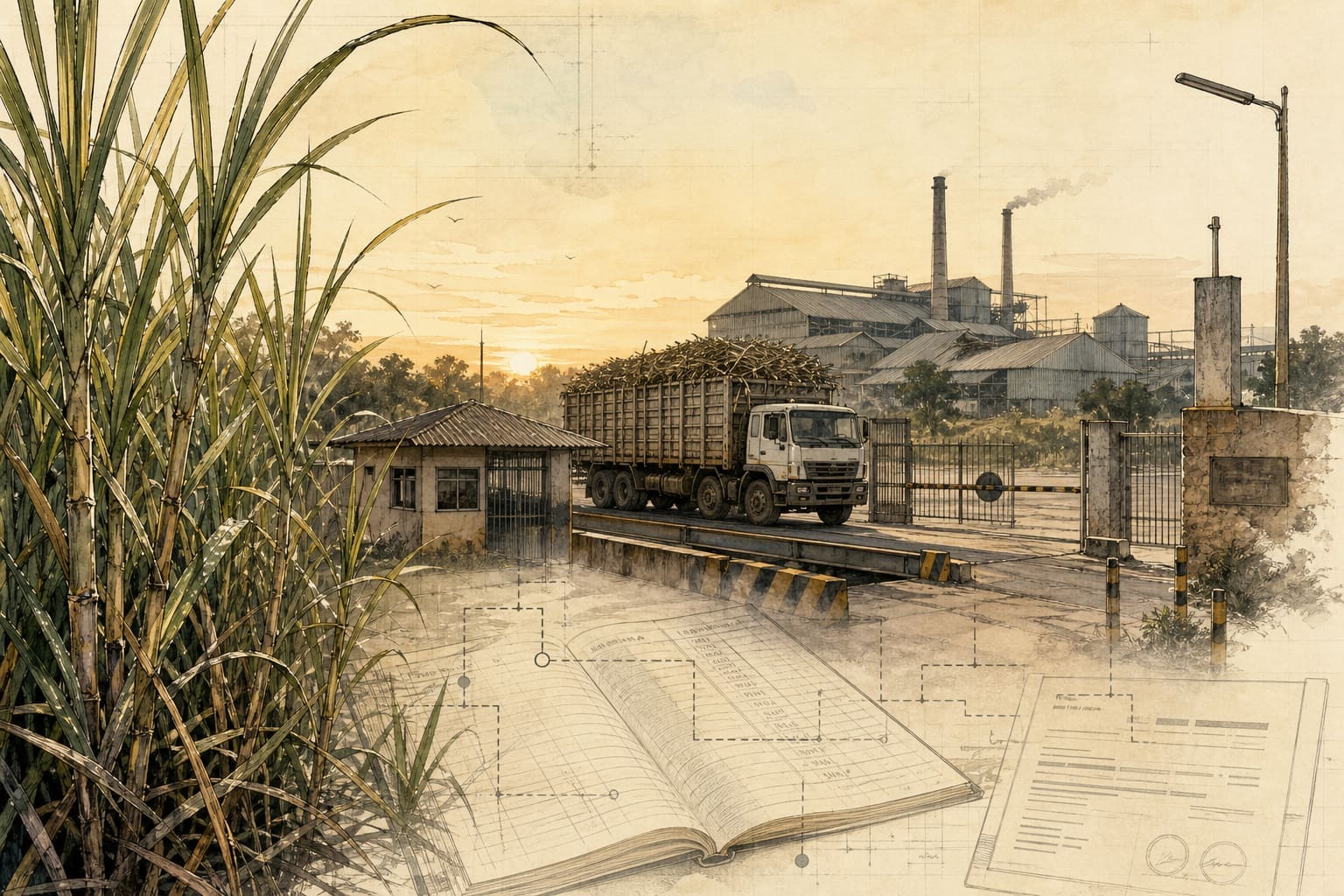
Conceptual editorial image, not a documentary photograph and not an allegation against any lessee, farmer or official. Ivory-ground watercolor and ink: cane fields, a truck at the mill gate, and faint ledger and contract overlays. Four state sugar mills were leased for 30 years in May 2025; whether that transfer produced verified sector capability is the question this case tracks.
Conceptual editorial diagram. Four stations run left to right: Field with cane and cooperatives; Mill with factory silhouettes; Ledger with an open account book and sealed folder; Market with rail wagons and import pressure toward a distant horizon. Not a documentary image.
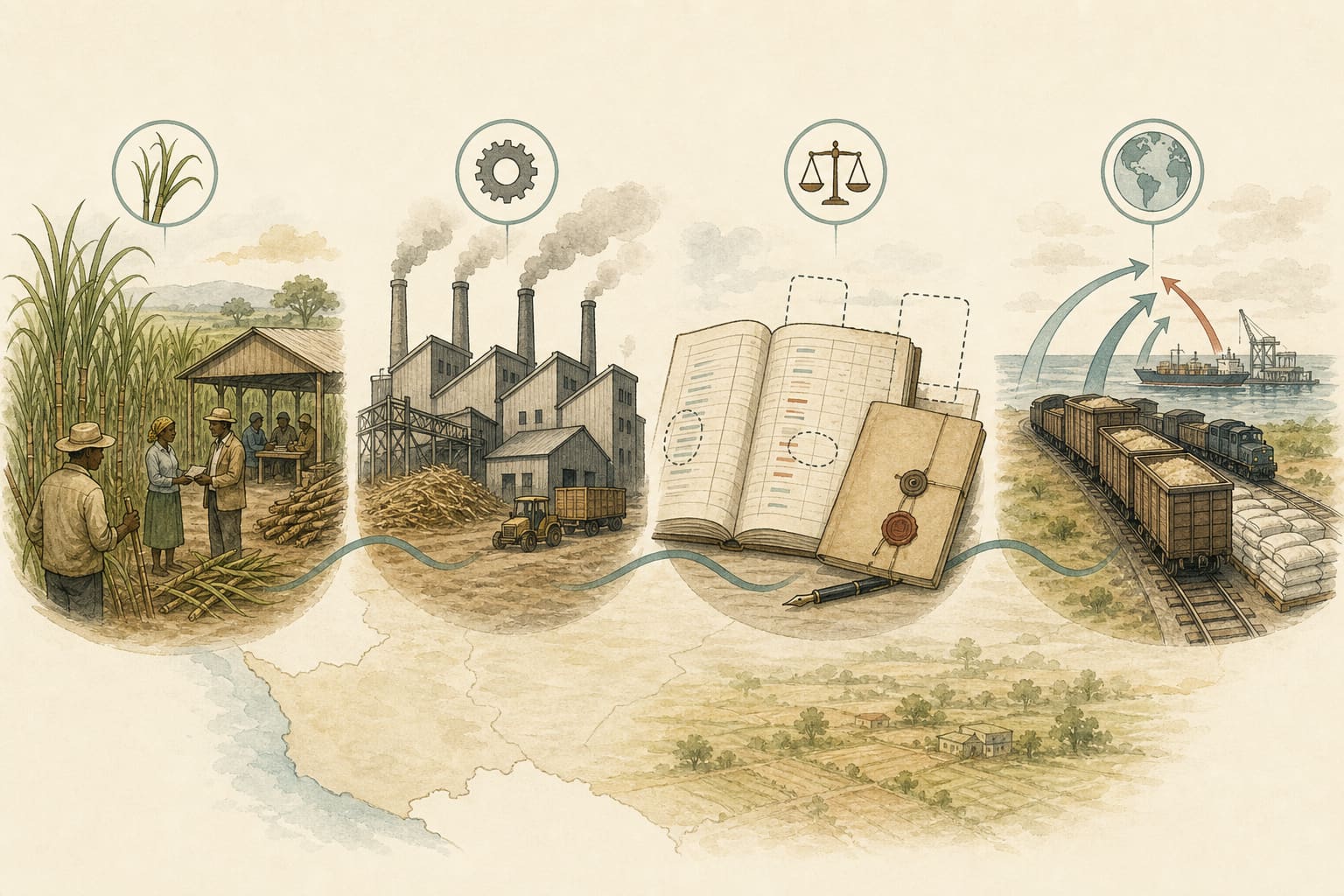
Four Mills, One Belt, Many Ledgers
Begin at the mill gate, not the ministry press release. A truckload of cane arrives before dawn. Somewhere behind the weighbridge sits a ledger: what the farmer is owed, what the mill can pay this week, what the state promised to clear before it ever handed the gate to someone else. Multiply that ledger by four factories, Nzoia, Chemelil, Sony and Muhoroni, and by tens of thousands of farmers and workers whose household budgets move with the milling season, and the sugar belt stops looking like a single transaction and starts looking like an operating system under new management.
In May 2025 the Kenyan government completed 30-year leases of those four state-owned mills to private operators, replacing an earlier 2015 privatisation plan that had never been executed. The announcement was framed as revival: private capital, private management, public ownership preserved. More than a year later, parts of that story are holding up. Other parts remain contested, undisclosed, or simply unresolved.
01
Nzoia
Leased to West Kenya Sugar Company
02
Chemelil
Leased to Kibos Sugar and Allied Industries
03
Sony (South Nyanza)
Leased to Busia Sugar Industry
04
Muhoroni
Leased to West Valley Sugar Company
All four leases run for 30 years from May 2025, as reported; ownership and land are stated to remain public and revert to government at the end of the term.
Leasing changes who runs the mill gate. It does not, by itself, prove capability.
That distinction is the spine of this case. The question worth asking is not lease versus keep the mills under state management. It is whether leasing has produced verified sugar-sector capability, transparent terms, reliable farmer and worker payment, an accountable worker transition, real competition safeguards, and enforceable performance, while ownership and land remain public, as promised.
The Lease, Not the Sale
Conceptual editorial image. Silhouettes exchange keys at a mill gate. Dashed property lines and a faint calendar arc suggest a thirty-year concession in which ownership and land are stated to remain public. Not an allegation against any named person or company.
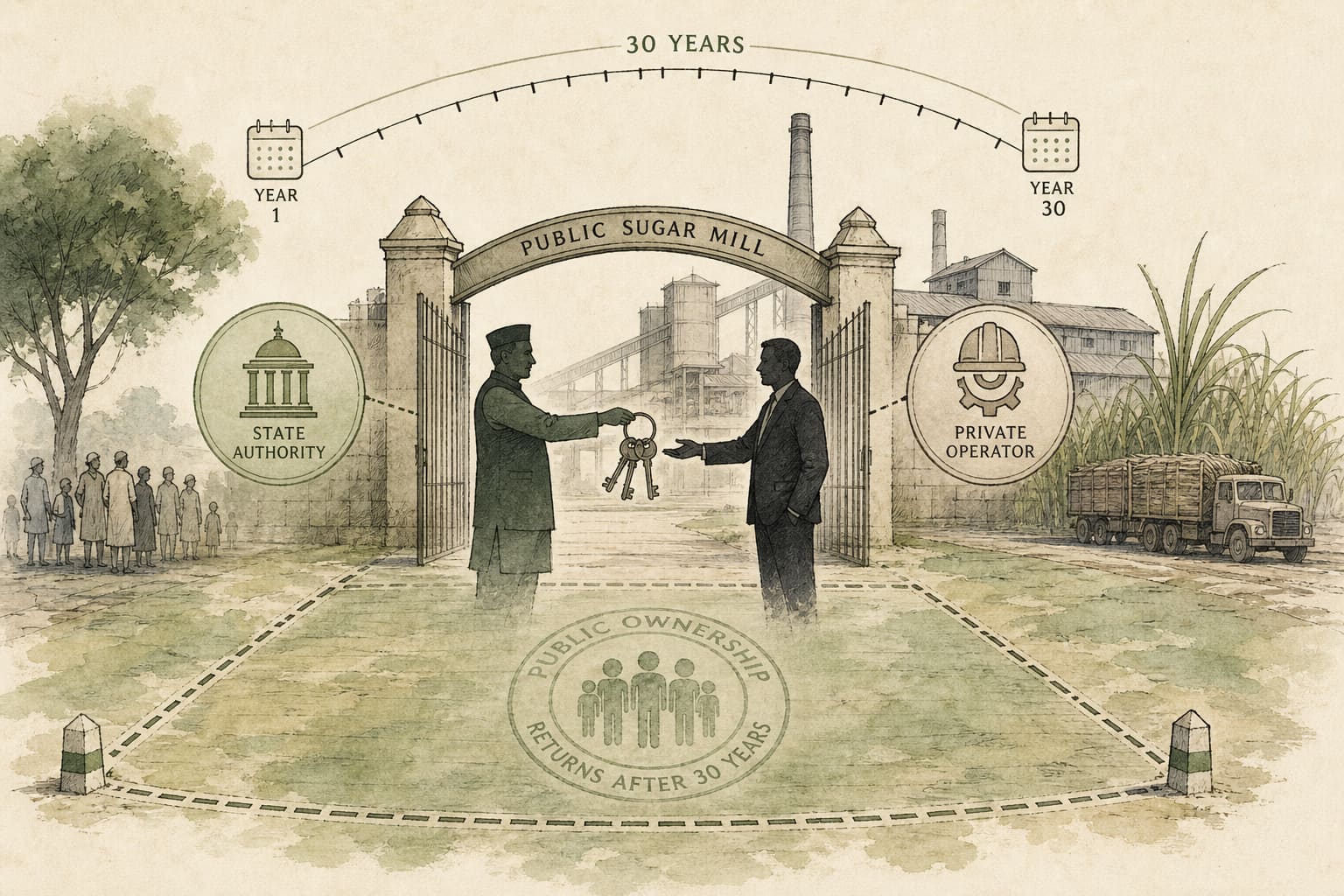
Agriculture Cabinet Secretary Mutahi Kagwe has repeatedly told Parliament and the public that no sugar factory was sold, only leased, for 30 years, under terms he says were approved by Cabinet and Parliament (Kenyans.co.ke). Under the lease framework, investors pay annual rent per hectare (reported at roughly KSh40,000 for Chemelil, Muhoroni and Sony, and KSh45,000 for Nzoia), a concession fee per tonne of sugar and molasses produced, and a one-off goodwill payment; all of it is intended to feed a government revenue pool for farmer support and cane development (Kenyan Wall Street). Investments and infrastructure built during the term are stated to revert to government when it ends.
This is a materially different transaction from a sale, and treating it as one, in either direction, as looting or as liberation, misses what actually needs governing: a long, contractually complex relationship in which the state keeps the asset and the risk of getting the terms wrong for three decades.
Three Questions Hiding Inside “Leasing Works”
Farmers
Depend on predictable cane-payment cadence, transparent pricing and an accessible grievance route.
State
Retains ownership and land, sets lease terms, owes disclosure, and must clear pre-handover arrears it promised to settle.
Lessees
Operate the mills for 30 years and must demonstrate disclosed, verifiable performance against enforceable milestones.
Sugar Belt
A single headline, "leasing revived the sugar sector", collapses at least three separate questions that deserve separate evidence. First, an operations question: are mills actually milling more cane, more reliably, than before? Second, a disclosure question: were the leases awarded and documented in a way the public, farmers, workers and auditors can actually verify? Third, a distribution question: who is bearing the transition cost, redundant workers, unpaid creditors, farmers awaiting price clarity, while the recovery narrative is told from the mill gate outward?
Collapsing the three produces a familiar false binary: doubting the disclosure record becomes "opposing sugar-sector revival"; welcoming improved milling becomes "endorsing an opaque deal." Kenya should reject both readings. A lease can be operationally promising and procedurally undocumented at the same time. Both facts belong in the same sentence.
What the Record Supports, and Does Not Yet Establish
| Claim or implication | Verdict | What the evidence shows |
|---|---|---|
| "The government sold the state sugar mills to private investors." | Incorrect | Agriculture CS Mutahi Kagwe and the leasing framework describe a 30-year operating lease. Ownership and land are stated to remain with government and to revert at the end of the term. |
| "Kenya leased Nzoia, Chemelil, Sony and Muhoroni to private millers in May 2025." | Supported | Handover occurred 9-10 May 2025: Nzoia to West Kenya Sugar Company, Chemelil to Kibos Sugar and Allied Industries, Sony (South Nyanza) to Busia Sugar Industry, Muhoroni to West Valley Sugar Company. |
| "Farmers are now paid within seven days at every leased mill, independently confirmed." | Only partly supported | Mill management and Ministry statements report seven-day payment at some mills (Sony, Muhoroni, Chemelil per contemporaneous coverage). No independent, multi-season audit across all four mills was found in the record reviewed here. |
| "The Auditor-General found the Nzoia lease was corrupt." | Not established | The Auditor-General's report (tabled 1 April 2026) found no handover document, lease contract, or valuation evidence on file, an audit finding about documentation and process, not a finding of corruption or fraud. |
| "It has been proven that Nzoia's assets were sold cheap to the lessee." | Not established | Because no independent valuation was provided for audit, there is no public benchmark to compare the agreed terms against. Opacity is itself the documented problem, not proof of underpricing. |
| "Workers are owed nothing now because the arrears were fully paid." | Incorrect | Government has announced partial payments, for example KSh350 million toward Nzoia workers in August 2026, against union claims of roughly KSh10.8 billion sector-wide and an earlier audited figure near KSh1.9 billion. Full reconciliation was not found in the record reviewed here. |
| "The government promised billions in arrears relief and paid nothing." | Misleading | Government has reported staged payments, including KSh1.7 billion in cane-delivery arrears and later tranches toward worker dues. Payments have been partial and phased, not entirely absent. |
| "The High Court ruled the sugar mill leases illegal." | Incorrect | On 27 February 2026 the High Court declined interim conservatory orders in a petition challenging the leasing-policy shift, finding the relief sought would resolve the dispute prematurely. The substantive petition remains undecided. |
| "Kenya still fully protects its sugar industry from cheap imports." | Incorrect | The 24-year COMESA Sugar Safeguard lapsed on 30 November 2025. Kenya now permits duty-free COMESA sugar imports while retaining import-licensing control and a separate, limited EAC industrial-sugar duty-waiver window. |
| "Miwani Sugar is part of the four-mill lease examined in this case." | Needs correction | Miwani Sugar was leased separately to Pandhal Industries around the same period. This case is scoped to the four mills named in the May 2025 handover: Nzoia, Chemelil, Sony and Muhoroni. |
"The government sold the state sugar mills to private investors."
- Verdict
- Incorrect
- What the evidence shows
- Agriculture CS Mutahi Kagwe and the leasing framework describe a 30-year operating lease. Ownership and land are stated to remain with government and to revert at the end of the term.
"Kenya leased Nzoia, Chemelil, Sony and Muhoroni to private millers in May 2025."
- Verdict
- Supported
- What the evidence shows
- Handover occurred 9-10 May 2025: Nzoia to West Kenya Sugar Company, Chemelil to Kibos Sugar and Allied Industries, Sony (South Nyanza) to Busia Sugar Industry, Muhoroni to West Valley Sugar Company.
"Farmers are now paid within seven days at every leased mill, independently confirmed."
- Verdict
- Only partly supported
- What the evidence shows
- Mill management and Ministry statements report seven-day payment at some mills (Sony, Muhoroni, Chemelil per contemporaneous coverage). No independent, multi-season audit across all four mills was found in the record reviewed here.
"The Auditor-General found the Nzoia lease was corrupt."
- Verdict
- Not established
- What the evidence shows
- The Auditor-General's report (tabled 1 April 2026) found no handover document, lease contract, or valuation evidence on file, an audit finding about documentation and process, not a finding of corruption or fraud.
"It has been proven that Nzoia's assets were sold cheap to the lessee."
- Verdict
- Not established
- What the evidence shows
- Because no independent valuation was provided for audit, there is no public benchmark to compare the agreed terms against. Opacity is itself the documented problem, not proof of underpricing.
"Workers are owed nothing now because the arrears were fully paid."
- Verdict
- Incorrect
- What the evidence shows
- Government has announced partial payments, for example KSh350 million toward Nzoia workers in August 2026, against union claims of roughly KSh10.8 billion sector-wide and an earlier audited figure near KSh1.9 billion. Full reconciliation was not found in the record reviewed here.
"The government promised billions in arrears relief and paid nothing."
- Verdict
- Misleading
- What the evidence shows
- Government has reported staged payments, including KSh1.7 billion in cane-delivery arrears and later tranches toward worker dues. Payments have been partial and phased, not entirely absent.
"The High Court ruled the sugar mill leases illegal."
- Verdict
- Incorrect
- What the evidence shows
- On 27 February 2026 the High Court declined interim conservatory orders in a petition challenging the leasing-policy shift, finding the relief sought would resolve the dispute prematurely. The substantive petition remains undecided.
"Kenya still fully protects its sugar industry from cheap imports."
- Verdict
- Incorrect
- What the evidence shows
- The 24-year COMESA Sugar Safeguard lapsed on 30 November 2025. Kenya now permits duty-free COMESA sugar imports while retaining import-licensing control and a separate, limited EAC industrial-sugar duty-waiver window.
"Miwani Sugar is part of the four-mill lease examined in this case."
- Verdict
- Needs correction
- What the evidence shows
- Miwani Sugar was leased separately to Pandhal Industries around the same period. This case is scoped to the four mills named in the May 2025 handover: Nzoia, Chemelil, Sony and Muhoroni.
Two of these deserve a second look. The claim that the Auditor-General "found corruption" at Nzoia overstates a real and serious finding: her report for the year to June 2025, tabled in the National Assembly on 1 April 2026, states plainly that no handover document, lease contract or asset-valuation evidence was provided for audit, and that "the regularity of the leasing process could not be confirmed" (Business Daily). That is an undocumented-process finding, not a corruption verdict, and it is the first time any of the four leases' financial terms became public at all, eleven months after signing.
The claim that farmers are now reliably paid within seven days is likewise a real, reported improvement at some mills, Sony, Muhoroni and parts of Chemelil have been described this way in contemporaneous reporting (Eastleigh Voice; Pulse Kenya), but it rests on operator and Principal Secretary statements, not an independent, published, multi-season audit across all four mills.
Allegation-evidence matrix
Separate claim from finding
| Issue | Allegation / question | Source type | Counter-position | Status | Decision relevance | Verification required | Possible remedy |
|---|---|---|---|---|---|---|---|
| Lease-terms disclosure | Only one of four leases has had substantive terms made public | Auditor-General report | Government says the leasing process was transparent and Parliament-approved | Disputed | Whether leasing can be assessed as a public-value transaction at all | Redacted publication of all four lease agreements | Publish remaining lease terms and selection criteria |
| Handover valuation | No independent asset valuation on file for at least one mill | Official audit finding | Lessee has not publicly responded to the finding, in the record reviewed | Evidence gap | Whether the public received fair value for leased assets | Independent valuation report for each mill | Commission retrospective valuation; disclose method |
| Worker arrears | Union claims of ~KSh10.8bn sector-wide arrears | Union claim (KUSPAW) | Government reports partial payments and an audited figure near KSh1.9bn | Disputed | Worker household hardship and transition legitimacy | Reconciled, mill-by-mill arrears ledger | Publish funded settlement schedule |
| Redundancy protocol | Notices issued before settlement terms were public | Reported fact (ministry directive) | Notices followed Employment Act Section 40 procedure, as reported | Verified process, disputed adequacy | Whether transition was fair to affected workers | Published re-hire and terminal-dues completion status | Name transition owner; publish appeal route |
| Cane-payment cadence | Farmers now paid within seven days at some mills | Company / Principal Secretary assertion | Not independently audited in the record reviewed | Evidence gap | Whether recovery claims reflect verified capability | Independent, multi-season payment-cadence audit | Publish audit results by mill and season |
| Pre-lease creditor claims | Distributors claim ~KSh173.58m owed across three mills | Court petition (August 2026) | Tender terms reportedly assign most liabilities to government | Judicial / disputed | Whether pre-lease liabilities were properly ascertained | Court determination; published liability reconciliation | Do not treat as an established debt before judgment |
| Public participation | Policy shift to leasing lacked adequate participation | Court petition (pending) | Government cites Cabinet and parliamentary approval | Judicial / disputed | Legitimacy of the leasing-policy shift itself | Independent participation-record review | Publish participation log for the 2023-2025 process |
| Competition exposure | COMESA safeguard exit may pressure recovering mills | Trade-policy record | Government retains import-licensing control and EAC duty-waiver limits | Evidence gap | Sustainability of mill recovery under import competition | Published import-exposure and farmer-price assessment | Publish impact assessment before further liberalisation |
| Beneficial ownership | Lessee ownership structures are not fully disclosed publicly | Analytical inference / policy gap | Not independently mapped in the reviewed record | Evidence gap | Conflict-of-interest and competition-policy review | Published beneficial-ownership disclosure per lease | Require disclosure as a condition of continued lease |
Lease-terms disclosure
- Allegation / question
- Only one of four leases has had substantive terms made public
- Source type
- Auditor-General report
- Counter-position
- Government says the leasing process was transparent and Parliament-approved
- Status
- Disputed
- Verification required
- Redacted publication of all four lease agreements
Handover valuation
- Allegation / question
- No independent asset valuation on file for at least one mill
- Source type
- Official audit finding
- Counter-position
- Lessee has not publicly responded to the finding, in the record reviewed
- Status
- Evidence gap
- Verification required
- Independent valuation report for each mill
Worker arrears
- Allegation / question
- Union claims of ~KSh10.8bn sector-wide arrears
- Source type
- Union claim (KUSPAW)
- Counter-position
- Government reports partial payments and an audited figure near KSh1.9bn
- Status
- Disputed
- Verification required
- Reconciled, mill-by-mill arrears ledger
Redundancy protocol
- Allegation / question
- Notices issued before settlement terms were public
- Source type
- Reported fact (ministry directive)
- Counter-position
- Notices followed Employment Act Section 40 procedure, as reported
- Status
- Verified process, disputed adequacy
- Verification required
- Published re-hire and terminal-dues completion status
Cane-payment cadence
- Allegation / question
- Farmers now paid within seven days at some mills
- Source type
- Company / Principal Secretary assertion
- Counter-position
- Not independently audited in the record reviewed
- Status
- Evidence gap
- Verification required
- Independent, multi-season payment-cadence audit
Pre-lease creditor claims
- Allegation / question
- Distributors claim ~KSh173.58m owed across three mills
- Source type
- Court petition (August 2026)
- Counter-position
- Tender terms reportedly assign most liabilities to government
- Status
- Judicial / disputed
- Verification required
- Court determination; published liability reconciliation
Public participation
- Allegation / question
- Policy shift to leasing lacked adequate participation
- Source type
- Court petition (pending)
- Counter-position
- Government cites Cabinet and parliamentary approval
- Status
- Judicial / disputed
- Verification required
- Independent participation-record review
Competition exposure
- Allegation / question
- COMESA safeguard exit may pressure recovering mills
- Source type
- Trade-policy record
- Counter-position
- Government retains import-licensing control and EAC duty-waiver limits
- Status
- Evidence gap
- Verification required
- Published import-exposure and farmer-price assessment
Beneficial ownership
- Allegation / question
- Lessee ownership structures are not fully disclosed publicly
- Source type
- Analytical inference / policy gap
- Counter-position
- Not independently mapped in the reviewed record
- Status
- Evidence gap
- Verification required
- Published beneficial-ownership disclosure per lease
The Lessee's Burden
A lessee cannot claim capability merely because a mill is milling again. Resumed production is necessary but not sufficient. West Kenya Sugar Company, named in the Auditor-General's findings on Nzoia, has not publicly answered the documentation questions raised in that report, in the material reviewed for this case, an absence of response, not evidence of wrongdoing, but an unclosed loop nonetheless. Kibos Sugar and Allied Industries, Busia Sugar Industry and West Valley Sugar Company face a lighter public spotlight only because no equivalent audit disclosure has yet reached Parliament for their leases.
Reported cane-payment improvements, pledged investment figures (one lessee reportedly committed to a front-loaded KSh5.76 billion within six months of signing), and worker re-absorption claims are all assertions a responsible operator board should want independently verified, not because the operator is presumed to be misrepresenting them, but because unverified good news is exactly as governance-fragile as unverified bad news.
Lessee Operator Board worksheet
Record dissent before you lock a recommendation
- What evidence supports your decision?
- What remains disputed?
- Which institution has legal authority?
- Is the intervention proportionate?
- What is reversible?
- What becomes hard to reverse within a 30-year lease?
- Who receives the upside?
- Who bears the downside?
- What conflicts could distort this decision?
- What implementation capacity has actually been demonstrated?
- What is the strongest argument against your position?
- What new evidence would make you reopen the decision?
Enter the lessee mirror in the Corporate Governance Console: Lessee Oversight Review.
The State's Burden
The state designed a 30-year concession and then struggled to produce a single handover document when its own auditor asked for one. It took a citizen access-to-information request filed in July 2025, an unanswered follow-up, and a binding Ombudsman order threatening criminal prosecution under the Access to Information Act before redacted lease terms were even promised, let alone published in full (Capital FM; Business & Human Rights Resource Centre). Kagwe's insistence that "the whole process was above board" and his openness to submit documents "for scrutiny" sit uneasily beside an Auditor-General report that, months later, could not confirm the regularity of at least one of those same leases.
Disclosure-after-the-fact
Why it may matter: Terms confirmed only through an audit long after signing weaken contemporaneous public scrutiny.
Supporting concern: Nzoia lease terms became public via the Auditor-General report tabled 1 April 2026, eleven months after handover.
Possible rebuttal: Commercial-sensitivity limits can justify a lawful delay if explained and time-bound.
Redundancy-before-verification
Why it may matter: Ending a worker's contract before arrears and re-hire terms are settled shifts risk onto the most exposed party.
Supporting concern: Redundancy notices were issued from around August 2025, before published arrears-settlement ledgers existed.
Possible rebuttal: A published, funded settlement schedule alongside notices would rebut this concern.
Announcement-as-proof
Why it may matter: A reported seven-day payment cycle is not the same as an independently audited one.
Supporting concern: Improved cane-payment cadence has been described mainly through operator and Principal Secretary statements.
Possible rebuttal: An independent, published payment audit across seasons would resolve this.
Competition timed against fragile recovery
Why it may matter: Newly recovering mills face duty-free import exposure just as they rebuild cash flow.
Supporting concern: The COMESA Sugar Safeguard lapsed in November 2025, months after the mills resumed milling.
Possible rebuttal: Retained import-licensing control and EAC duty-waiver limits may cushion this exposure.
Liability transferred before it was counted
Why it may matter: Handing over assets before liabilities are ascertained can leave creditors and the public exposed.
Supporting concern: A creditor petition alleges at least one handover proceeded without a completed due-diligence report.
Possible rebuttal: The court has not yet ruled; the tender terms reportedly assign most liabilities to government.
Pattern language here is diagnostic, not an accusation against any named official. Run the Sugar Belt panel fixture in Decision Review, stress-test compound risk in Risk Simulator, and load the Team Participation and Decision Journal records.
Government Review Panel worksheet
Record dissent before you lock a recommendation
- What evidence supports your decision?
- What remains disputed?
- Which institution has legal authority?
- Is the intervention proportionate?
- What is reversible?
- What becomes hard to reverse within a 30-year lease?
- Who receives the upside?
- Who bears the downside?
- What conflicts could distort this decision?
- What implementation capacity has actually been demonstrated?
- What is the strongest argument against your position?
- What new evidence would make you reopen the decision?
The Worker's Burden
More than five thousand workers across the four mills received ministry-directed redundancy notices from around 21 August 2025, ahead of the lease transition, under Section 40 of the Employment Act (Kenyans.co.ke; ChiniMandi). Workers who wished to remain had to re-apply for their own jobs. Government pledged to clear pre-handover salary, pension and statutory arrears through a Memorandum of Understanding with KUSPAW; by January 2026, more than 30,000 employees across the sector were threatening strike action over roughly KSh10.8 billion in claimed unpaid wages and bonuses (Eastleigh Voice). Some individual arrears claims reportedly reached twenty-two months of unpaid salary (TV47). Partial payments have followed, KSh350 million toward Nzoia workers by August 2026 (The Horizon Wire), but a reconciled, published, mill-by-mill ledger of what is owed and what has been paid was not found in the record reviewed for this case.
The Farmer Is Not a Footnote
Conceptual editorial image. Dawn at a sugar mill weighbridge, cane truck, weigh ticket, payment window, with soft overlays of a payment calendar and incomplete ledger. Suggests that household cash flow depends on verified payment cadence, not only resumed milling.
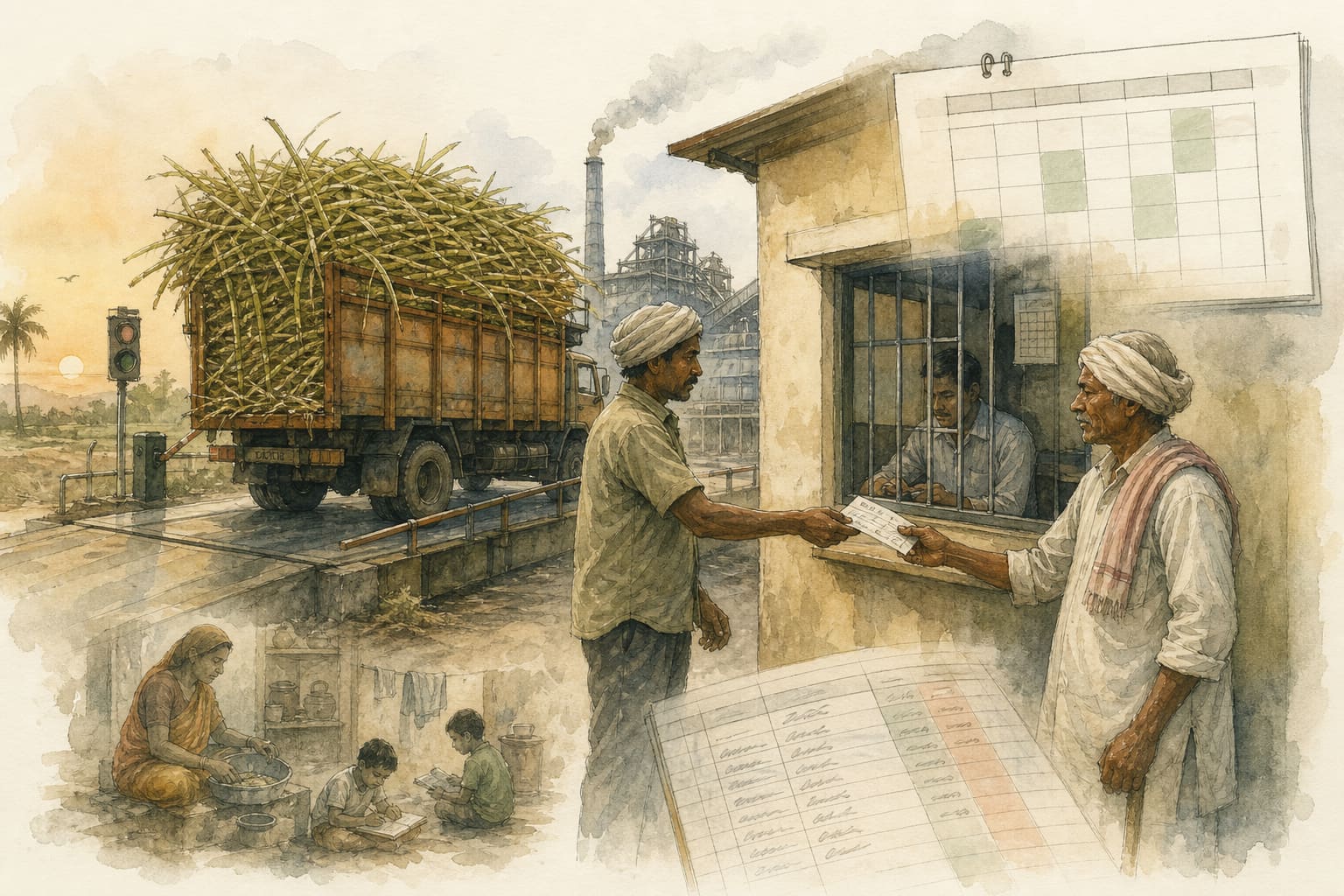
Cane farmers sit at the centre of every claim of "revival," yet their evidence is the thinnest in the public record. Reported price and payment-cadence improvements are real to the extent they have been described consistently across mills and by more than one source, but they remain operator and official statements about the operators' own performance. A farmer who is paid on time this season has no guarantee about next season under a 30-year concession whose performance conditions are not yet public.
Public Commons Lens
Who carries the consequence?
Does the actor with the most power also carry the most consequence? This explorer does not rank farmers, workers or communities.
- Benefit sought
- Reliable payment cadence and fair per-tonne pricing
- Risk carried
- Delayed payment and under-verified price claims
- Decision power
- Low formal power over lease terms
- Information access
- Limited access to lease and payment-audit files
- Transition exposure
- High, household cash flow depends on cane season
- Accountability route
- Kenya Sugar Board rules; cooperative representation
Continue into Public Participation: Sugar Belt Capability Compact, Sugar Belt challenges, listening prompts, and accountability commitments.
Capability Is a Verified System, Not an Announcement
Conceptual editorial image. Left side shows resumed milling and cane trucks. Right side shows incomplete evidence, sealed leases, missing valuation, partial arrears ledgers. Message: operational recovery is not the same as verified capability.
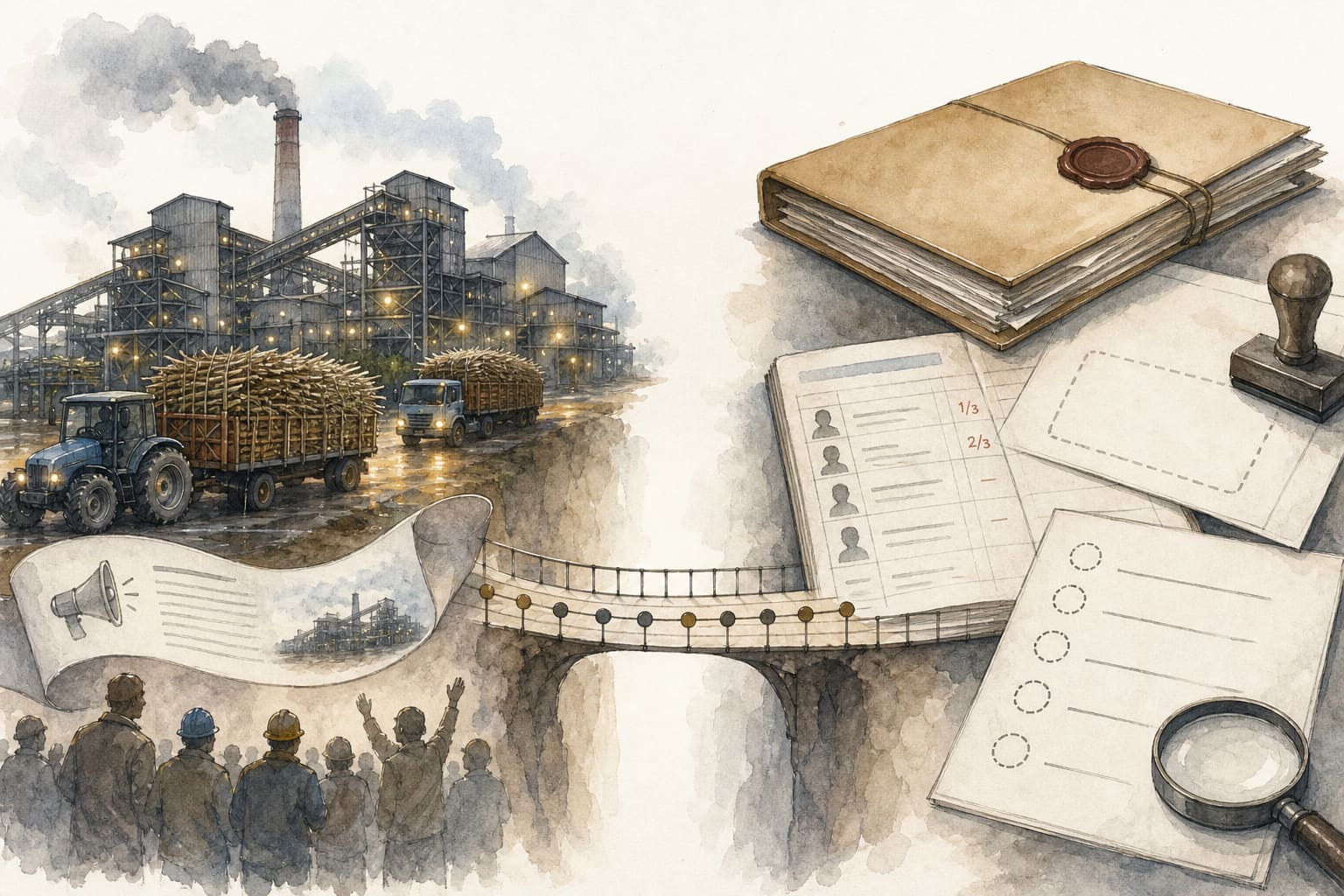
A lease is a legal instrument. Capability is an operating result that has to be demonstrated, repeatedly, under independent scrutiny. Kenya's sugar belt currently has more of the first than the second. Milling has resumed at mills that had been dark for years. That is a genuine, welcome fact. It is not the same fact as "farmer payment is reliably weekly," "worker arrears are settled," "creditor claims are resolved," or "lease terms are transparent", each of which needs its own, separately verified evidence trail.
A. Continue on currently disclosed terms
- Main strength
- Preserves operational momentum at mills that have resumed milling and improved farmer-payment cadence
- Main hazard
- Normalises an opacity problem the Auditor-General and Ombudsman have already flagged
- Evidence required
- None required, which is itself the governance risk this option accepts
B. Compel full public disclosure and renegotiated safeguards
- Main strength
- Restores a shared evidence base for farmers, workers, creditors and the public
- Main hazard
- Could unsettle operating relationships that are functioning better than before the lease
- Evidence required
- Redacted publication of all four lease agreements; standardised valuation and audit method
C. Sugar Belt Capability Compact
- Main strength
- Combines continuity with enforceable disclosure, payment, transition and competition obligations
- Main hazard
- Complex negotiation across four lessees and multiple counties may produce ceremonial commitments
- Evidence required
- Published milestones, named sanctions, independent verification, reopening triggers
D. Lawful review and targeted re-tender
- Main strength
- Resets terms where audit or participation failures are independently confirmed and left uncured
- Main hazard
- Disrupts mills that are recovering; litigation, transition and financing risk
- Evidence required
- Independent finding of uncured failure; continuity and transition financing plan
Option A is defensible only as long as nobody mistakes operational recovery for governance closure. Option C offers the most promising balance if its milestones and sanctions are real rather than ceremonial. Option D should remain available, but only against mills where an independent finding, not a political dispute, confirms an uncured failure. The disciplined sequence is: Disclose → Verify → Compact → Enforce → Reopen when evidence changes.
Scenario aid, not prediction
Qualitative capability-risk banding
Top drivers: Months since lease handover; Lease-terms disclosure gap; Worker salary-arrears severity
Most vulnerable stakeholder: Redundant and retained mill workers awaiting arrears settlement
Most irreversible assumption: That resumed milling and a 30-year lease already amount to demonstrated institutional capability
Evidence to obtain next: Independent handover valuation and full lease-contract disclosure with a dated compliance gate
Scenario aid, not prediction. Outputs support deliberation rather than automate a decision.
Map power, information and exposure in the Influence Map, without treating influence as wrongdoing.
What Happens at Farmer Payday, at the Mill Gate?
Operational continuity
Farmer payday, mill gate: who owns each step?
Mark each item. A lease can transfer legal control of a mill gate faster than it can build a verified, repeatable payment system behind it.
Who verifies the cane-weight ticket at the mill gate?
Who confirms the farmer is paid within seven days?
Who signs off outstanding worker arrears?
Who owns the KUSPAW MOU commitments?
Who tracks redundancy and re-hire status by name?
Who publishes the lease terms for this mill?
Who reconciles pre-handover creditor claims?
Who monitors import-competition impact on farm-gate price?
Who confirms the pledged investment was actually made?
Who inspects mill-gate scales for accuracy?
Who handles a farmer payment dispute?
Who reports lease-performance milestones publicly?
What happens if a lessee misses a disclosed milestone?
Who owns the environmental and land-use conditions of the lease?
Identified 0 · Unclear 0 · No protocol 0 · Unset 14
A signature on a 30-year lease is faster than a verified weekly payment system. Capability is the second thing, not the first.
The Sugar Belt Capability Compact
Kenya does not have to choose between celebrating resumed milling and demanding disclosure. A governed path can hold both: publish the remaining lease terms, reconcile the arrears and creditor ledgers, verify the payment-cadence claims independently, and attach real sanctions to real milestones, while the mills keep running and farmers keep getting paid.
Capability Compact worksheet
Build obligations, not a compliance score
This worksheet is not the Civic Compact. Open the Living Constituency Commons to endorse safeguarded priorities.
Compact completeness: 0 of 21 obligations selected. Never treat this as a compliance score.
Open Sugar Belt Capability CompactThis worksheet does not write into the Civic Compact. Shape safeguarded priorities in the Living Constituency Commons: Open the Sugar Belt Capability Compact.
The Question Kenya Should Be Asking
The sugar belt debate should not end with the simplistic conclusion that leasing was either a rescue or a giveaway. Both framings skip the actual governance work still outstanding.
The state must finish disclosing what it signed, reconcile what it owes farmers, workers and creditors, and prove that the leasing model can be independently verified rather than merely announced. Lessees must show that resumed milling reflects durable capability rather than a temporary bounce, with evidence a farmer, a worker or an auditor can actually check.
Kenya should welcome mills running again. It should also insist that running again is the beginning of the evidence, not the end of it. The real test of the sugar belt is therefore not whether the state can hand a mill gate to someone else. It is whether what follows is more transparent, more verifiably fair to farmers and workers, more competitively resilient, and more enforceable than what came before.
Leasing is a legal transfer of control. Capability is a verified, repeatable result. One does not prove the other.
Related ThePortal work on sovereignty and capability at Lake Magadi, corporate governance simulation, real business in policy, and African knowledge systems sits beside this case. Public-asset governance is also a theme of Corporate Participation and the Living Constituency Commons.
Watch what happens next
Accountability tracker
Editorial tracker for future updates, not a live government feed. Status values: OPEN, VERIFYING, CONFIRMED, DISPUTED, DELIVERED, MISSED, SUPERSEDED.
| Claim | Commitment | Owner | Status |
|---|---|---|---|
| Nzoia lease disclosure | Full lease contract published | Ministry / Kenya Sugar Board | OPEN |
| Chemelil, Sony, Muhoroni disclosure | Redacted terms published | Ministry | OPEN |
| Handover valuation | Independent valuation published | Auditor-General / Ministry | OPEN |
| Worker arrears | Reconciled ledger published | Treasury / Ministry | VERIFYING |
| Redundancy transition | Re-hire and terminal-dues status by mill | Lessees / labour desk | OPEN |
| Cane-payment audit | Independent multi-season audit | Kenya Sugar Board | OPEN |
| Creditor claims | Court determination or settlement | Courts / Treasury | VERIFYING |
| Public-participation petition | Court ruling on the merits | Courts | VERIFYING |
| Beneficial ownership | Public disclosure per lease | Ministry | OPEN |
| Performance milestones | Published, dated, sanctioned | Ministry / lessees | OPEN |
| Import-exposure assessment | Published impact assessment | Kenya Sugar Board | OPEN |
Sources and status
Primary timeline anchors used in this educational case: 30-year lease handover, 9-10 May 2025; redundancy notices from 21 August 2025; Ombudsman disclosure order, December 2025; COMESA Sugar Safeguard exit, 30 November 2025; High Court interim ruling, 27 February 2026; Auditor-General report tabled 1 April 2026; creditor suit, August 2026. Live case: government, lessee and union positions remain disputed on several points; facts may evolve after 4 September 2026.
Enter the Sugar Belt governance simulation → Decision Review. Explore who carries the consequence → Public Commons Lens.
From reading to civic action
The Kenya Sugar Belt is a live educational case on leasing, disclosure, farmer and worker payment, and enforceable performance across four state sugar mills. Run the Corporate Governance simulation, or shape Sugar Belt priorities in the Living Constituency Commons Civic Compact. Outputs support deliberation; they do not determine liability or certify public value.
Improve this article
Ask a question, suggest a correction, submit a source, share experience, or propose a topic. Contact details stay private. Publicly consequential allegations need editorial review.