Real Business Is in Policy (Part VI): Finance the Learning. Prove the Capability.
Public finance buys access. Capability is proved when skill can be shown and used.
Commentary on how education financing should be evaluated. National employment rates are not invented here. Cited figures are attributed to named sources with scope limits. Scoreboard recommendations are the author’s unless attributed. Bill No. 49 remains a Bill under public participation as of 23 September 2026, not yet law.
On this page
Editorial illustration. A young Kenyan adult stands between an open cash ledger on a wooden table and a workshop doorway with tools and a workbench. Soft daylight. Conceptual art, not a documentary photograph. No political likenesses or official seals.

Two Ledgers, One Promise
In Part IV of Real Business Is in Policy, the school gate opened on a debt ledger: who gains access today, who repays tomorrow, and who carries risk when learning does not quickly become income.
In Part V, Amina’s journey showed that placement and funding are only the first doors. Participation, experience, assessment, credentials and a first chance still decide how far a learner can travel.
This Part VI asks the evaluation question those instalments leave open. If public rules finance learning, how do we know the investment bought capability? Money paid is one ledger. Capability proved is another. A serious education reform must keep both.
Editorial illustration. An open book on a wooden table. Left page labelled Money Paid with coins and a bank slip. Right page labelled Capability Proved with a skills checklist and stamp.

What We Often Count
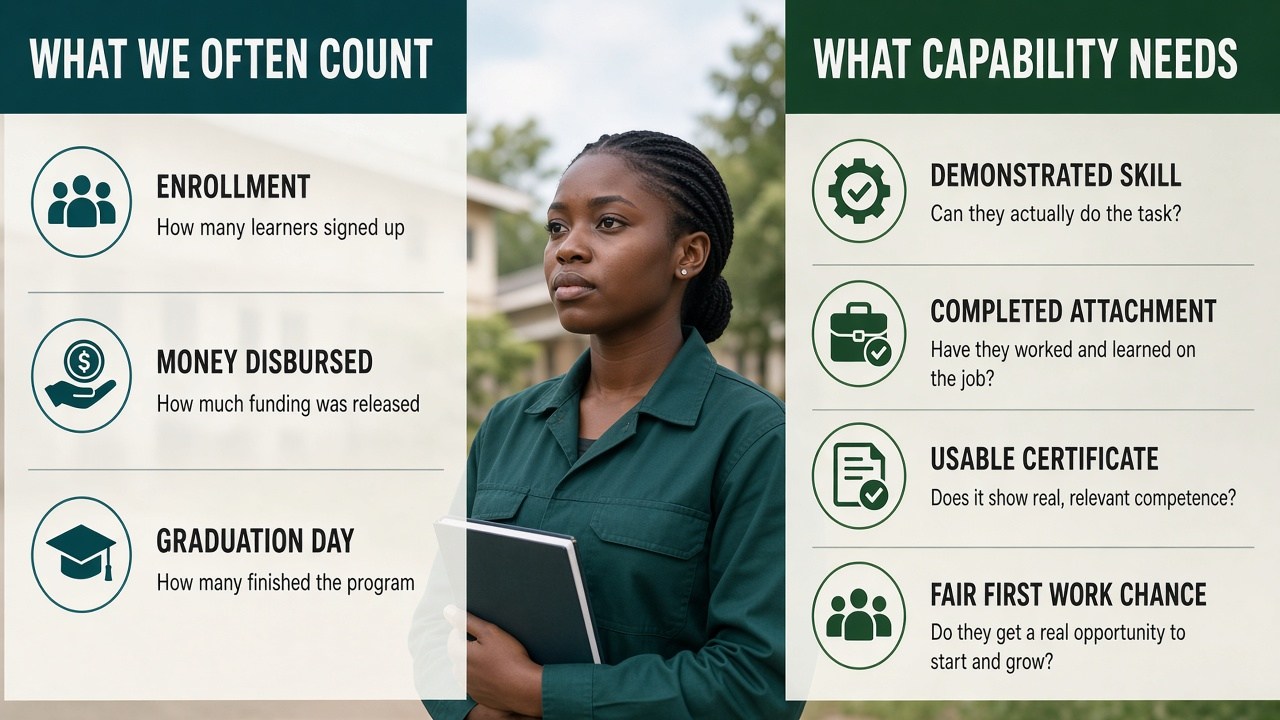
Public systems are good at counting what passes through an office. Applications received. Learners placed. Loans and scholarships awarded. Money disbursed. Heads enrolled. Certificates printed on graduation day.
Those numbers matter. They tell a country whether the gate opened and whether the fund moved. They do not, by themselves, prove that a graduate can do the work a programme promised, that an attachment was real, that a certificate can be verified when an employer asks, or that a first chance into work or enterprise followed.
Editorial graphic comparing What We Often Count, enrolment, money disbursed, graduation day, with What Capability Needs, demonstrated skill, completed attachment, usable certificate, fair first work chance.
The Skills Towards Labour Market Information survey (STLI 2025) reports large skills outturns from training institutions, about 193,156 graduates across sampled institutions for the 2022 reference year. That is a supply picture: who completed training in which programmes. It is not, on its face, a national employment-outcome scoreboard. Outturn is necessary information. It is not the same as proved capability in use.
Four Proofs of Capability
Capability is not a slogan. For a mwananchi household that borrowed hope against a loan, proof has to answer practical questions.
Editorial pathway with four labelled proofs: Skill Shown, Experience Done, Credential Works, and First Chance, ending at a workplace.

| Proof | Public question | Who should answer |
|---|---|---|
| Skill shown | Can the learner demonstrate the tasks the programme promised? | Training institutions and assessors |
| Experience done | Was supervised practice completed under clear terms? | Institutions, hosts and supervisors |
| Credential works | Can employers and platforms verify what the credential claims? | Awarding bodies and verification services |
| First chance | Did a fair first opportunity into work or enterprise open? | Employers, buyers, platforms, and repayment design |
These four proofs sit on top of Part V’s gates. A gate that looks open but cannot show skill, experience, a usable credential or a first chance is an administrative success and a household disappointment.
What the Public Already Sees
Kenya already publishes fragments of the proof story, unevenly, and often without joining finance to capability.
The Ministry of Education’s TVET Sub-Sector Report for FY 2025/26-2027/28 describes tracer studies across TVET institutions and notes that Meru National Polytechnic, as a Centre of Excellence in Building Technology, reported that 86 percent of graduates in priority programmes got employed within six months. That figure is an institutional tracer result for priority programmes, not a national employment rate for all tertiary graduates. It shows what a serious proof system can look like when a cohort is followed.
On the financing side, public reporting more often emphasises recovery of loans than proof of skill. Secondary accounts of HELB’s 2024/25 performance cite about Sh5.21 billion recovered and, as of 30 June 2025, a loan book described as 67.5 percent performing with about 32.5 percent at risk. Those numbers, if accurate for the board’s portfolio, matter for the sustainability of the fund. They still answer a different question from “Did financed learning produce usable capability?” A performing loan can sit beside weak skill; a struggling borrower can sit beside strong skill and no first chance.
The Tertiary Education, Placement and Funding Bill, 2026 (Bill No. 49) remains a Bill under public participation as of 23 September 2026. Whatever final text Parliament adopts, the evaluation gap will remain unless placement, funding and outcome proof are designed to speak to one another.
What Institutions Should Publish
The recommendations below are the author’s, not a claim that every measure already appears in statute. They are the minimum public scoreboard a citizen should be able to demand when education is financed at scale.
| Publish by cohort | Why it belongs on the scoreboard |
|---|---|
| Placement and award | Shows who entered and on what financing terms |
| Completion with assessed competence | Separates sitting through a programme from proving skill |
| Attachment / apprenticeship completion | Links classroom learning to supervised practice |
| Credential verification response time | Shows whether proof can travel when a buyer asks |
| Cohort destination at 6 and 12 months | Tracks work, enterprise, further study or waiting, without pretending every path is formal employment |
| Repayment start conditions met | Connects the debt ledger to whether capability produced income capacity |
Publish the definitions with the numbers. “Employed” must say whether it means formal wage work, informal work, self-employment or further study. “Default” must not be treated as a moral verdict when the first chance never arrived. A fair scoreboard protects both the fund and the learner.
Follow the Money and the Skill
Part I of this series argued that real business is in policy: rules cultivate markets. Education financing is one of those cultivated spaces. If the state and households put money into learning, the return that matters is not only recovery into the fund. It is whether learners leave with capability they can use, and whether the gates beyond college allow that capability to become income, enterprise or further learning.
Editorial scene. Left: money flowing into a college labelled Money Into Learning. Right: a learner proving skill and a workplace door opening, labelled Proof of Capability. A connecting note says Follow Both.
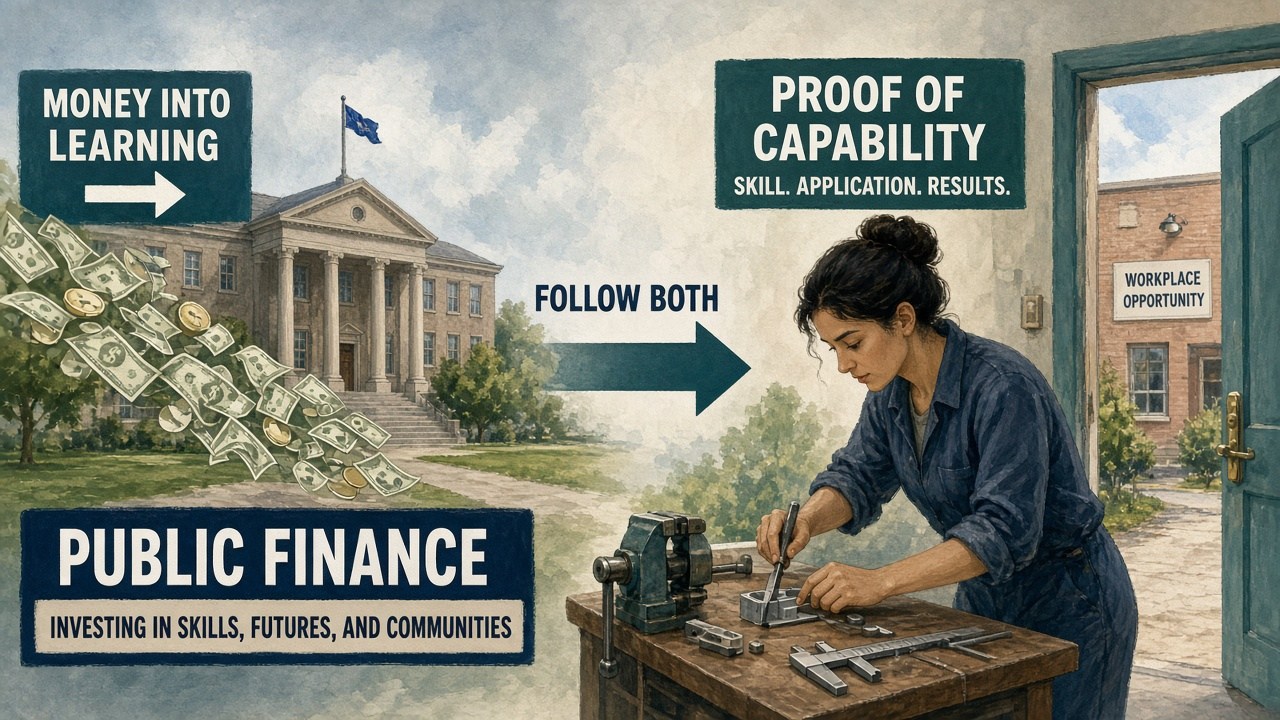
Follow the money into learning. Follow the proof that skill was shown. When those two tracks diverge, reform has financed attendance more than opportunity.
End with Proof the Citizen Can Use
A parent at the college gate needs more than a disbursement notice. A graduate carrying a loan needs more than a graduation photograph. A taxpayer funding tertiary education needs more than enrolment totals.
They need a public habit of proof: skill shown, experience done, credentials that work, and a first chance that is not crushed by a clock that starts before capability can earn.
Public question: If your county’s financed cohort were published tomorrow, placement, competence, attachment, credentials and destinations at twelve months, which number would most change how you judge the reform?
Continue to Part VII
The Tender Begins Before the Tender
Series: Real Business Is in Policy, how acquisition costs and fiscal treatment can shape competition before the bid.
Read Part V
Who Owns the Gate to Opportunity?
Series: Real Business Is in Policy, the gates beyond funding that decide how far a learner can travel.
Read Part IV
The School Gate and the Debt Ledger
Series: Real Business Is in Policy, how education funding rules shape access, repayment and risk.
Read Part III
Coffee, Cash Crops and the Chief
Series: Real Business Is in Policy, how permission, institutions and power shaped the coffee economy.
Read Part I
Real Business Is in Policy
Series: Real Business Is in Policy, how rules, institutions and lived practice cultivate markets.
Sources and Further Reading
- Tertiary Education, Placement and Funding Bill, 2026 (National Assembly Bill No. 49) : Parliament PDF (still a Bill as of 23 September 2026)
- Ministry of Education: TVET Sub-Sector Report for FY 2025/26 to FY 2027/28 (as at 8 October 2024); Meru NP priority-programme tracer figure cited with institutional scope
- Skills Towards Labour Market Information (STLI) Report 2025, labourmarket.go.ke (skills outturns / supply picture)
- The Star: HELB application and loan-book performance figures as of 30 June 2025 (7 August 2025; secondary)
- The Star: HELB recovery and write-off reporting for 2024/25 (15 July 2025; secondary)
- Real Business Is in Policy (Part V): Who Owns the Gate to Opportunity?: ThePortal
- Real Business Is in Policy (Part IV): The School Gate and the Debt Ledger: ThePortal
- Real Business Is in Policy (Part II): ThePortal
- Real Business Is in Policy (Part I): ThePortal
From reading to civic action
Capability finance still needs proof that learning turns into trusted work. Explore skills challenges and organisational decision practice.
Improve this article
Ask a question, suggest a correction, submit a source, share experience, or propose a topic. Contact details stay private. Publicly consequential allegations need editorial review.