Real Business Is in Policy (Part VII): The Tender Begins Before the Tender
When two contractors quote different prices, how much of the gap is productivity, and how much is the ledger that formed before the bid?
Evidence reviewed as of 25 September 2026. Constitution Articles 35, 201, 210 and 227 verified against the Kenya Law Constitution text; Parliament-hosted PDF used as a starting reference. OECD Competitive Neutrality Toolkit (2024) used as comparative analysis only, not Kenyan law. Petition facts are attributed to media reporting (Business Daily, 24 September 2026; Kenyans.co.ke, 19 August 2026). No official court filing, case number or judgment was located for this article. Hypothetical figures are labelled illustrations, not transaction evidence. Auditor-General amounts cited by petitioners were not independently matched in OAG summary reports reviewed. Procedural developments after the reported 6 October mention should be checked against later court records.
On this page
- Two Trucks, Two Acquisition Ledgers
- What the Dispute Does, and Does Not, Establish
- The Cost Difference Before the Tender
- Follow the Concession Beyond the Project
- Who Receives the Benefit?
- Test Competing Explanations
- What Evidence Would Answer the Question?
- The Business-Strategy Implication
- Sources and Further Reading
Editorial illustration. Two similar heavy trucks stand side by side in soft daylight. Paper ledgers show different acquisition totals. A tender document lies in the foreground. Conceptual art, not a documentary photograph. No flags, political likenesses or official seals.
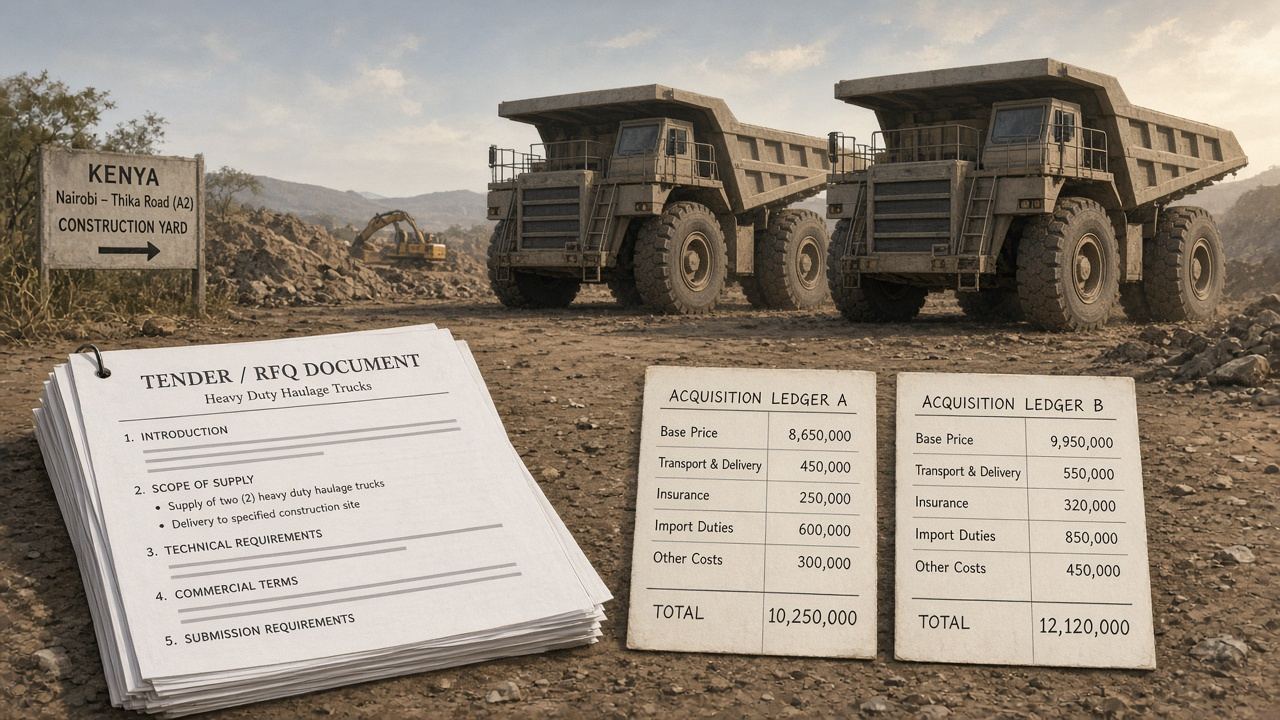
Two Trucks, Two Acquisition Ledgers
Imagine two contractors preparing to quote for the same haulage job.
Editorial illustration. Two similar heavy trucks stand side by side. On a desk: equipment quotation, loan schedule, tender document and two ledgers with different totals. Conceptual art, not a documentary photograph. No flags or seals.
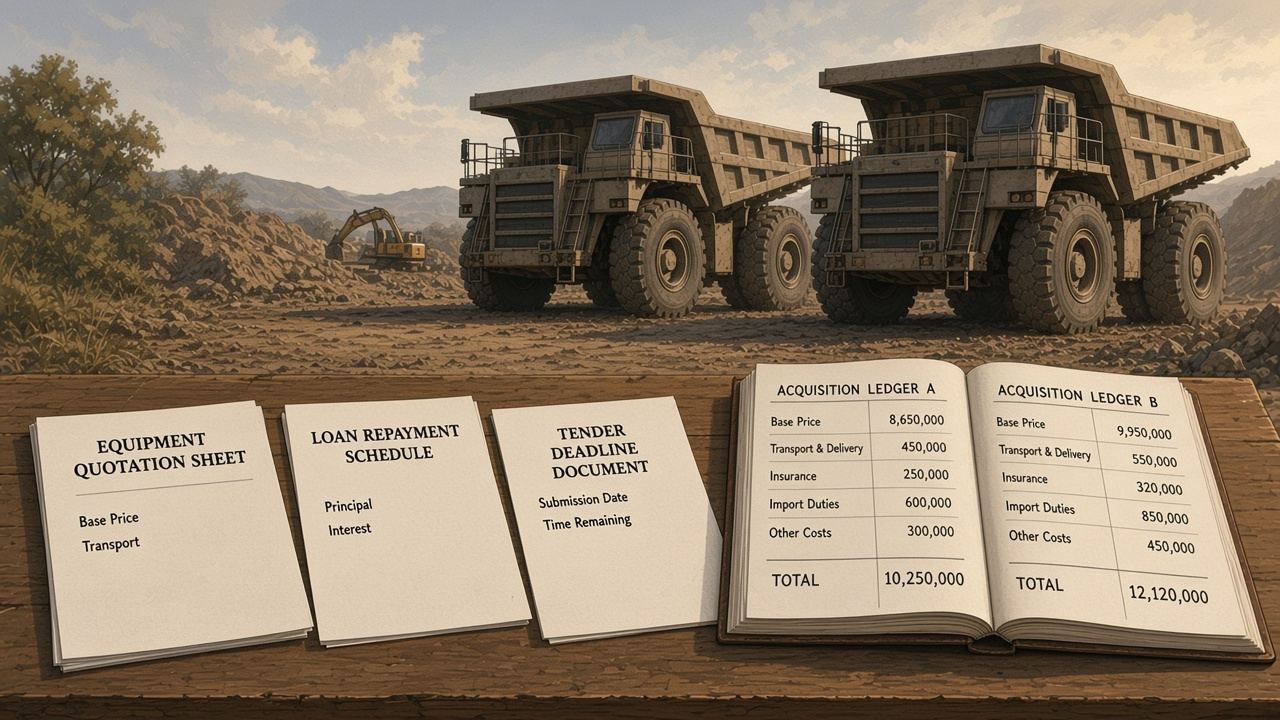
The trucks look equivalent. The payload, the route and the delivery window are the same. Each firm will need fuel, drivers, maintenance and a margin that keeps the business alive. On the desk sits an equipment quotation, a loan schedule and a tender deadline. None of this scene is an interview. It is an expressly imagined opening, useful only if it sharpens the question that follows.
Now suppose the acquisition ledgers differ. One contractor entered the market with a lower capital cost for comparable equipment. The other borrowed more to put similar steel on the road. When their bids arrive, the lower price will look like efficiency. The higher price will look like weakness. The tender committee will still have to award something. The public will still have to pay for a road, a port call or a lift.
This series has argued that enterprise often begins where permission, obligation and incentive are written,before customers alone decide. Part VII asks a narrower question: when two contractors submit different prices, how much of the difference reflects productivity, and how much reflects the conditions under which they acquired equipment, obtained finance and entered the market?
A bid price reveals a number. It does not, by itself, reveal the ledger that made that number possible.
The title is a framing device. It does not claim that any particular tender’s outcome was predetermined. It asks what must be examined before a price difference is treated as proof of superior efficiency, or as proof of wrongdoing.
What the Dispute Does, and Does Not, Establish
Editorial illustration. Left: petition folder stamped Alleged. Right: empty evidence tray and unchecked checklist labelled Not yet proved. Conceptual art, not a court judgment.

On 24 September 2026, Business Daily reported that local contractors and truck owners had moved to court seeking orders to compel the government to publish tax and duty concessions associated with Chinese contractors on infrastructure projects. The report names petitioners including the African Centre for Corrective and Preventive Action (ACCPA), Swan Movers Lifters Limited, the Association of Micro and Small Enterprises Association of Kenya, and Universal Lifters Limited.
According to that report, the petitioners allege unpublished exemptions have created a 25-35 percent cost advantage for foreign firms, and that acquiring a truck costs a local operator at least 51 percent more than a foreign competitor benefiting from duty-free importation. They want continued use of contract-embedded tax and duty concessions without published legal authority declared unconstitutional, and they seek publication of the legal notices, Gazette notices, administrative directives or executive instruments through which such concessions have been granted since January 2008. The report also attributes to the petitioners citations of Auditor-General reports showing revenue foregone through tax exemptions of KES 38.6 billion in 2022/23 and KES 41.2 billion in 2023/24.
Those fiscal figures remain, for this article, petitioner-attributed and media-reported. They are not independently matched line items from Auditor-General summaries reviewed for this article, not amounts shown to benefit Chinese contractors exclusively, and not established losses. A newspaper can verify that an allegation was reported. It does not independently establish the allegation’s truth.
Earlier media accounts, including a 19 August 2026 Kenyans.co.ke report, describe a Milimani High Court petition seeking constitutional declarations, gazettement of instruments since 2008, audits of duty-free equipment, and prohibition orders against future awards predicated on a duty-free advantage unavailable to resident Kenyan contractors. Those accounts quote petition language. They are not a substitute for the filed record. No official case number or e-filing was located for this article; none is invented here.
Business Daily reports that the Attorney-General has opposed the petition, arguing that it raises no constitutional issue and was filed in the wrong forum, characterising the matter as commercial. The same report states that the case will be mentioned on 6 October. A mention is a procedural step. It is not a judgment. As of 25 September 2026, no verified court order invalidating the contested concessions was located for this article. Later mentions, responses or orders should be read against the filed record, not against this summary alone.
Filing an allegation establishes that a dispute has entered the judicial system. It does not establish the facts alleged. The sections that follow offer analysis of the commercial and public questions the dispute raises, not a recreation of the newspaper report, and not a verdict.
The Cost Difference Before the Tender
Consider a compact, clearly labelled example. It is a hypothetical illustration, not transaction evidence and not a reconstruction of Kenyan import taxes. No duty, VAT, import declaration fee or railway development levy rate is invented here to manufacture the gap.
| Item | Contractor A | Contractor B |
|---|---|---|
| Assumed acquisition cost | KES 10,000,000 | KES 15,100,000 |
| Assumed debt-financed share | 80% | 80% |
| Initial borrowing | KES 8,000,000 | KES 12,080,000 |
Assumed acquisition cost
Contractor A: KES 10,000,000. Contractor B: KES 15,100,000.
Assumed debt-financed share
Contractor A: 80%. Contractor B: 80%.
Initial borrowing
Contractor A: KES 8,000,000. Contractor B: KES 12,080,000.
Under these assumptions, Contractor B’s acquisition cost is 51 percent above Contractor A’s. Contractor A’s cost is approximately 33.8 percent below Contractor B’s. Both statements are arithmetically true. They use different denominators. Readers who treat “51 percent higher” and “about a third lower” as interchangeable slogans will misread the scale of the gap.
The additional borrowing is KES 4,080,000 if both finance 80 percent of acquisition cost. Any repayment comparison must hold interest rate, tenor, fees and repayment structure constant. Change those terms and the cash-flow story changes even when the sticker prices stay fixed.
An acquisition-cost gap is not automatically an equivalent difference in total project cost. Fuel consumption, maintenance, utilisation, labour productivity, financing terms, residual value and payment timing would also need examination. The entire acquisition gap is not “tax.” Tax may be one component among several, or none, if the illustration’s numbers were produced by other commercial conditions.
Follow the Concession Beyond the Project
Editorial pathway with five stages: Legal instrument, Import entry, Approved project use, Project completion, and Authorised next treatment with a fork for re-export, retention with approval, or assessment of charges.
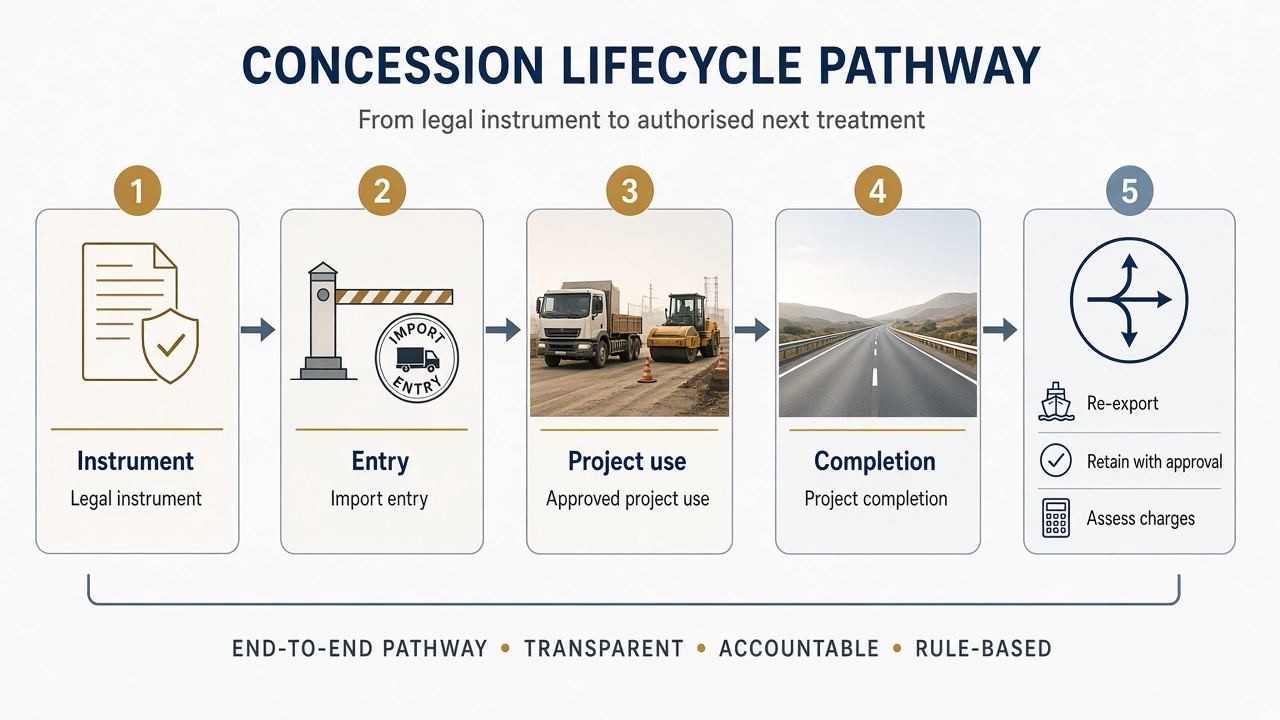
A concession is not only an entry stamp. Its commercial life can run through a chain: legal instrument → import entry → approved project use → project completion → authorised next treatment. Each arrow is a place where evidence can confirm compliance, or leave a gap.
Business Daily attributes to ACCPA executive director John Maingi Macharia the claim that exemptions can be lawful in principle, yet flawed in implementation where re-exportation requirements, tracking and audit mechanisms, and post-project usage restrictions are absent. That is an attributed allegation about design and enforcement. It is not, by itself, a finding that every piece of equipment remaining in Kenya after a project proves a violation.
Conversely, an initially authorised import does not automatically permit unrestricted subsequent commercial use. Temporary admission, remission, waiver and exemption are not interchangeable labels. The applicable law and instrument at the transaction date matter. Rules in force today should not be applied retrospectively to transactions dating back to 2008 without checking what governed those entries then.
The evidence needed includes asset identifiers, utilisation records, and the authorised treatment at completion, re-export, retention with approval, transfer, or assessment of applicable charges. The question is about actual terms and their enforcement. It is not an accusation against an entire nationality or industry.
Who Receives the Benefit?
Editorial triptych. Panel one: statute book labelled Legal authority. Panel two: two bid envelopes and trucks labelled Commercial effect. Panel three: a road and a citizen with a question labelled Public outcome.

Even where a concession is lawful, a separate question remains: who captures the commercial effect? Relief might translate into a lower public contract price, lower user charges, improved delivery, another documented benefit, or greater contractor returns. A stated policy objective is not the same as an observed result.
Credible assessment needs a comparison with what would have happened without the concession. An accounting estimate of revenue forgone is not automatically a net economic loss, and it is not an amount the State would certainly have collected. Some activity might not have occurred at the same scale, on the same timetable, or under the same financing package.
Plausible rationales for concessions, project feasibility, lender conditions, technology transfer, or speed of delivery, are hypotheses to investigate. They become the government’s documented defence only when a source says so. Until then, they compete with other explanations on equal footing: they must be tested against records.
Forgone revenue on a spreadsheet is a starting question, not a closed verdict on public value.
Test Competing Explanations
Lower prices might also reflect procurement scale, equipment specification, technology, utilisation intensity or financing terms that have nothing to do with a tax concession. Some relief may be accessible under eligibility rules that are not nationality-based. A lower acquisition cost may coexist with contractual restrictions, performance bonds, localisation obligations or payment structures that raise other costs.
Recoverable taxes, permanent costs and cash-flow timing effects are different economic animals. Treating them as one lump “advantage” without verified sources manufactures clarity the records have not earned. Balance does not mean giving an unsupported explanation the status of established evidence. It means stating what records would distinguish the accounts.
The OECD’s Competitive Neutrality Toolkit (2024) offers a comparative analytical frame: identify and disclose state support and its policy objective; assess whether support is granted on clear, objective criteria; and design procurement so bidders are treated without discrimination on ownership, legal form, nationality or origin of goods, while recognising that advantages granted to specific groups should be clearly defined in law and justified by overriding public objectives. That toolkit is not Kenyan law. It does not prove that any particular Kenyan concession breaches Kenyan requirements. It does clarify the kinds of questions competitive markets ask when the State shapes costs before the tender opens.
What Evidence Would Answer the Question?
The matrix below is a proposed research framework. It is not a statement that the records have been obtained, or that all are publicly disclosable. A lack of access to evidence is not proof that the evidence does not exist. Article 35 of the Constitution affirms citizens’ rights of access to State-held information and a State duty to publish important information affecting the nation; applicable limitations under the constitutional scheme still have to be verified before claiming that any particular file must be produced in a particular form.
| Question | Evidence required |
|---|---|
| What authorised the concession? | Applicable law, instrument, eligibility criteria and reasons. |
| Were comparable transactions treated differently? | Matched equipment specifications, import dates, classifications and assessments. |
| What explains the bid-price difference? | Acquisition, financing, operating and tender-cost records. |
| Did the public receive an identifiable benefit? | Contract pricing, relevant benchmarks and documented delivery outcomes. |
| What happened after project completion? | Asset identifiers, utilisation records and authorised disposal or retention treatment. |
What authorised the concession?
Applicable law, instrument, eligibility criteria and reasons.
Were comparable transactions treated differently?
Matched equipment specifications, import dates, classifications and assessments.
What explains the bid-price difference?
Acquisition, financing, operating and tender-cost records.
Did the public receive an identifiable benefit?
Contract pricing, relevant benchmarks and documented delivery outcomes.
What happened after project completion?
Asset identifiers, utilisation records and authorised disposal or retention treatment.
On legal authority, Article 210 provides that no tax or licensing fee may be imposed, waived or varied except as provided by legislation; where legislation permits waivers, a public record of each waiver and its reason must be maintained and reported to the Auditor-General. That is a public-record and reporting requirement. It is not, by itself, an instrument-specific Gazette requirement, though other statutes or notices may impose publication duties of their own.
Article 201 sets principles of openness, accountability and fairness in the tax burden among the guides for public finance. Article 227 requires that public procurement systems be fair, equitable, transparent, competitive and cost-effective, while also contemplating that an Act of Parliament may provide for preferences and protections. These provisions frame the inquiry. They do not, without more, settle the petition.
The Business-Strategy Implication
For the entrepreneur, contractor, fleet owner or adviser reading a competitor’s price, the practical move is a pre-tender diagnostic, not a story that ends at the bid table.
Ask first about rules and eligibility: which instruments, if any, shape capital costs for equipment of this class? Ask about capital costs themselves: cash price, duty and levy treatment where applicable, and the financing package. Ask about operating capability: utilisation, maintenance, labour and residual value. Ask about payment conditions and contractual obligations that travel with the work. Then, and only then, interpret the competitor’s price as a signal about productivity.
This series began with permission and incentive. Part VI asked whether education finance buys capability that can be shown. Part VII asks whether a tender price reveals capability, or conceals a prior ledger written by fiscal treatment, financing and equipment-use rules. The Portal does not operate a live concession registry. The diagnostic above is a business habit, not a product pitch.
What evidence would show whether a concession lowered public project costs, changed competition, or did both?
Leave that question open. The public interest is not served by treating a lower bid as automatic proof of efficiency, a concession as automatic proof of wrongdoing, or local ownership as an automatic entitlement to a contract. It is served by records that can separate legal authority, commercial effect and public outcome, and by readers who refuse to collapse those three into one slogan.
Series companion
Finance the Learning. Prove the Capability.
Part VI, when public money buys access, what proves capability?
Series introduction
Real Business Is in Policy
Part I, where permission, obligation and incentive create enterprise.
Sources and Further Reading
- Sam Kiplagat: Business Daily: Local contractors sue State over tax breaks for Chinese firms (24 September 2026; media reporting of petition, AG response and 6 October mention)
- Joseph Ogungo: Kenyans.co.ke: Chinese firms face scrutiny over tax advantages in major infrastructure projects (19 August 2026; media account quoting petition text; not an official court record)
- Constitution of Kenya, 2010: Parliament-hosted PDF (starting reference); text of Articles 35, 201, 210 and 227 verified for this article via Kenya Law
- OECD: Competitive Neutrality Toolkit (2024; DOI 10.1787/3247ba44-en); publication landing page, comparative analysis of state support and procurement; not Kenyan law
- Real Business Is in Policy (Part VI): Finance the Learning. Prove the Capability., ThePortal
- Real Business Is in Policy (Part I): ThePortal
From reading to civic action
Procurement gates form before the tender notice. Track public commitments and practise structured organisational decisions on related risks.
Improve this article
Ask a question, suggest a correction, submit a source, share experience, or propose a topic. Contact details stay private. Publicly consequential allegations need editorial review.