Real Business Is in Policy (Part V): Who Owns the Gate to Opportunity?
A place in college opens one door. The decisions that follow determine how far a learner can travel.
Amina is a fictional learner used to illustrate possible institutional barriers, not a reported case or a claim about national prevalence. Accountability measures are author recommendations unless attributed to a named source. No interviews or original fieldwork are claimed.
On this page
- Now Let Us Follow the Learner Through the Gate
- The Learner Who Entered, but Could Not Yet Advance
- The First Gate: Permission to Participate
- The Second Gate: Access to Experience
- The Third Gate: Who May Certify What You Know?
- The Fourth Gate: When Achievement Becomes Usable Evidence
- The Fifth Gate: Who Gets a First Chance?
- Who Should Answer at Each Gate?
- Follow People Between Institutions
- Return to Amina
- Sources and Further Reading
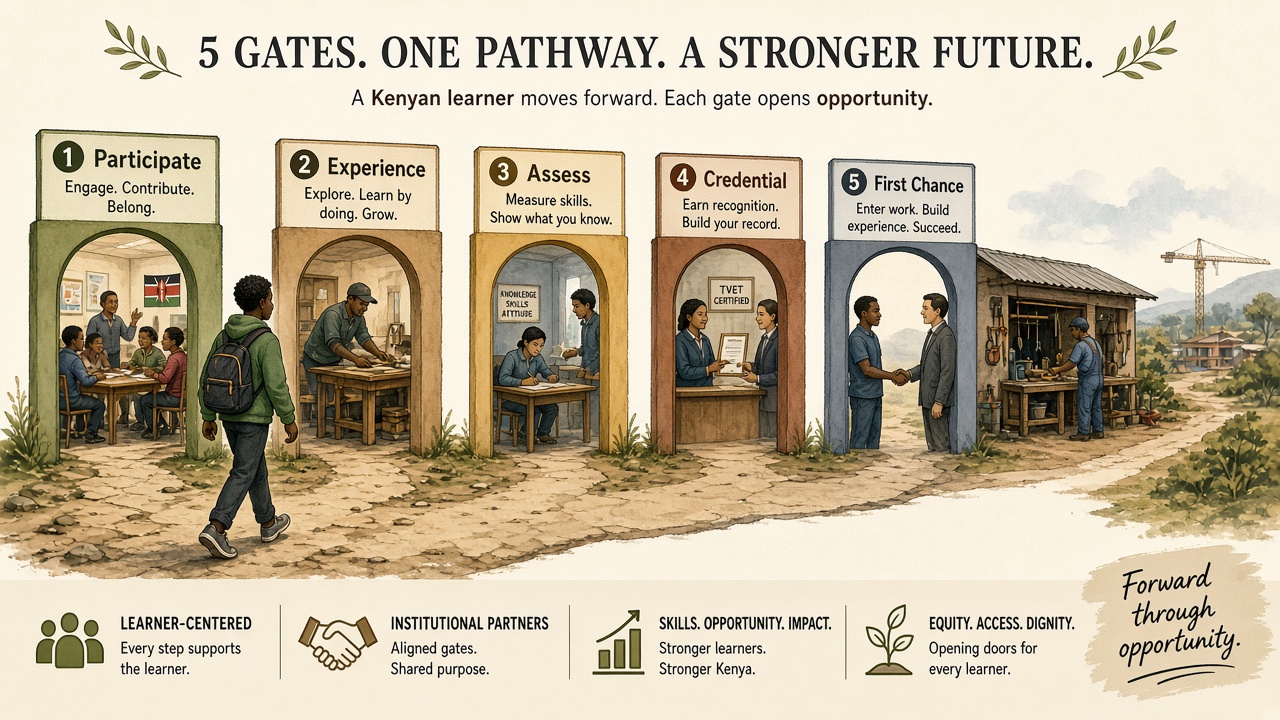
Editorial illustration. A young Kenyan technical learner walks through several distinct institutional doorways, college, workshop, assessment, credentials, into a workplace. Soft daylight. Conceptual art, not a documentary photograph. No political likenesses or official seals.

Now Let Us Follow the Learner Through the Gate
In Part IV, The School Gate and the Debt Ledger, we examined the relationship between education financing and the obligation to repay. We asked what happens when access arrives before income, and the repayment clock moves faster than the graduate’s prospects.
Now let us follow the learner through the gate.
The placement is confirmed. The funding has arrived. The family exhales.
But the learner still needs to attend, practise, be assessed, obtain usable evidence of achievement, and persuade someone to offer work or buy a service.
Each transition involves another decision. Each decision has a gatekeeper.
The opportunity announced at admission is therefore only the beginning of a journey whose conditions are distributed across many institutions.
Editorial pathway with five labelled gates: Participate, Experience, Assess, Credential, and First Chance. A learner moves toward a workshop and workplace.
The Learner Who Entered, but Could Not Yet Advance
Consider Amina, a fictional learner enrolled in a technical programme in Kenya. Her story is an illustration of possible institutional barriers, not a reported case or a claim about their prevalence.
Her fees are covered. Yet she must still organise transport, equipment and time for practical sessions. Later, an industrial attachment requires a host willing to supervise her. An administrative error delays one result. A prospective employer wants evidence of experience. A customer considering her first independent assignment wants proof she can deliver.
Every organisation sees a different part of Amina.
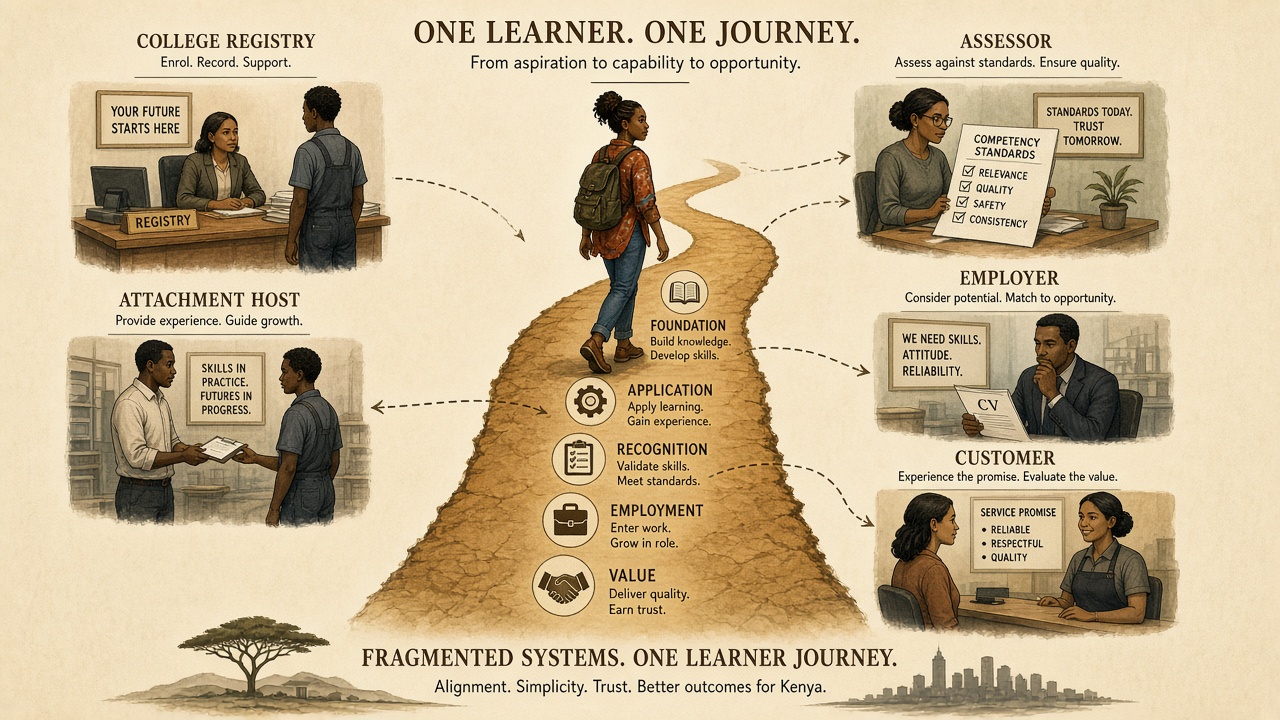
The college sees a registered student. The attachment host sees a supervision commitment. The assessor sees work against a standard. The employer sees a hiring risk. The customer sees a promise awaiting proof.
Amina experiences one continuous journey. The institutions administer separate transactions.
That gap is where opportunity can stall without any single institution admitting that it has closed the road.
Editorial illustration. A Kenyan learner stands in the centre of a continuous path. Around her, separate offices show a college registry, attachment host, assessor, employer and customer, each seeing only part of the journey.
Plain meaning: Getting a place and paying the fees do not complete the journey into useful work.
The First Gate: Permission to Participate
Enrolment is an administrative fact. Participation is a daily achievement.
A learner may have a funded place and still struggle to reach the workshop, access required materials, use an inaccessible learning system or attend a timetable that conflicts with care responsibilities.
Institutions cannot remove every personal difficulty. They can, however, explain the full requirements before enrolment, identify foreseeable barriers and make decisions about assistance transparently.
The policy question is whether access is measured at registration or throughout participation.
If a system counts the learner when money arrives but loses sight of them when attendance becomes difficult, its definition of success is too narrow.
The Second Gate: Access to Experience
Practical experience must be organised. Somebody supplies equipment, accepts risk, supervises the learner and assesses progress.
Employers have legitimate concerns about those costs. A workable policy must recognise them. But a learner also needs a fair route into the experience that future employers may demand.
An unpaid opportunity requiring travel or temporary accommodation can be easier to accept for someone with family support. Access may then depend partly on the ability to finance the experience, even after tuition has been funded.
The International Labour Organization’s Quality Apprenticeships Recommendation, 2023 (No. 208), with its Guide for Policymakers (19 December 2024), provides a useful benchmark: structured learning, defined agreements, financial compensation and protections for apprentices. It is an international recommendation, not proof that every internship in Kenya has those conditions or falls within its scope.
My proposal is straightforward: institutions and participating employers should publish selection criteria, learning objectives, supervision arrangements, costs and complaint routes before a learner accepts a placement.
Editorial illustration of a Kenyan learner at a practical-experience gate: workshop tools, a supervising host, and modest travel costs visible beside the doorway.

Plain meaning: An opportunity to learn at work should explain both what the learner will gain and what participation will cost.
The Third Gate: Who May Certify What You Know?
Assessment is necessary. Competence cannot be established by confidence alone, especially where poor practice can harm others.
The problem arises when the route to demonstrating competence is harder to understand than the standard itself.
A learner should know what evidence is required, how it will be judged, when a decision should arrive and how an error can be challenged. These are proposed service expectations, not a claim that every institution currently applies identical rules.
This question also reaches people who learned outside the classroom.
Kenya’s Recognition of Prior Learning approach, described by the Kenya National Qualifications Authority, provides for skills acquired through work and informal learning to be assessed against qualification standards. Its process includes assembling evidence and assessing competence, with provision for appeal. Recognition is therefore an assessment route, not an automatic certificate for experience.
The implication is substantial: institutions can preserve demanding standards while allowing more than one route to demonstrate them.
An artisan’s workshop and a college laboratory may produce different evidence. The task is to judge that evidence fairly against the relevant competence.
The Fourth Gate: When Achievement Becomes Usable Evidence
A result must travel beyond the institution that produced it.
Employers and customers need credible evidence. Learners need practical ways to obtain and present it. Verification must protect against fraud without turning every legitimate applicant into a permanent suspect.
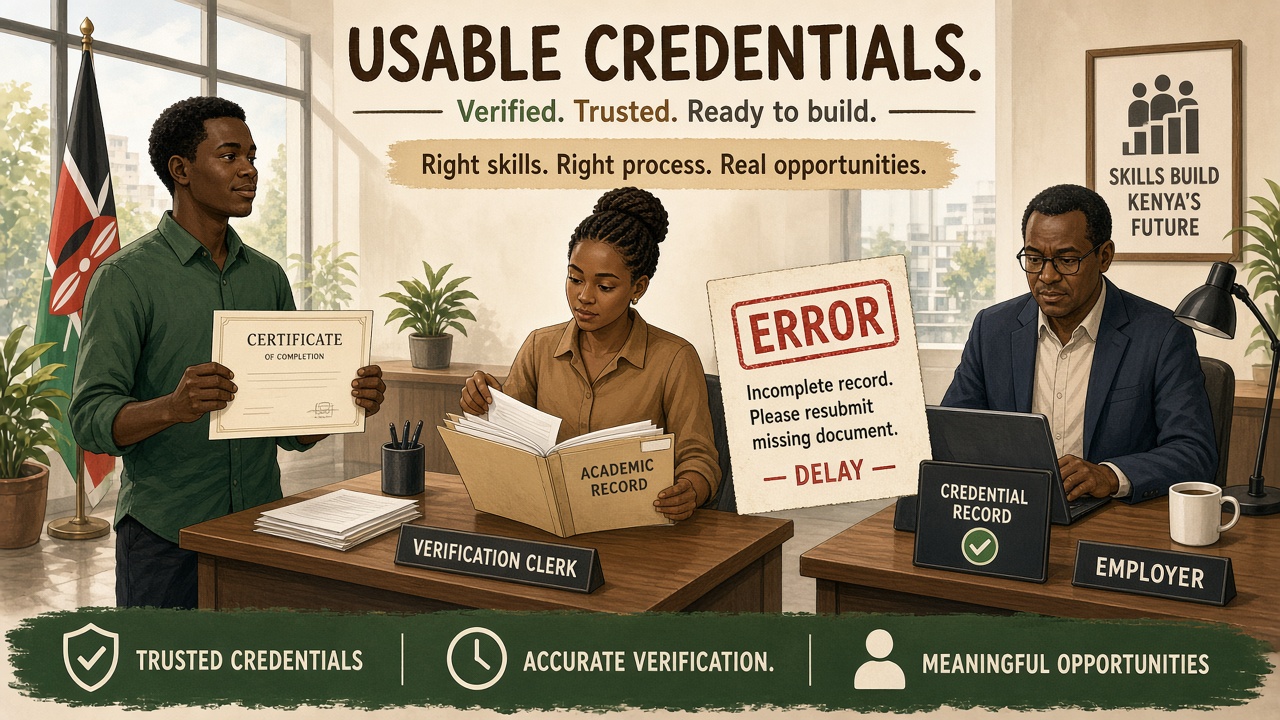
Consider what happens when records contain an error, a verification request has no clear owner, or different systems cannot reconcile the same learner’s details.
The learner bears the delay even when they cannot repair its cause.
My recommendation is for institutions and service providers to make correction procedures visible, identify the responsible office, publish realistic turnaround commitments and provide secure ways to share necessary evidence.
Digital platforms should also explain how records are used. A ranking or matching system can influence visibility as powerfully as a physical reception desk.
Putting the gate online does not make its decisions accountable by itself.
Editorial illustration of usable credentials: a Kenyan graduate holds a certificate while a verification clerk and an employer check records; one file shows an error that needs correction.
The Fifth Gate: Who Gets a First Chance?
An employer’s hiring decision and a customer’s purchasing decision are not academic assessments. They concern whether someone can perform in a particular setting, at an acceptable cost and risk.
Education cannot guarantee either decision.
Yet the route into a first opportunity can be designed more thoughtfully. Employers can define genuine entry-level requirements, use relevant work samples and explain when experience is essential. Training institutions can help learners present credible portfolios and organise supervised projects.
Enterprise support should take the first customer seriously. Another entrepreneurship seminar will not necessarily resolve a buyer’s concern about quality, delivery or reliability.
Possible responses include paid trial assignments, mentoring, proportionate supplier requirements and clear payment terms. Each should be tested for usefulness rather than treated as a universal solution.
Responsibility also rests with learners: developing competence, presenting truthful evidence and meeting reasonable commitments. Fair access does not eliminate those obligations.
Editorial illustration of a first-chance gate: a Kenyan graduate presents a portfolio or work sample to an employer or small customer across a simple desk.

Plain meaning: A qualification helps establish achievement. A fair first opportunity allows the person to show what they can do with it.
Who Should Answer at Each Gate?
“Who owns the gate?” asks who can set its conditions, interpret its rules and correct its mistakes.
The answer changes along the journey.
| Gate | Principal decision-makers | Accountability to seek |
|---|---|---|
| Participation | Institutions and learner-support services | Full requirements, accessible delivery and clear assistance criteria |
| Practical experience | Institutions, employers and supervisors | Transparent selection, learning commitments and fair participation terms |
| Assessment | Assessors and qualification-awarding bodies | Published standards, reasons and review procedures |
| Credentials | Awarding institutions and verification services | Accurate records, correction procedures and predictable responses |
| Work and enterprise | Employers, buyers and platforms | Relevant requirements, honest opportunities and proportionate evaluation |
Participation
Decision-makers: Institutions and learner-support services
Accountability: Full requirements, accessible delivery and clear assistance criteria
Practical experience
Decision-makers: Institutions, employers and supervisors
Accountability: Transparent selection, learning commitments and fair participation terms
Assessment
Decision-makers: Assessors and qualification-awarding bodies
Accountability: Published standards, reasons and review procedures
Credentials
Decision-makers: Awarding institutions and verification services
Accountability: Accurate records, correction procedures and predictable responses
Work and enterprise
Decision-makers: Employers, buyers and platforms
Accountability: Relevant requirements, honest opportunities and proportionate evaluation
This is an analytical map, not a complete statement of statutory responsibilities.
It also reveals why institutional success can coexist with a learner’s failure to progress. One office has processed the application. Another has issued the result. A third has advertised the opportunity. Yet no one has examined what happens between those steps.
Good gates protect. Unaccountable gates exclude.
The solution is not to remove standards or compel every employer to hire every graduate.
A practical assessment can protect the public. A verification check can prevent fraud. A supervised placement can develop skills that a classroom cannot reproduce.
The test is whether the requirement serves a legitimate purpose and gives a qualified person a fair way to meet it.
Some barriers also lie beyond administration. If firms have few orders, improving recruitment forms will not create enough jobs. If learning quality is poor, faster certification will not create competence.
Policy must therefore address productive capacity and educational quality alongside access. Otherwise, it risks perfecting the queue while leaving the opportunity scarce.
Follow People Between Institutions
To investigate these gates, follow contrasting learner journeys over time: those who progress, those who wait, those who withdraw and those who never secure the next opportunity.
With informed consent, document costs, repeated requirements, decision times, errors and remedies. Combine those accounts with administrative records. A small qualitative study can explain how a barrier works; it cannot establish national prevalence by itself.
Measure transitions as well as transactions: access to practical learning, completion of assessment, correction of records and movement into work, enterprise or further study.
Such evidence can distinguish a necessary standard from an avoidable obstacle.
For responsible businesses, this creates a worthwhile field of service: helping institutions coordinate and helping learners carry reliable evidence between them. Their value should be demonstrated through reduced friction and better outcomes, without selling privileged access or creating a compulsory new toll.
Return to Amina
Amina needs to learn, practise and earn the trust of others. Institutions need to make the conditions understandable, the evidence usable and mistakes correctable.
Public investment in her education becomes more meaningful when those responsibilities meet.
The deepest question is not whether someone controls the gate. Every credible system entrusts decisions to someone.
It is whether that authority is exercised for the purpose the gate was created to serve, and whether the person waiting outside can obtain an answer.
Opening the college gate begins the promise. What happens at the gates beyond it determines how much of that promise the learner can use.
Public question: After placement and funding, which gate most often stops a learner from progressing, and who should be accountable for making it fair?
Continue in Part VI: Finance the Learning. Prove the Capability., which asks how education investment should be evaluated, money paid versus capability proved.
Continue to Part VI
Finance the Learning. Prove the Capability.
Series: Real Business Is in Policy, how to evaluate whether education finance bought usable capability.
Read Part IV
The School Gate and the Debt Ledger
Series: Real Business Is in Policy, how education funding rules shape access, repayment and risk.
Read Part III
Coffee, Cash Crops and the Chief
Series: Real Business Is in Policy, how permission, institutions and power shaped the coffee economy.
Read Part II
What Kenya’s Post-Vision 2030 Blueprint Could Mean for Enterprise
Series: Real Business Is in Policy, apply the thesis to Kenya’s conversation beyond Vision 2030.
Read Part I
Real Business Is in Policy
Series: Real Business Is in Policy, how rules, institutions and lived practice cultivate markets.
Sources and Further Reading
- International Labour Organization: Quality Apprenticeships Recommendation, 2023 (No. 208). Used as an international policy benchmark; not represented as a Kenyan statutory entitlement.
- International Labour Organization: Guide for Policymakers on Quality Apprenticeships Recommendation, 2023 (No. 208) (19 December 2024).
- Kenya National Qualifications Authority: Recognition of Prior Learning. Used for the description of competency assessment, evidence and appeals. It does not establish automatic eligibility for every programme or profession.
- Real Business Is in Policy (Part VI): Finance the Learning. Prove the Capability., ThePortal
- Real Business Is in Policy (Part IV): The School Gate and the Debt Ledger: ThePortal
- Real Business Is in Policy (Part III): ThePortal
- Real Business Is in Policy (Part II): ThePortal
- Real Business Is in Policy (Part I): ThePortal
From reading to civic action
After funding and placement, opportunity still passes through institutional gates. Document a shared education or skills challenge, then track who answers for delivery.
Improve this article
Ask a question, suggest a correction, submit a source, share experience, or propose a topic. Contact details stay private. Publicly consequential allegations need editorial review.