Real Business Is in Policy (Part IV): The School Gate and the Debt Ledger
Who gains access today, who repays tomorrow, and who carries the risk.
Legislative status note: based on the Tertiary Education, Placement and Funding Bill, 2026 (National Assembly Bill No. 49), Kenya Gazette Supplement published 24 July 2026, still a Bill under public participation as of 23 September 2026 evening re-check (county forums continuing through 2 October 2026; written memoranda deadline 2 October 2026, 5pm). No amended committee print or second-reading print located. Not yet law. A further status refresh is required after the 2 October participation close.
On this page
Editorial illustration. A Kenyan learner stands near a college gate at soft daylight. In the foreground, an open household ledger sits on a wooden surface. The scene links today’s access to tomorrow’s repayment obligation. Conceptual art, not a documentary photograph.

From the Coffee Tree to the College Gate
In Part III of Real Business Is in Policy, the coffee shamba showed how rules shape permission, labour, institutions and power. The comparison that follows is about that architecture of opportunity, not an equation of contemporary student finance with colonial coercion.
Consider a household that is easy to recognise. A qualified learner holds an admission offer. The fees are due before the semester begins. Relatives have already stretched school fees, transport and rent. Without upfront financing, the gate stays closed even when the marks are enough.
Upfront public financing can unlock that gate. It can turn an offer letter into a registered student. The real benefit arrives first as access: books, boarding, tuition paid, a seat in class.
The future obligation arrives later, as a ledger. The question for this Part IV is not whether education should be financed. It is how the rules decide who enters, how money moves, who sets the terms, and who carries risk when learning does not quickly become income.
Editorial illustration. A young Kenyan stands at a college gate holding an admission letter. An open family ledger sits in the foreground. Labels mark admission letter, college gate, and family ledger.

What the Reform Proposes
The published Bill proposes two main bodies. Clause 6 would establish the Kenya Universities and Colleges Central Placement Service. Clause 28 would establish the Tertiary Education Funding Authority. Placement and funding are designed as related but separate institutions.
For a learner, the journey is not a single stamp. Admission means an institution has accepted you. Placement, under the draft, is the Placement Service’s allocation into a programme. Loan eligibility and an approved award are Authority decisions. Disbursement is money actually released. Confusing those steps makes reform look either more generous or more automatic than the text allows.
Editorial pathway with five labelled stations: Admission, Placement, Eligibility, Award, Money Paid. A student moves from offer letter to classroom.
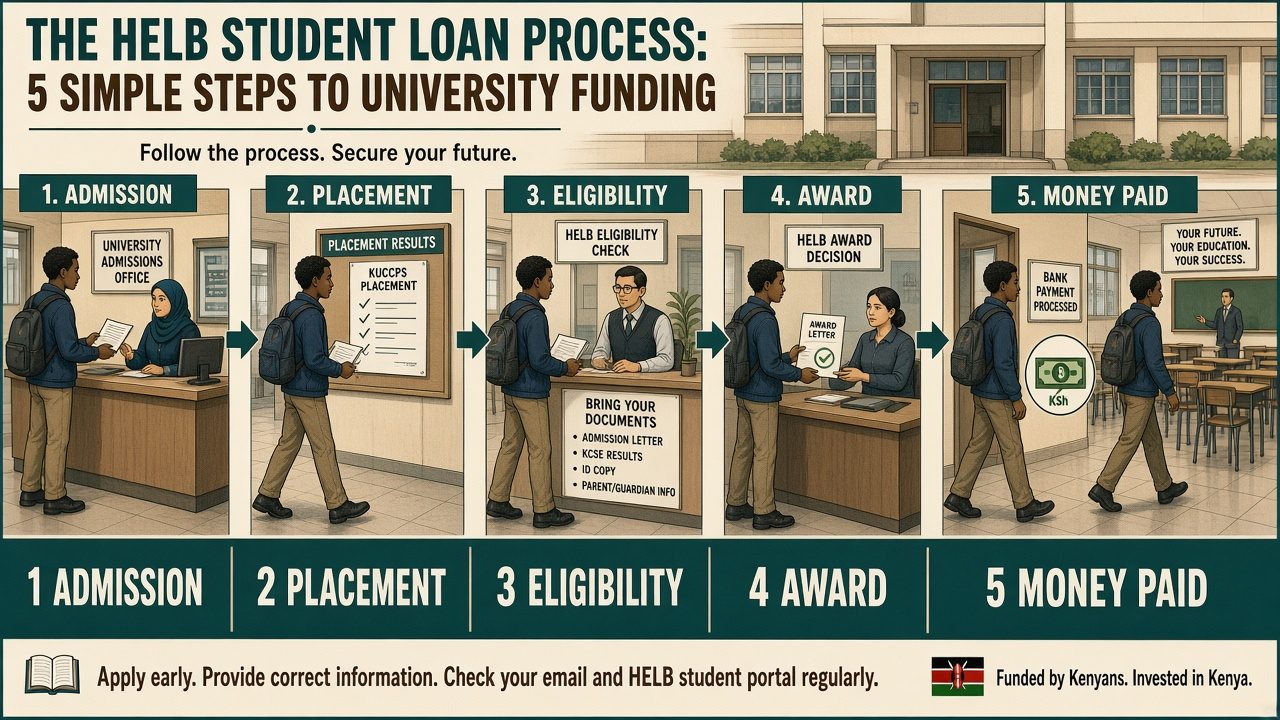
Clause 20(5) states that funding under the proposed Act shall be for students placed by the Placement Service. The school gate and the debt ledger are linked on purpose.
Clauses 64 and 65 set out repeal and succession: the Authority would succeed HELB and related funding boards; the Placement Service would succeed the prior placement board. That is institutional redesign, not a minor rename.
| Verified provision | Practical implication for a learner |
|---|---|
| Clauses 6 and 28 | Placement and funding sit in separate bodies: the Placement Service and the Tertiary Education Funding Authority. |
| Clause 20(5) | Under the draft, funding follows Placement Service placement, admission alone is not the full financing gate. |
| Clause 29(d) | The Authority retains a function to administer scholarships, even where the Fund’s stated purpose emphasises loans. |
| Clause 30(d) | Loan interest may be set by the Authority with the Cabinet Secretary; the published draft states no rate and no statutory interest ceiling. |
| Clauses 43-48 | A Tertiary Education Fund, eligibility rules, application and an Authority decision sit between hope and disbursement. |
| Clause 49(1), (3), (4) | Repayment begins within one year of completing studies; informal workers negotiate a plan; employed deductions are capped at 25% of emoluments. |
| Clauses 64-65 | The Authority would succeed HELB and related funding boards; the Placement Service would succeed the prior placement board. |
Clauses 6 and 28
Placement and funding sit in separate bodies: the Placement Service and the Tertiary Education Funding Authority.
Clause 20(5)
Under the draft, funding follows Placement Service placement, admission alone is not the full financing gate.
Clause 29(d)
The Authority retains a function to administer scholarships, even where the Fund’s stated purpose emphasises loans.
Clause 30(d)
Loan interest may be set by the Authority with the Cabinet Secretary; the published draft states no rate and no statutory interest ceiling.
Clauses 43-48
A Tertiary Education Fund, eligibility rules, application and an Authority decision sit between hope and disbursement.
Clause 49(1), (3), (4)
Repayment begins within one year of completing studies; informal workers negotiate a plan; employed deductions are capped at 25% of emoluments.
Clauses 64-65
The Authority would succeed HELB and related funding boards; the Placement Service would succeed the prior placement board.
Who Pays When Education Is Called Free?
“Free” can mean three different things. Upfront public financing means the state or a fund pays now so the learner can enrol. A non-repayable grant or scholarship means that portion never becomes a personal debt. A repayable loan means today’s access is tomorrow’s balance, principal, interest and charges.
Three panels labelled Pay Now, Gift / Scholarship, and Loan / Debt, showing the difference between upfront financing, a non-repayable grant, and a repayable loan.

Clause 44 says the purpose of the Tertiary Education Fund is to provide funds granted as education loans. That is a strong signal toward loan-centred financing. It is not, however, a complete erasure of scholarships in the published draft: clause 29(d) retains an Authority function to administer scholarships, and clause 56 still budgets for loans and scholarships together in annual estimates.
What the verified text does not do is settle the household mix. In the pages checked, there is no dedicated scholarship fund, no prescribed scholarship shares by need category, and no separate statutory source labelled for grants as distinct from the loan-purpose Fund. Political and ministerial statements describing an all-loan shift therefore describe a policy direction that may still be written into criteria, regulations or amendments, they are not, by themselves, the Act. Public debate has already pressed this gap; the controlling finding for this article is simply that the published Bill leaves the grant-loan balance under-specified.
Read the Repayment Trigger
Clause 49(1) of the published Bill provides that a loanee shall commence repayment within one year of completion of studies, including principal, accrued interest and other charges. That is a completion trigger, not, in this draft, a trigger that waits for first employment.
That distinction is not academic. Some August 2026 reporting summarised ministerial framing as repayment beginning one year after securing employment. Those reports are accounts of statements or expectations. Against the gazetted Bill No. 49 text verified for this article, the completion clock controls. No amended committee print resolving the difference was located as of 23 September 2026. If later amendments change the trigger, the analysis should move with the text, not freeze an outdated contrast.
Two labelled scenes. Left: the Bill says repayment after finishing studies. Right: some reports say after getting a job.

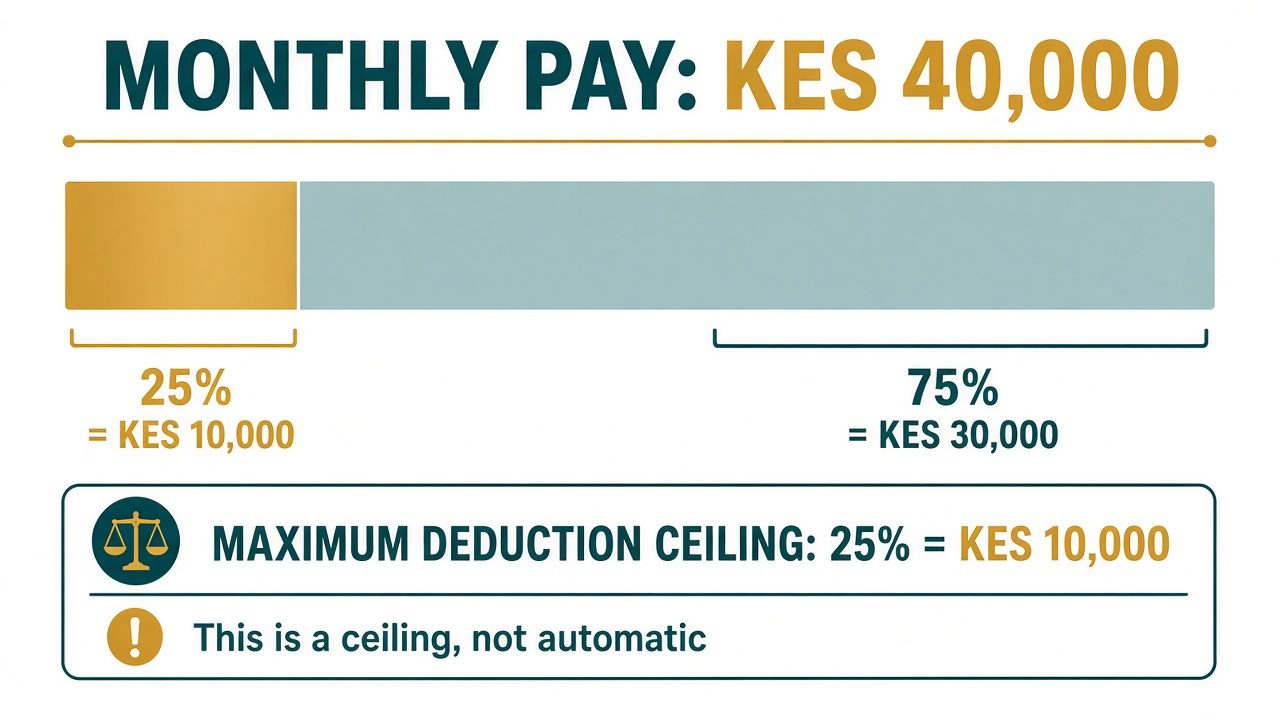
Clause 49(3) requires borrowers in informal employment to enter a payment plan with the Authority. Clause 49(4) caps deductions at not more than twenty-five percent of a loanee’s emoluments. That ceiling is not the interest rate. Interest is a separate power under clause 30(d), set by the Authority in consultation with the Cabinet Secretary.
On interest and tenure, the verified finding is negative but clear: the published draft states neither a percentage rate nor a statutory interest ceiling, and it does not fix a standard repayment term in the clauses relied upon here. Secondary accounts that cite a four percent figure or employment-linked grace periods must be treated as reports of practice, proposals or oral framing, not as substitutes for the Bill’s silence. Households therefore cannot yet read a complete price of credit from the statute alone.
Nor is twenty-five percent an automatic slice from every graduate or a general education tax. It is a maximum on deductions from emoluments when recovery runs through that channel.
Illustration only: twenty-five percent of KES 40,000 in monthly emoluments is KES 10,000. That shows the ceiling’s scale. It is not a borrower’s actual repayment schedule, take-home pay, interest burden or total debt.
Infographic bar for KES 40,000 monthly pay with a 25 percent ceiling marked as KES 10,000, noting it is a ceiling not an automatic deduction.
Follow the Risk
Apply the series’ lenses. Permission sits at placement and funding eligibility. Obligation sits in the loan contract and the repayment clock. Incentives reward completion and employment, but can punish delay if safeguards are thin. Infrastructure is data, disbursement systems and employer remittance. Institutions are the Placement Service and the Authority. Power is who sets interest, criteria, hardship rules and recovery practice.
Six labelled cards around a college gate and debt book: Who may enter, What you owe, What rewards or punishes, Systems that move money, The two bodies, Who sets the rules.
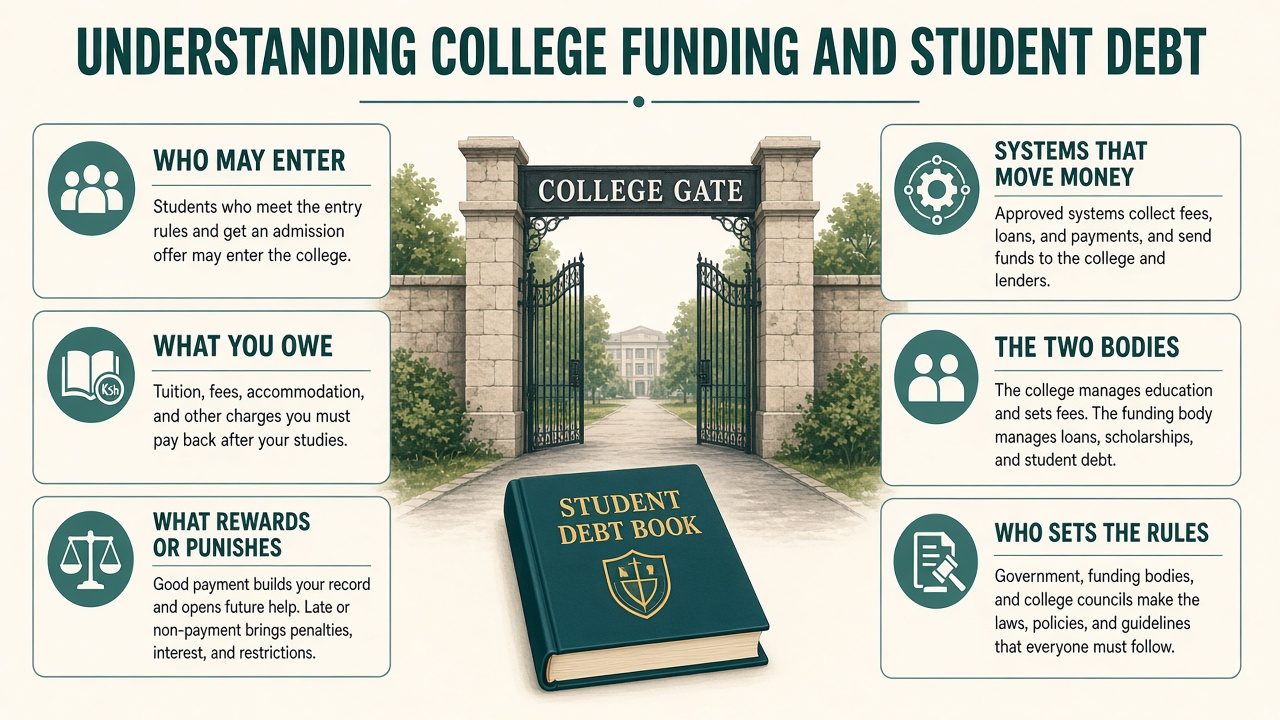
Risk does not fall evenly. A learner faces delayed employment, illness, disability or interrupted study. A household may have co-signed hope without a buffer. An institution waits on disbursement timing. The funding authority balances sustainability against fairness. An employer becomes a remittance agent under draft employer duties. The taxpayer funds the system that makes access possible.
Some protections appear in the draft, alternative dispute resolution under clause 54, informal payment plans under clause 49(3), a deduction ceiling under clause 49(4), and succession of existing boards. What remains to be designed, in statute, regulations or published criteria, includes a protected minimum income beneath enforceable deductions, clear hardship and unemployment treatment on the completion clock, transparent award reasons with meaningful appeals, timely disbursement rules, and a scholarship architecture with identifiable funding, not only a residual administrative function.
Test the Argument Fairly
The strongest case for reform is serious. Upfront exclusion is real. Fragmented administration has costs. A sustainable fund can serve the next cohort after this one. A graduate who borrows on fair terms, finds work and repays successfully can treat the loan as a bridge rather than a trap.
Two panels. Left labelled When the loan works: graduate with employment. Right labelled When work is delayed: graduate with a heavy ledger and empty street.

Contrast that experience with an unemployed or low-income graduate facing a completion clock. The same design can expand freedom for one household and concentrate risk on another. Distribution and safeguards are therefore not optional footnotes; they are how the design proves itself.
These are hypothetical journeys, not population evidence. A proposed research approach, not research already done, would track applicant journeys through placement, award, disbursement and early repayment, and follow cohorts by employment status, informal income and hardship outcomes. Without that evidence, national causal claims should stay off the page.
A Fairer Financing Promise
Recommendations follow from the gaps above, unless already fixed in the verified framework. Award letters should state grant versus loan portions in plain language. Interest and charges should be understandable before acceptance. A protected minimum income should sit beneath enforceable deductions. Hardship and unemployment arrangements should be explicit. Decisions should be transparent, with meaningful appeals. Payments to institutions and students should be timely. Targeted grants should remain available where loans alone would exclude the poorest.
Responsible enterprise has a role at the edges of this system: helping families assemble applications, check evidence and reconcile payments. Value comes from reducing friction and error, not from selling preferential access or implying government endorsement of a private platform.
End with the Citizen
Return to the opening household. Financing that opens the college gate can expand practical freedom. A ledger that starts too soon, explains too little or recovers without a floor can shrink that freedom over a lifetime. The citizen’s question is therefore sharper than any slogan about free education:
What minimum protection should a graduate receive before education-loan repayment becomes enforceable?
Continue in Part V: Who Owns the Gate to Opportunity?, which asks who controls the next gates after placement and funding, participation, experience, assessment, credentials and a first chance at work.
Continue to Part V
Who Owns the Gate to Opportunity?
Series: Real Business Is in Policy, the gates beyond funding that decide how far a learner can travel.
Read Part III
Coffee, Cash Crops and the Chief
Series: Real Business Is in Policy, how permission, institutions and power shaped the coffee economy.
Read Part II
What Kenya’s Post-Vision 2030 Blueprint Could Mean for Enterprise
Series: Real Business Is in Policy, apply the thesis to Kenya’s conversation beyond Vision 2030.
Read Part I
Real Business Is in Policy
Series: Real Business Is in Policy, how rules, institutions and lived practice cultivate markets.
Sources and further reading
- Tertiary Education, Placement and Funding Bill, 2026 (National Assembly Bill No. 49) : Parliament PDF (Kenya Gazette Supplement, 24 July 2026)
- National Assembly Order Paper: Tuesday, 11 August 2026 (First Reading listing)
- The Star, public participation extended to 2 October 2026 (21 September 2026)
- The Star, county forums continuing; memoranda deadline restated as 2 October 2026, 5pm (23 September 2026)
- The Star: 6 August 2026 (accounts of proposals and statements; compare with Bill text)
- The Star: 13 August 2026 (institutional redesign reporting)
- Pulse Kenya: 12 August 2026 (secondary report quoting Bill clauses; notes absence of a fixed interest rate in the draft)
- Education News: 17 September 2026 (parliamentary debate on scholarship safeguards and interest clarity; not a transcript of any video)
- Real Business Is in Policy (Part V): Who Owns the Gate to Opportunity?: ThePortal
- Real Business Is in Policy (Part I): ThePortal
- Real Business Is in Policy (Part II): ThePortal
- Real Business Is in Policy (Part III): ThePortal
From reading to civic action
School gates and debt ledgers decide who can stay in learning. Surface education challenges and listen before institutions decide alone.
Improve this article
Ask a question, suggest a correction, submit a source, share experience, or propose a topic. Contact details stay private. Publicly consequential allegations need editorial review.