Pan Paper Mills, Webuye: Industrial Revival or Industrial Capability?
A collapsed state mill has become a working recycled-fibre plant. Whether that is proof of restored industrial capability, or still mostly a well-told announcement, depends on evidence Webuye residents cannot yet fully see.
On this page
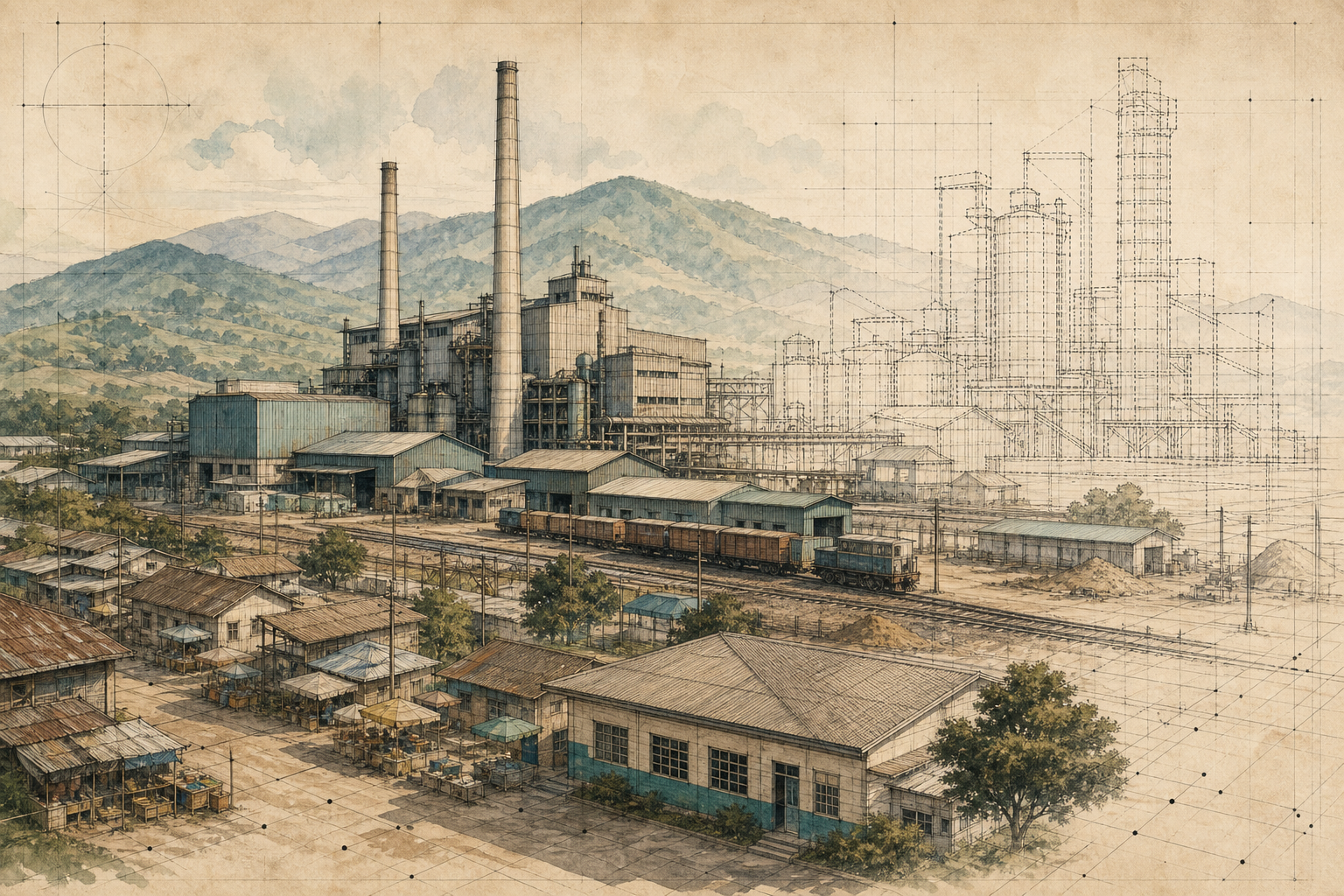
Conceptual editorial image, not a documentary photograph and not an allegation against any person or company. Ivory parchment with mill geometry, a town market, and unfinished dashed modernization outlines suggesting promised capacity that is not yet verified.
A Mill That Was the Town
Webuye, in Bungoma County, grew up around a paper mill. For decades, Pan African Paper Mills did not just employ people; it organised the town's rhythm, shift schedules, school fees, market days, the smell in the air that residents learned to live with because it meant wages were still moving. Structural pressures through the 1990s and 2000s eroded that arrangement, and by 2009 the mill had collapsed, reportedly owing creditors on the order of Sh3 billion and leaving thousands of workers without income (Business Daily).
01
2009
Collapse, roughly Sh3bn owed, thousands of jobs lost
02
2010
State switch-on ceremony; revival fails within months
03
2016
Rai Group buys the derelict plant for about Sh900m
04
2025
Modernization claims: Sh931m or Sh3bn, not yet reconciled
Overlay across every stage: jobs · feedstock · capital · environment · public trust
A collapsed industrial anchor does not simply vanish from a town's economy. It leaves a crater: idle machinery, unpaid claims, a generation of workers whose skills were built around one employer, and a local economy that has to relearn how to function without the wages that used to circulate through it every month.
The Revival That Wasn't
Webuye's first attempt at revival was not private and not quiet. In 2010, the national government pumped roughly Sh1.2 billion into the mill to pay off lenders and restart production, and then-President Mwai Kibaki held a public ceremony switching on the factory machines as a symbol of restoration. The revival did not last. The factory shut down again shortly afterward (Business Daily).
Three-panel editorial drawing on ivory paper: left, ceremony and cameras at a mill gate; centre, corroded idle plant; right, paper machine with recycled-fibre bales and open dashed verification marks. Illustrative only, not a documentary scene.
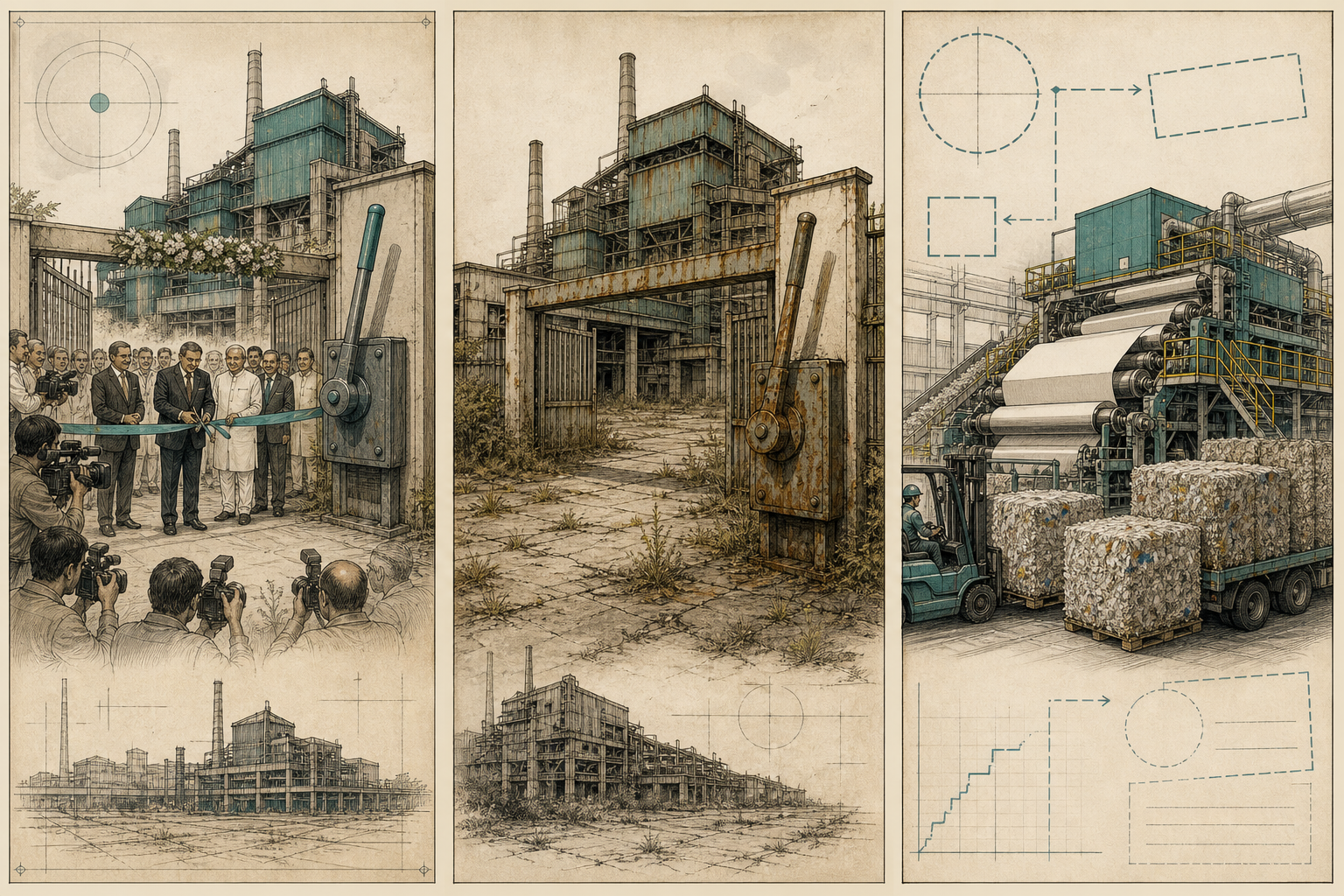
That first failure matters for how Webuye residents, and outside observers, should read every subsequent announcement. A switch-on ceremony is a photograph, not a production line. The gap between a ribbon-cutting and a functioning operating system is exactly where this case lives.
A Derelict Asset Changes Hands
In April 2016, the billionaire Rai family's Rai Group acquired the shuttered Pan Paper Mills for about Sh900 million, beating other bidders in a competitive receivership process. Rai Group pledged to invest roughly Sh6 billion over five to ten years, and then-President Uhuru Kenyatta publicly projected that the investment would create close to 1,500 jobs within three years (Business Daily).
Rai Group was not new to distressed paper assets; it had acquired the Mufindi Paper Mills in Tanzania in 2005. Inheriting a corroded, seven-year-dormant industrial facility is a genuinely different undertaking from building a new plant on a clean site, and it is worth naming that difficulty honestly rather than treating ownership change alone as proof of revival.
When the Forest Closed
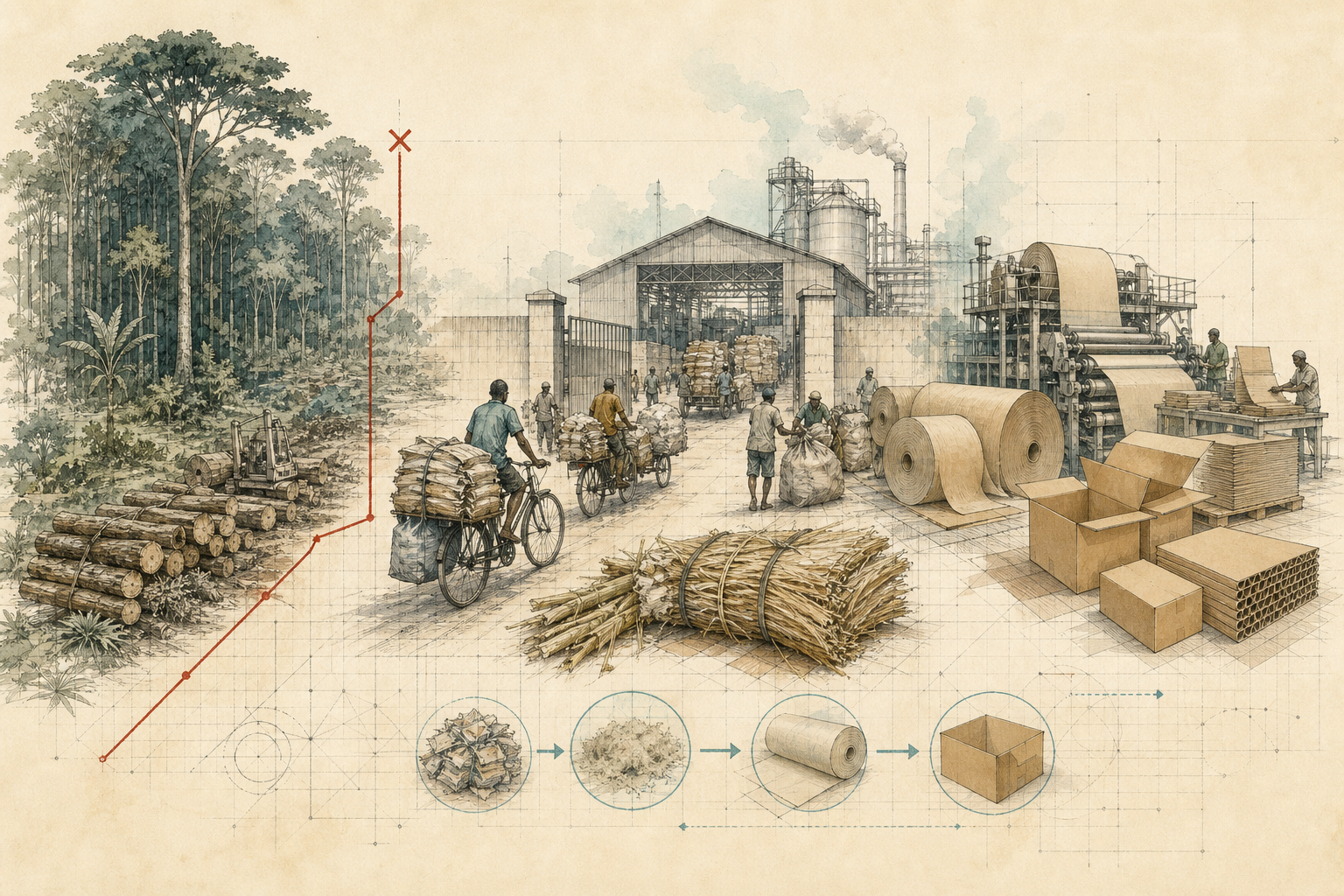
The plan Rai Group inherited assumed wood pulp as feedstock, the same input the original mill had relied on. A national ban on logging in public and community forests then closed off that route, forcing a fundamental change in business model rather than a simple restart (Business Daily).
Left-to-right editorial scene: forest and wood pulp with a red closure mark; bicycle collectors and bagasse at a mill gate; paper rolls and packaging boxes. Conceptual illustration, not a supply-chain audit.
01
Wood pulp
Original 20th-century feedstock
02
Logging ban
Traditional feedstock route closed
03
Wastepaper & bagasse
Collector-network recycled inputs
04
Paper & board
Test liner, kraft liner, fluting medium
05
Packaging
Downstream boxes and containerboard use
Overlay across the chain: collector income · water use · emissions · tonnage · jobs
Management shifted the plant toward recycled wastepaper and bagasse, sugarcane fibre, as feedstock, producing test liner, kraft liner and fluting medium for packaging rather than virgin-fibre paper. The company describes a nationwide network of more than 3,000 wastepaper collectors supporting this shift. That collector-network figure is a company disclosure, not an independently audited supply-chain census, and it says nothing on its own about whether collectors are paid fairly or reliably.
This is also where the environmental-legitimacy story gets told. Local and company reporting in late 2025 described a “green makeover”, less smoke, less noise, less odour, as a result of moving away from virgin wood-pulp chemistry (The Standard). That is a plausible and welcome direction. It is still an observed and asserted claim, not an independent emissions or effluent audit.
Two Numbers, One Mill
Here is where the capability-versus-announcement question sharpens into something concrete. Industry analysis reports that the plant produced about 27,600 tonnes of recycled-fibre paper in 2025, against a modernization plan valued at roughly Sh931 million intended to expand capacity to 74,100 tonnes by replacing pulp-mill and recovery-unit equipment (Mordor Intelligence). Separately, a September 2025 news report headlined a Sh3 billion investment figure for the same modernization programme (The Standard).
Split editorial drawing: left, empty podium, cameras and a framed mill photograph with confetti; right, paper machine, control gauges, balance scale and open ledger with blank stamps. Dashed bridge between them. Not a documentary photograph.

Industrial capability
Can audited tonnage, feedstock security and financing support the stated 74,100-tonne target?
Community continuity
Do workers, former employees and wastepaper collectors experience verified, fair continuity, not just a ceremony?
Environmental legitimacy
Do reduced-smoke and green-makeover claims hold up against an independent baseline, not just local observation?
Webuye
Neither figure is obviously false. They may describe different scopes, equipment replacement versus a fuller multi-year capital programme, or one may simply be a rounder, more quotable number for a headline. What matters for governance purposes is that the public record reviewed here does not reconcile them. Treating either number as settled fact, in either direction, would be premature.
| Claim or implication | Verdict | What the evidence shows |
|---|---|---|
| “Pan Paper Mills is dead; nothing has changed at Webuye since 2009.” | Outdated | The plant has operated under Rai Group since 2016 and is reported to have produced about 27,600 tonnes of recycled-fibre paper in 2025, well short of announced ambition, but not a closed factory. |
| “Rai Group’s Sh3 billion investment has fully modernized the plant.” | Not established | Industry reporting separately describes a Sh931 million plan to replace pulp-mill and recovery-unit equipment. The Sh3 billion figure is a September 2025 press headline that the reviewed public record does not reconcile with the smaller figure. |
| “Former Pan Paper workers have now been paid everything they are owed.” | Partly true, incomplete | The national government released about Sh229–230 million in arrears in November 2025, a real, reported payment overseen by national and county leadership. Independent confirmation that every eligible former worker received full payment was not found in the reviewed record. |
| “The mill still runs on wood pulp and smokes like it used to.” | Outdated | A national logging ban cut off the traditional wood-pulp feedstock. Reporting describes a shift to wastepaper and bagasse, with reduced smoke and odour, an observed and company-described change, not an independently audited emissions finding. |
| “The 1,500 jobs promised in 2016 have been created.” | Not independently verified | The 1,500-job figure was a 2016 expectation tied to a roughly Sh6 billion, five-to-ten-year investment pledge. No independently verified current headcount was found in the reviewed public record. |
| “Rai Paper will give a job to a household member of every former employee.” | Announced, not yet demonstrated | This is a company statement made at the November 2025 arrears ceremony. Independent tracking of how many households have actually been integrated was not found in the reviewed record. |
| “Webuye already tried and failed to revive the mill in 2010, so this is the same story repeating.” | Misleading | The 2010 state-backed attempt collapsed months after a public switch-on ceremony. The 2016 effort involves a different owner, a different feedstock model forced by the logging ban, and a longer operating history, not an identical experiment. |
“Pan Paper Mills is dead; nothing has changed at Webuye since 2009.”
- Verdict
- Outdated
- What the evidence shows
- The plant has operated under Rai Group since 2016 and is reported to have produced about 27,600 tonnes of recycled-fibre paper in 2025, well short of announced ambition, but not a closed factory.
“Rai Group’s Sh3 billion investment has fully modernized the plant.”
- Verdict
- Not established
- What the evidence shows
- Industry reporting separately describes a Sh931 million plan to replace pulp-mill and recovery-unit equipment. The Sh3 billion figure is a September 2025 press headline that the reviewed public record does not reconcile with the smaller figure.
“Former Pan Paper workers have now been paid everything they are owed.”
- Verdict
- Partly true, incomplete
- What the evidence shows
- The national government released about Sh229–230 million in arrears in November 2025, a real, reported payment overseen by national and county leadership. Independent confirmation that every eligible former worker received full payment was not found in the reviewed record.
“The mill still runs on wood pulp and smokes like it used to.”
- Verdict
- Outdated
- What the evidence shows
- A national logging ban cut off the traditional wood-pulp feedstock. Reporting describes a shift to wastepaper and bagasse, with reduced smoke and odour, an observed and company-described change, not an independently audited emissions finding.
“The 1,500 jobs promised in 2016 have been created.”
- Verdict
- Not independently verified
- What the evidence shows
- The 1,500-job figure was a 2016 expectation tied to a roughly Sh6 billion, five-to-ten-year investment pledge. No independently verified current headcount was found in the reviewed public record.
“Rai Paper will give a job to a household member of every former employee.”
- Verdict
- Announced, not yet demonstrated
- What the evidence shows
- This is a company statement made at the November 2025 arrears ceremony. Independent tracking of how many households have actually been integrated was not found in the reviewed record.
“Webuye already tried and failed to revive the mill in 2010, so this is the same story repeating.”
- Verdict
- Misleading
- What the evidence shows
- The 2010 state-backed attempt collapsed months after a public switch-on ceremony. The 2016 effort involves a different owner, a different feedstock model forced by the logging ban, and a longer operating history, not an identical experiment.
Allegation-evidence matrix
Separate claim from finding
| Issue | Allegation / question | Source type | Counter-position | Status | Decision relevance | Verification required | Possible remedy |
|---|---|---|---|---|---|---|---|
| 2009 collapse debt | Pan African Paper Mills owed roughly Sh3 billion at closure | Contemporaneous reporting | Not disputed in reviewed record | Verified, context | Baseline for judging revival claims | Archival receivership records | Not applicable, historical record |
| 2010 state revival | Government-backed switch-on ceremony followed by failure within months | Contemporaneous reporting | Not disputed in reviewed record | Verified, context | Shows announcement is not delivery | Archival reporting cross-check | Not applicable, historical record |
| 2016 acquisition price | Rai Group acquired the plant for about Sh900 million | Contemporaneous reporting | Not disputed in reviewed record | Verified | Establishes ownership baseline | Company/receiver transaction record | Not applicable |
| Sh6 billion investment pledge | 5-10 year investment pledge of about Sh6 billion made at acquisition | Company statement (2016) | Cumulative delivery against this pledge not independently tracked | Evidence gap | Tests whether pledged capital has been delivered | Independent cumulative capex reconciliation | Publish cumulative investment-to-date report |
| Modernization figure | Sh931 million modernization plan reported alongside a Sh3 billion headline figure | Industry report / press report (2025) | Neither source reconciles the other figure | Disputed | Central to whether capability claims are bankable | Public reconciliation of both figures | Publish a single audited capital plan |
| Production tonnage | ~27,600 tonnes produced in 2025 against a 74,100-tonne target | Industry report | Not independently audited in reviewed record | Evidence gap | Core capability-versus-announcement question | Independent tonnage audit | Publish audited quarterly tonnage |
| Wastepaper collector network | More than 3,000 collectors support the feedstock shift | Company statement | Pricing and payment terms not independently disclosed | Evidence gap | Feedstock security depends on fair collector terms | Independent collector-terms survey | Publish pricing bands and payment cadence |
| Worker arrears payout | Sh229-230 million released to former employees (Nov 2025) | Government/press reporting | Full disbursement completion not independently confirmed | Verified, partial | Legacy-claim closure question | Disbursement-completion report | Publish per-worker disbursement confirmation |
| Household-employment pledge | One household member per former employee offered a job opportunity | Company statement (Nov 2025) | Fulfilment not independently tracked | Evidence gap | Tests whether the pledge becomes a delivered outcome | Independent fulfilment tracking | Publish hiring outcomes against the pledge |
| Environmental-legitimacy narrative | "From smoke to sustainability" reporting on reduced emissions | Press / local observation | Not an independent emissions or effluent audit | Disputed | Tests whether environmental legitimacy is earned or asserted | Independent environmental baseline | Publish baseline and compliance status |
2009 collapse debt
- Allegation / question
- Pan African Paper Mills owed roughly Sh3 billion at closure
- Source type
- Contemporaneous reporting
- Counter-position
- Not disputed in reviewed record
- Status
- Verified, context
- Verification required
- Archival receivership records
2010 state revival
- Allegation / question
- Government-backed switch-on ceremony followed by failure within months
- Source type
- Contemporaneous reporting
- Counter-position
- Not disputed in reviewed record
- Status
- Verified, context
- Verification required
- Archival reporting cross-check
2016 acquisition price
- Allegation / question
- Rai Group acquired the plant for about Sh900 million
- Source type
- Contemporaneous reporting
- Counter-position
- Not disputed in reviewed record
- Status
- Verified
- Verification required
- Company/receiver transaction record
Sh6 billion investment pledge
- Allegation / question
- 5-10 year investment pledge of about Sh6 billion made at acquisition
- Source type
- Company statement (2016)
- Counter-position
- Cumulative delivery against this pledge not independently tracked
- Status
- Evidence gap
- Verification required
- Independent cumulative capex reconciliation
Modernization figure
- Allegation / question
- Sh931 million modernization plan reported alongside a Sh3 billion headline figure
- Source type
- Industry report / press report (2025)
- Counter-position
- Neither source reconciles the other figure
- Status
- Disputed
- Verification required
- Public reconciliation of both figures
Production tonnage
- Allegation / question
- ~27,600 tonnes produced in 2025 against a 74,100-tonne target
- Source type
- Industry report
- Counter-position
- Not independently audited in reviewed record
- Status
- Evidence gap
- Verification required
- Independent tonnage audit
Wastepaper collector network
- Allegation / question
- More than 3,000 collectors support the feedstock shift
- Source type
- Company statement
- Counter-position
- Pricing and payment terms not independently disclosed
- Status
- Evidence gap
- Verification required
- Independent collector-terms survey
Worker arrears payout
- Allegation / question
- Sh229-230 million released to former employees (Nov 2025)
- Source type
- Government/press reporting
- Counter-position
- Full disbursement completion not independently confirmed
- Status
- Verified, partial
- Verification required
- Disbursement-completion report
Household-employment pledge
- Allegation / question
- One household member per former employee offered a job opportunity
- Source type
- Company statement (Nov 2025)
- Counter-position
- Fulfilment not independently tracked
- Status
- Evidence gap
- Verification required
- Independent fulfilment tracking
Environmental-legitimacy narrative
- Allegation / question
- "From smoke to sustainability" reporting on reduced emissions
- Source type
- Press / local observation
- Counter-position
- Not an independent emissions or effluent audit
- Status
- Disputed
- Verification required
- Independent environmental baseline
Webuye Is Not a Backdrop
In November 2025, the national government released about Sh229-230 million to former Pan Paper Mills employees, arrears owed since the 2009 collapse, disbursed roughly sixteen years later. National Assembly Speaker Moses Wetang'ula and Bungoma Governor Kenneth Lusaka presided over the payment at a ceremony held on the mill's own grounds (The Standard; Capital FM; The Star). At the same event, the investor said the company would offer a job opportunity to one household member of every former employee.
That payout is real and reported. It is not, on its own, evidence that every eligible worker was reached, or that the household-employment pledge has been fulfilled. A ceremony that closes a sixteen-year wait deserves to be taken seriously, and deserves a published disbursement record showing it actually reached everyone it was meant to reach.
Public Commons Lens
Who carries the consequence?
Does the actor with the most power also carry the most consequence? This explorer does not rank communities or individuals.
- Benefit sought
- Wages, skills, occupational continuity
- Risk carried
- Redundancy if modernization stalls again
- Decision power
- Low formal power over investment decisions
- Information access
- Limited access to financing and reconciliation detail
- Transition exposure
- High, immediate livelihood shock
- Accountability route
- Labour law, plant management, continuity protocol
Continue into Public Participation: Webuye Transformation Compact, Webuye challenges, listening prompts, and accountability commitments.
Capability Is Not an Announcement
Kenya has a documented pattern of celebrating industrial revival at the announcement stage. The 2010 switch-on ceremony is the clearest example inside this very case: a public moment of restoration that did not survive contact with operating reality. The lesson is not that revival is impossible. It is that the distance between an announcement and a verified operating system is exactly the distance this case still has to travel.
Announcement-as-capability bias
Why it may matter: A modernization figure is not the same as delivered, audited tonnage.
Supporting concern: Sh931m and Sh3bn modernization figures both circulate unreconciled.
Possible rebuttal: Published, audited tonnage against the 74,100-tonne target would rebut this.
Legacy-claim closure bias
Why it may matter: A payout ceremony can be mistaken for a completed process.
Supporting concern: Sh230m arrears payout (Nov 2025) followed roughly sixteen years of waiting.
Possible rebuttal: A published disbursement-completion report for every eligible worker would rebut this.
Feedstock-security blind spot
Why it may matter: Recycled-fibre inputs depend on thousands of small, dispersed collectors.
Supporting concern: Company reporting cites 3,000+ collectors without published pricing terms.
Possible rebuttal: Published collector pricing and payment cadence would rebut this concern.
Environmental-narrative bias
Why it may matter: Local observation of less smoke is not an emissions or effluent audit.
Supporting concern: "From smoke to sustainability" reporting rests on local observation.
Possible rebuttal: An independent environmental baseline and compliance report would rebut this.
Pattern language here is diagnostic, not an accusation of misconduct. Run the Webuye panel fixture in Decision Review, stress-test compound risk in Risk Simulator, and load the Team Participation and Decision Journal records.
Webuye Capability Review Panel worksheet
Record dissent before you lock a recommendation
- What evidence supports treating this as verified capability?
- What remains disputed or unreconciled?
- Which institution has authority to require independent verification?
- Is the current milestone claim proportionate to the evidence?
- What is reversible if the claim does not hold up?
- What becomes irreversible, household expectations, public trust?
- Who receives the upside if the story is treated as verified?
- Who bears the downside if it later is not?
- What conflicts could distort how this milestone is reported?
- What implementation capacity has actually been demonstrated, not announced?
- What is the strongest argument against your position?
- What new evidence would make you reopen the decision?
Enter the operator mirror in the Corporate Governance Console: Rai Paper Operator Board Review.
Rai Paper Operator Board worksheet
Record dissent before you lock a recommendation
- What evidence supports treating this as verified capability?
- What remains disputed or unreconciled?
- Which institution has authority to require independent verification?
- Is the current milestone claim proportionate to the evidence?
- What is reversible if the claim does not hold up?
- What becomes irreversible, household expectations, public trust?
- Who receives the upside if the story is treated as verified?
- Who bears the downside if it later is not?
- What conflicts could distort how this milestone is reported?
- What implementation capacity has actually been demonstrated, not announced?
- What is the strongest argument against your position?
- What new evidence would make you reopen the decision?
A. Certify current claims as verified capability
- Main strength
- Rewards visible progress and encourages continued investment
- Main hazard
- Risks treating an announcement as proof; sets a low bar for future claims
- Evidence required
- None additional required, but the claim itself becomes the standard
B. Commission independent verification first
- Main strength
- Separates audited fact from company and press assertion before public celebration
- Main hazard
- Slower; may be read as distrust of a genuinely improving operation
- Evidence required
- Audited tonnage, reconciled modernization financing, environmental baseline
C. Webuye Capability Compact with milestone gates
- Main strength
- Combines continued investment with enforceable, dated verification checkpoints
- Main hazard
- Requires sustained multi-party coordination that may not materialise
- Evidence required
- Published milestone schedule, named verification owners, public reporting cadence
D. Wait-and-see disclosure without new obligations
- Main strength
- Low cost; avoids overcommitting institutional attention
- Main hazard
- Leaves feedstock, worker and environmental questions unresolved indefinitely
- Evidence required
- Continued reliance on company and press self-reporting alone
Option B or C offer the most defensible path: neither dismisses genuine progress since 2016 nor accepts an unreconciled headline figure as proof of capability. Option A rewards the best press release rather than the best evidence. Option D is comfortable but leaves Webuye residents dependent on whichever version of events reaches them first.
Scenario aid, not prediction
Qualitative capability-risk banding
Top drivers: Evidence certainty of production claims (inverted); Modernization financing certainty (inverted); Asset condition risk
Most vulnerable stakeholder: Webuye households dependent on mill continuity and community services
Most irreversible assumption: That wastepaper and bagasse supply can be scaled on demand once modernization equipment arrives
Evidence to obtain next: Reconciled modernization financing figures and a published feedstock-security plan
Scenario aid, not prediction. Outputs support deliberation rather than automate a decision.
Map power, information and exposure in the Influence Map, without treating influence as wrongdoing.
Operational continuity
What happens if the mill pauses for a week?
Mark each item. A modernization announcement can travel faster than the operating system it describes can actually be rebuilt or verified.
Who pays wastepaper and bagasse collectors this week?
Who maintains plant and boiler safety?
Who pays current employees?
Who tracks the household-employment pledge?
Who holds spare-parts inventory for corroded equipment?
Who services domestic packaging-buyer contracts?
Who monitors water and effluent quality?
Who reconciles the Sh931m and Sh3bn modernization figures?
Who reports tonnage against the 74,100-tonne target?
Who funds the next modernization phase if the current tranche runs out?
Who verifies disbursement completion for the Sh230m arrears payout?
What happens if independent tonnage figures are lower than reported?
Identified 0 · Unclear 0 · No plan 0 · Unset 12
A modernization figure can be announced faster than an operating capability can be verified.
Webuye Transformation Compact worksheet
Build obligations, not a compliance score
This worksheet is not the Civic Compact. Open the Living Constituency Commons to endorse safeguarded priorities.
Compact completeness: 0 of 20 obligations selected. Never treat this as a compliance score.
Open Webuye Transformation CompactThis worksheet does not write into the Civic Compact. Shape safeguarded priorities in the Living Constituency Commons: Open the Webuye Transformation Compact.
The question worth asking is not whether Webuye should hope the mill succeeds. Of course it should. The question is whether a modernization claim, a payout ceremony and a reduced-smoke story add up to verified industrial capability, or whether they are still, mostly, an announcement that Webuye has heard something like before.
A switch-on ceremony is a photograph. Capability is a verified operating system.
Related ThePortal work on The Magadi Test, corporate governance simulation, and real business in policy sits beside this case. Industrial policy is also a theme of Corporate Participation and the Living Constituency Commons.
Sources and status
Primary timeline anchors used in this educational case: 2009 collapse, 2010 state revival attempt, and 2016 Rai Group acquisition for about Sh900 million; logging-ban feedstock shift and incremental capacity investment; 2025 production (~27,600 tonnes) and Sh931 million modernization target (74,100 tonnes); 18 September 2025 Sh3 billion modernization investment report; environmental-narrative reporting on the feedstock transition; November 2025 Sh229-230 million former-worker arrears payout (Capital FM; The Star). Additional community and historical texture drawn from academic commentary on Webuye's industrial history. Live case: figures may evolve after 4 September 2026.
Enter the Webuye governance simulation → Decision Review. Explore who carries the consequence → Public Commons Lens.
From reading to civic action
Pan Paper Mills is an educational case on industrial capability, feedstock transition, worker continuity and environmental legitimacy. Run the Corporate Governance simulation, or shape Webuye priorities in the Living Constituency Commons Civic Compact. Outputs support deliberation; they do not certify production, compliance or public value.
Improve this article
Ask a question, suggest a correction, submit a source, share experience, or propose a topic. Contact details stay private. Publicly consequential allegations need editorial review.