Of Platform User Journey and Customer Lifetime Value: UmojaLink at the Inflection Point
Can a platform grow demand without thinning the relationships that make demand possible?
On this page
- One customer, one promise
- The funnel ends where the platform begins
- Choose, Use and renewable connection
- The six Demand Plays
- African philosophies change the unit of value
- The African journey as a braid
- CLV as a financial trace, not a price on a person
- Why platform lifetime values are coupled
- The UmojaLink case file
- The three strategic options
- Decision Review
- Pattern and Risk Review
- Influence Map: power, benefit, burden and exposure
- Team deliberation and protected dissent
- The timed injects and restorative recovery
- Decision Journal, conditions and reopening triggers
- A resolution template, not a verdict
- Facilitator reveal and debrief questions
- Sources and simulation status
- Calls to action
Conceptual editorial image on ivory paper. Two interlocking loops: left Earn Choice, right Energise Use, centre Renewable Connection. A circular board table sits in a savannah-light courtyard. Not a documentary scene.
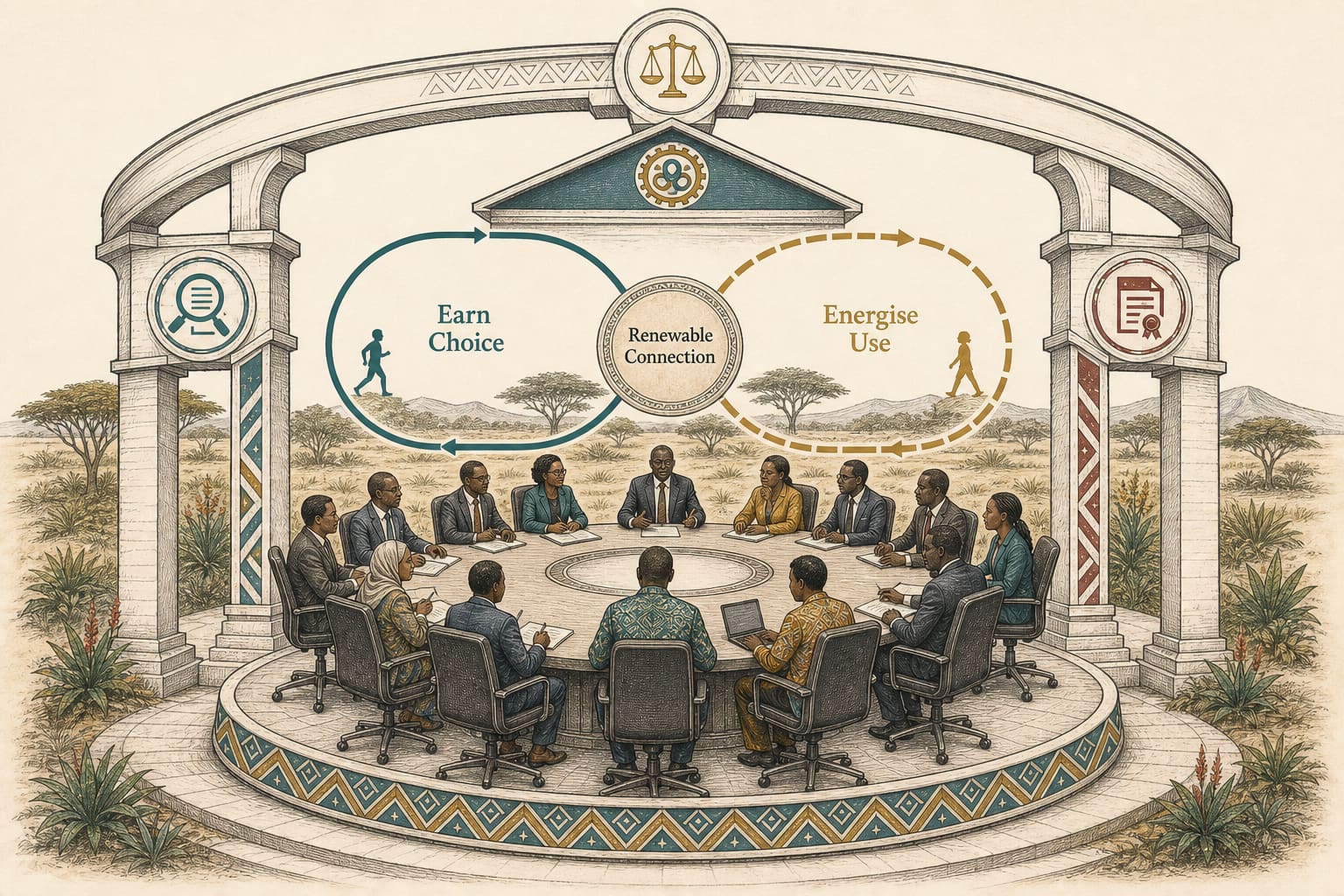
Educational simulation. UmojaLink Procurement Network, its board, partners, figures and injects are fictional composite data for learning. Outputs support deliberation; they do not automate a decision, certify competence or forecast a live market.
One customer, one promise
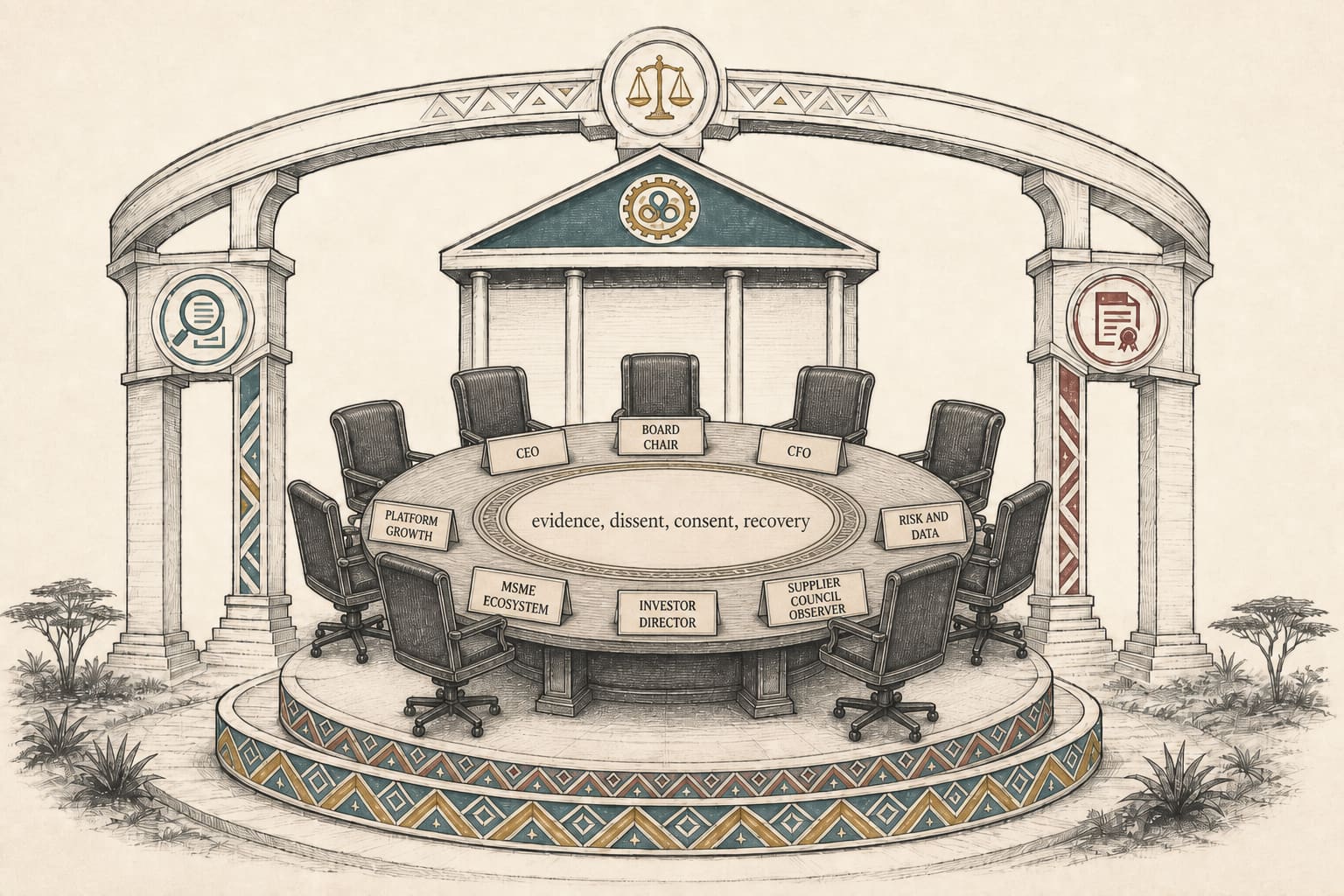
The board pack opens with a growth chart that looks healthy until someone asks a quieter question: when does a signed contract become a kept promise? Around the table sit eight roles, Chair, CEO, CFO, Platform and Growth, two independent directors, an investor nominee and a Supplier Council observer, with a shared three-year demand-system budget of KES 12 million. Outside the room, MSME suppliers wait for purchase orders that settle on time; associations wait for referral fees that arrive late; finance partners wait for clean data; households wait for wages that depend on those settlements.
A user does not experience organisational channels. The user experiences one promise. That is the opening discipline of this case. Marketing may own awareness, sales may own the contract, operations may own fulfilment and finance may own the invoice, but the participant experiences whether the platform did what it said it would do.
Circular table on a patterned dais. Eight named empty chairs. Centre reads evidence, dissent, consent, recovery. Illustrative only.
The funnel ends where the platform begins
The conventional funnel ends at the sale. For a platform, the real test begins there. Registration, a signed contract or an app download is not customer success. Those events may be necessary, but they are not yet evidence that value crossed the relationship in a form the participant can trust.
Journey research has long shown that customers evaluate a sequence of episodes against an overall experience, not against internal department maps (Lemon and Verhoef, Journal of Marketing). Multi-sided platforms intensify that lesson: one side’s convenience can be another side’s working-capital crisis (Rochet and Tirole on two-sided markets). The first completed, evidenced and trusted outcome is the hinge from Choose to Use. First success proves that the platform can work. First failure reveals whether it can be trusted.
Choose, Use and renewable connection
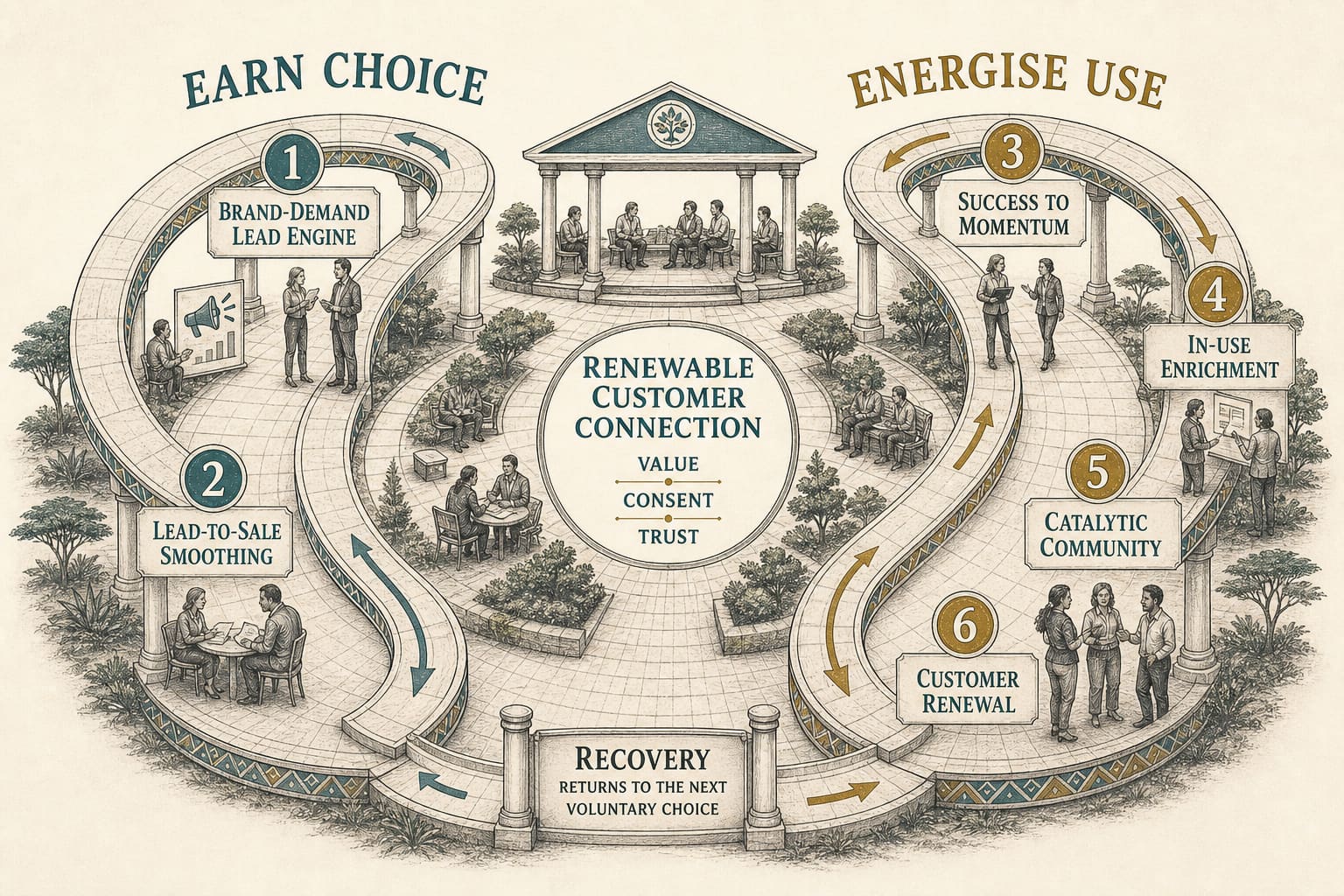
Platform Demand Plays organise growth around earning choice and energising use, an approach developed in platform strategy work on demand systems and customer connection (Winning Through Platforms; Demand Plays chapter). This article interprets “infinite connection” ethically. It means a relationship repeatedly renewed through value, consent and trust, not surveillance, lock-in, dark patterns or permanent capture.
Two walking loops around a courtyard. Left: Earn Choice, plays 1 and 2. Right: Energise Use, plays 3 to 6. Centre: Renewable Customer Connection, value, consent, trust. Bottom path: recovery returns to the next voluntary choice. Colour is secondary; labels carry the meaning.
Choose · Play 1
Brand-Demand Lead Engine
Earn attention without buying consent.
Choose · Play 2
Lead-to-Sale Smoothing
Remove wasteful friction; keep assurance friction.
Use · Play 3
Success to Momentum
First trusted outcome becomes the hinge to Use.
Use · Play 4
In-Use Enrichment
Deepen value while the promise is being kept.
Use · Play 5
Catalytic Community
Reciprocal contribution, not unpaid acquisition labour.
Use · Play 6
Customer Renewal and Expansion
Voluntary return, portable exit, earned expansion.
The customer is not an asset to own. The relationship is an asset to steward. A platform may value the relationship; it must never price the person. A platform worth building keeps becoming worthy of the next choice.
The six Demand Plays
- Brand-Demand Lead Engine, earn attention without purchasing consent.
- Lead-to-Sale Smoothing, remove wasteful friction while keeping assurance friction: identity verification, informed consent, price clarity and cooling-off.
- Success to Momentum, convert first trusted outcomes into durable use.
- In-Use Enrichment, deepen value while the promise is being kept.
- Catalytic Community, recognise reciprocal contribution; community is not a cheaper acquisition channel.
- Customer Renewal and Expansion, voluntary return, portable exit, earned expansion.
Not every point of friction is waste. Some friction is the form assurance takes when the relationship is honest.
African philosophies change the unit of value
African philosophy is plural. This case does not claim that “Africans believe” one thing, nor treat the continent as culturally uniform, nor reduce Ubuntu to a marketing slogan. Philosophical vocabulary earns no credit unless it changes operating choices. Selected traditions from different parts of Africa are placed in conversation with the board tests below, drawing on work in African ethics, Ubuntu and business responsibility (Ramose on Ubuntu; Stanford Encyclopedia entry on African ethics; Gyekye on moderate communitarianism; Ubuntu and business ethics; Harambee scholarship; Sankofa as critical retrieval).
| Lens | Operational meaning | Board test |
|---|---|---|
| Ubuntu, Hunhu, Botho and Swahili utu | Dignity and flourishing are relational, without extinguishing individual agency. | Does platform convenience or margin rely on supplier precarity, coerced consent or engineered dependence? |
| Gyekye’s moderate communitarianism | Community obligations matter, but the individual retains moral standing and rights. | Has collective endorsement improperly replaced a participant’s own consent or right of appeal? |
| Harambee | Collective action creates reciprocal obligations. | Are associations and community agents recognised, compensated and heard for the trust and work they contribute? |
| Sankofa | Retrieve experience critically so that memory improves the future. | Does transaction history help participants while remaining correctable, proportionate and governed? |
| Relational stewardship | The renewable relationship, not the captive customer, is the asset. | Is renewal voluntary, portable and continually earned? |
| Restorative recovery | Failure creates obligations of acknowledgement, repair and restored agency. | Who bears the cost when the platform’s promise fails, and how will their position be restored? |
Ubuntu, Hunhu, Botho and Swahili utu
- Operational meaning
- Dignity and flourishing are relational, without extinguishing individual agency.
- Board test
- Does platform convenience or margin rely on supplier precarity, coerced consent or engineered dependence?
Gyekye’s moderate communitarianism
- Operational meaning
- Community obligations matter, but the individual retains moral standing and rights.
- Board test
- Has collective endorsement improperly replaced a participant’s own consent or right of appeal?
Harambee
- Operational meaning
- Collective action creates reciprocal obligations.
- Board test
- Are associations and community agents recognised, compensated and heard for the trust and work they contribute?
Sankofa
- Operational meaning
- Retrieve experience critically so that memory improves the future.
- Board test
- Does transaction history help participants while remaining correctable, proportionate and governed?
Relational stewardship
- Operational meaning
- The renewable relationship, not the captive customer, is the asset.
- Board test
- Is renewal voluntary, portable and continually earned?
Restorative recovery
- Operational meaning
- Failure creates obligations of acknowledgement, repair and restored agency.
- Board test
- Who bears the cost when the platform’s promise fails, and how will their position be restored?
Safeguards travel with the lenses. Ubuntu cannot override individual consent. Harambee cannot mean that the community pulls while the platform alone owns. Sankofa cannot justify indefinite or uncorrectable data retention. Community structures can also exclude, silence or reproduce unequal power; treat that as a governance risk.
The African journey as a braid
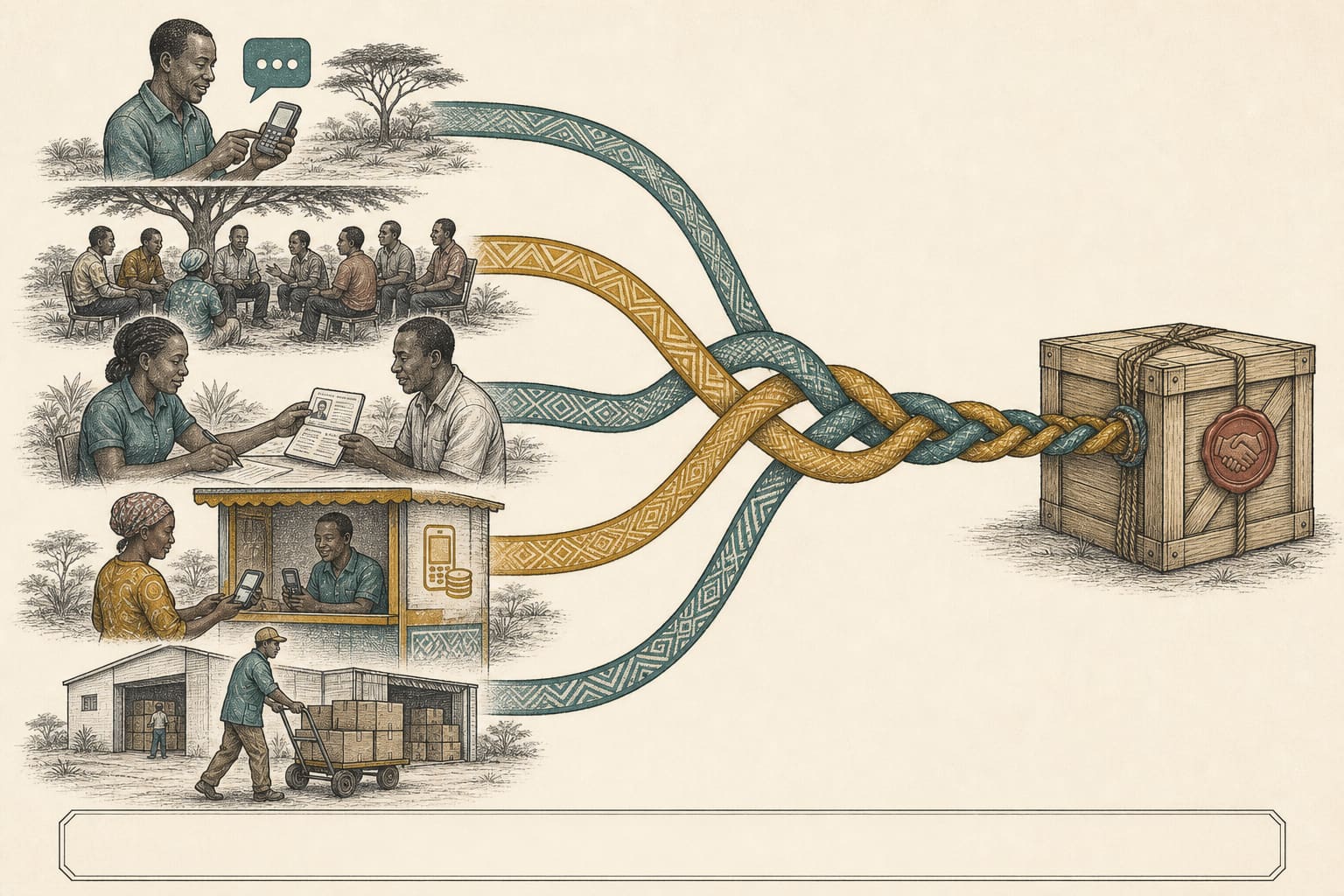
An African platform journey is often a braid rather than a clean digital funnel. Discovery may happen through WhatsApp or an association; verification through an agent; payment through mobile money or a bank; fulfilment physically; support through a call or community group. Mobile money’s reach across sub-Saharan Africa is part of that braid (Global Findex mobile-money brief), and Kenyan experimental work continues to test how money tools reshape household and firm behaviour (Management Science mobile-money evidence). The platform must govern the whole promise, including assisted and low-bandwidth journeys.
Five strands braided into one rope ending in a sealed delivery crate: phone chat, association meeting, agent with identity booklet, mobile-money kiosk, warehouse handcart. Conceptual, not a documentary scene.
CLV as a financial trace, not a price on a person
Customer lifetime value is a financial trace of a relationship under explicit assumptions; it is not a price placed on a person. Classic CLV research treats the metric as a disciplined forecast of contribution under retention and discounting assumptions (Gupta and colleagues on CLV). In this simulation, for platform side s:
CLVs,3 = −As + Σt=1..3 [ Ms,1(1+gs)t−1 rst−1 / (1+d)t ], with d = 15%, a three-year horizon and no terminal value. As is fully loaded acquisition and activation cost per active participant, including failed leads. Ms,1 is first-year contribution margin after payment, verification, support, fulfilment, incentives, refunds and recovery costs. Participants become active only after a completed, evidenced first transaction, not after registration or contract signature.
Never count as platform revenue: gross merchandise value, financing principal, VAT or taxes collected for government, pass-through settlement funds, or the same referral saving counted on more than one side.
Why platform lifetime values are coupled
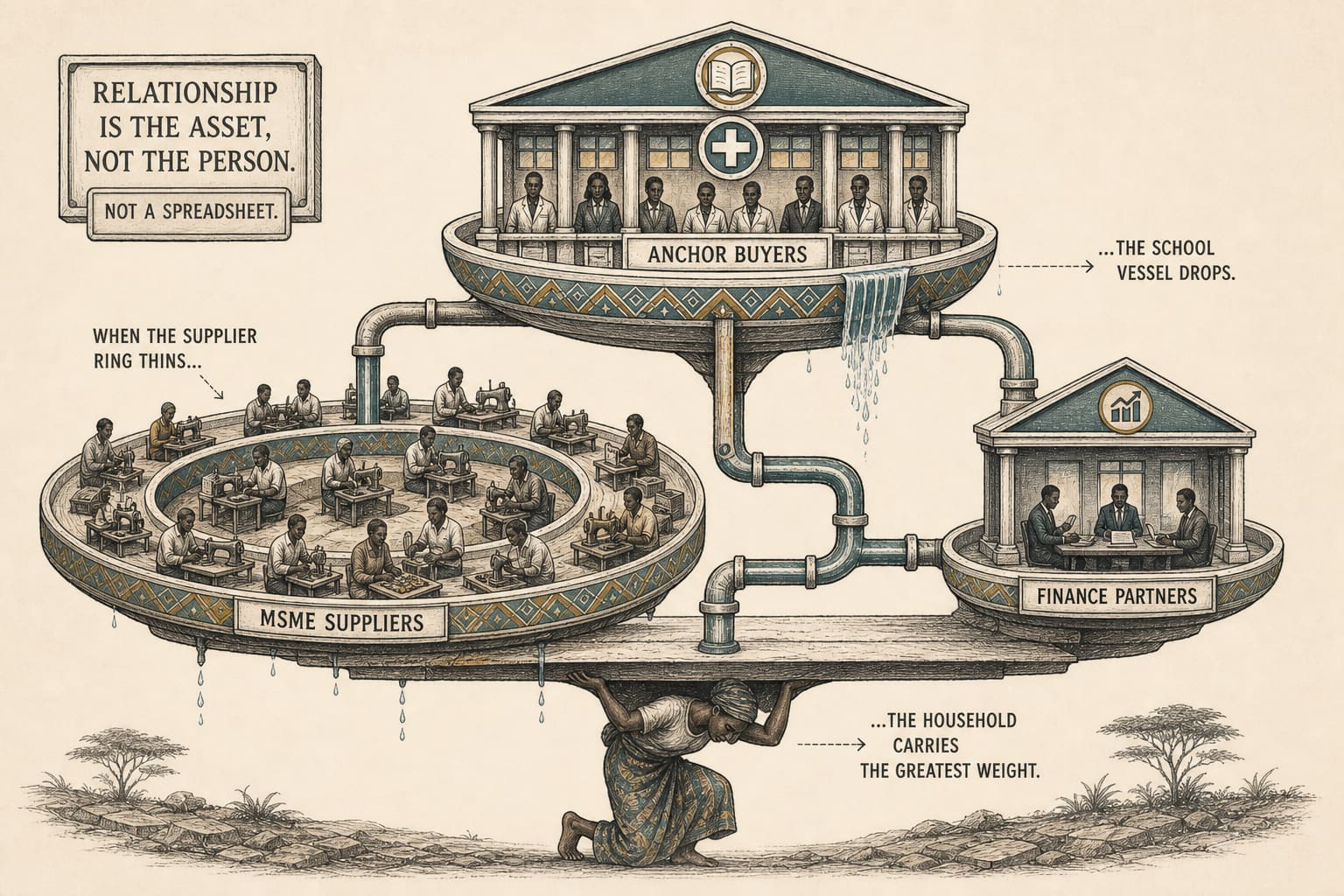
Adding side-level CLV can overstate platform value. Buyer value can rise while suppliers, agents or communities carry the hidden burden. This case requires at least eight active suppliers per active anchor for dependable fulfilment; above fourteen, supplier order volume becomes too diluted. Finance coverage requires one active partner per forty active anchors. Liquidity factors haircut contribution when density or coverage fails. Coupled ecosystem value deducts the shared KES 12 million investment once, applies side acquisition costs once, and then discounts haircut cash flows across three years.
Three connected vessels: school-hospital anchors, a ring of workshops, a finance office. Thinning the supplier ring lowers the other vessels. Household figure at the base. Conceptual illustration, not a spreadsheet.
The UmojaLink case file
UmojaLink Procurement Network is a fictional East African multi-sided platform connecting anchor buyers (schools, hospitals, companies and NGOs), MSME suppliers, finance partners providing invoice or purchase-order finance, and supplier associations that refer, verify, educate and support MSMEs. Revenue may include buyer workflow fees, supplier transaction or verification fees, and finance-partner integration fees.
The board may approve Option A, B or C; reject all three; approve a reasoned hybrid; or stage an option behind measurable operating and governance gates. Side-specific acquisition and activation costs are additional and must be counted once.
The three strategic options
A: Choose First maximises awareness, contracts and geographic reach, but risks sales outpacing fulfilment, supplier survival and repeat use. Option A exposes the difference between signed demand and realised value: 200 contracts produce only 120 evidenced first-value events.
B: Deepen Use acquires fewer buyers while improving activation, usage and retention, but may expand market coverage more slowly.
C: Balanced Loop balances acquisition, successful use, community contribution and voluntary renewal, but carries the greatest orchestration burden.
| Demand play | A: Choose First | B: Deepen Use | C: Balanced Loop |
|---|---|---|---|
| Brand-Demand Lead Engine | 35% | 10% | 15% |
| Lead-to-Sale Smoothing | 35% | 10% | 15% |
| Success to Momentum | 10% | 20% | 17% |
| In-Use Enrichment | 5% | 25% | 15% |
| Catalytic Community | 5% | 15% | 13% |
| Customer Renewal and Expansion | 10% | 20% | 25% |
| Total | 100% | 100% | 100% |
Brand-Demand Lead Engine
- A: Choose First
- 35%
- B: Deepen Use
- 10%
- C: Balanced Loop
- 15%
Lead-to-Sale Smoothing
- A: Choose First
- 35%
- B: Deepen Use
- 10%
- C: Balanced Loop
- 15%
Success to Momentum
- A: Choose First
- 10%
- B: Deepen Use
- 20%
- C: Balanced Loop
- 17%
In-Use Enrichment
- A: Choose First
- 5%
- B: Deepen Use
- 25%
- C: Balanced Loop
- 15%
Catalytic Community
- A: Choose First
- 5%
- B: Deepen Use
- 15%
- C: Balanced Loop
- 13%
Customer Renewal and Expansion
- A: Choose First
- 10%
- B: Deepen Use
- 20%
- C: Balanced Loop
- 25%
Total
- A: Choose First
- 100%
- B: Deepen Use
- 100%
- C: Balanced Loop
- 100%
| Metric | A | B | C |
|---|---|---|---|
| Qualified anchor leads | 1,000 | 500 | 650 |
| Lead-to-contract conversion | 20.0% | 18.0% | 20.0% |
| Contracts signed | 200 | 90 | 130 |
| Contract-to-first-value activation | 60.0% | 83.3% | 76.9% |
| Active anchor buyers | 120 | 75 | 100 |
| Active MSME suppliers | 1,080 | 1,050 | 1,300 |
| Suppliers per active anchor | 9 | 14 | 13 |
| Active finance partners | 3 | 3 | 4 |
| Median time to first trusted value | 42 days | 25 days | 28 days |
Qualified anchor leads
- A
- 1,000
- B
- 500
- C
- 650
Lead-to-contract conversion
- A
- 20.0%
- B
- 18.0%
- C
- 20.0%
Contracts signed
- A
- 200
- B
- 90
- C
- 130
Contract-to-first-value activation
- A
- 60.0%
- B
- 83.3%
- C
- 76.9%
Active anchor buyers
- A
- 120
- B
- 75
- C
- 100
Active MSME suppliers
- A
- 1,080
- B
- 1,050
- C
- 1,300
Suppliers per active anchor
- A
- 9
- B
- 14
- C
- 13
Active finance partners
- A
- 3
- B
- 3
- C
- 4
Median time to first trusted value
- A
- 42 days
- B
- 25 days
- C
- 28 days
Decision Review
Open the Corporate Console Decision Review with the educational fixture preloaded: Run Decision Review for platform-clv. The scan is deterministic and explainable. It does not imply that an AI system makes or validates the board’s decision. Record capacity constraints, required dissent, conditions and reopening triggers before any vote.
Pattern and Risk Review
The Risk Simulator fixture surfaces demand outpacing fulfilment, supplier liquidity deterioration, consent failure, data overreach, cross-side conflicts, elite capture in community structures, unpaid community labour, lock-in disguised as retention, settlement-partner failure, and reputation propagation through associations. Open the Risk Simulator. The indication is a deliberation aid, not a scientific risk score.
Influence Map: power, benefit, burden and exposure
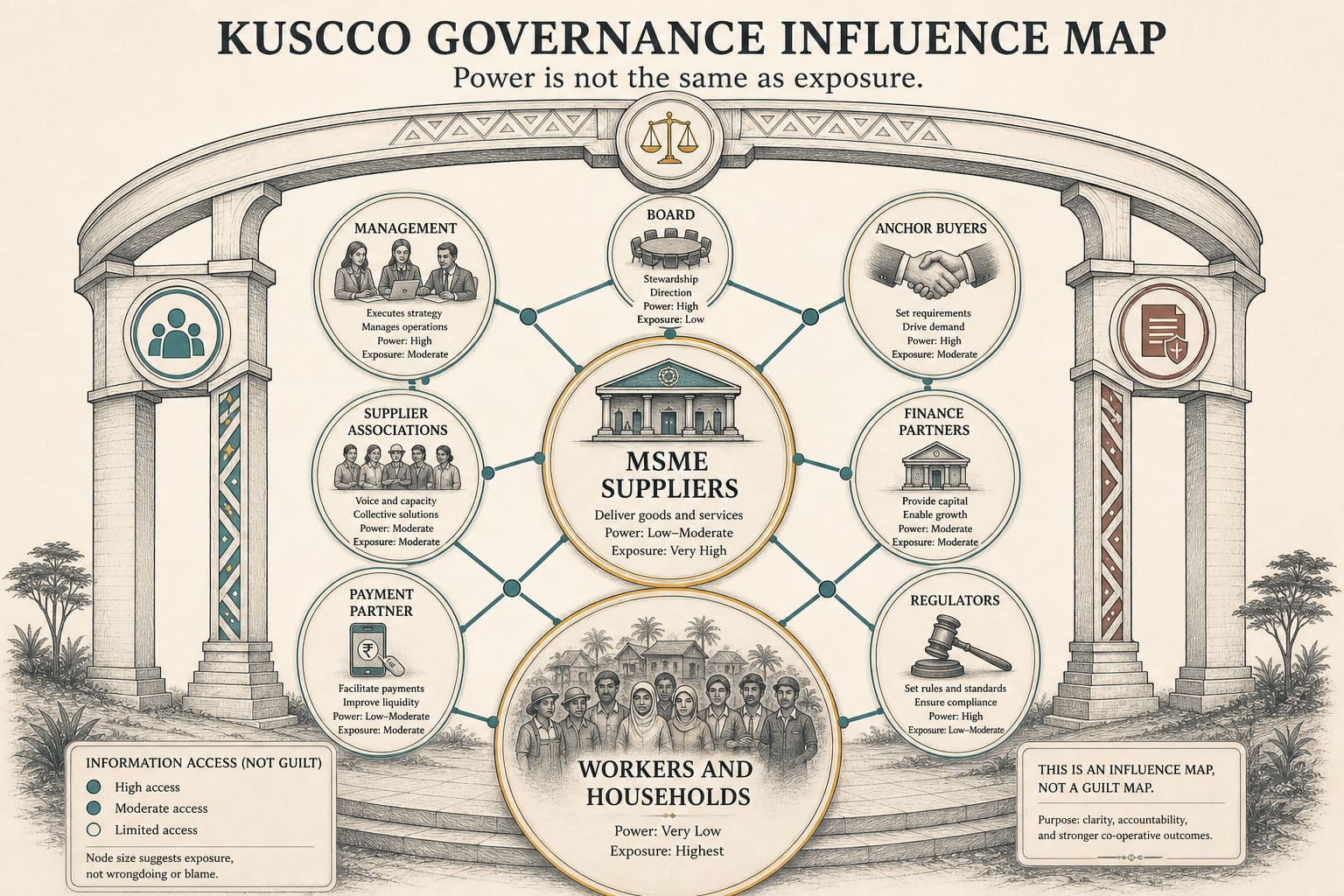
Power is not the same as exposure. Workers and households affected by delayed supplier payments may hold the least formal authority and the greatest operational harm. Open the Influence Map for board, management, anchor buyers, MSME suppliers, associations, finance partners, the payment partner, and regulators.
Node network on ivory ground. Households and suppliers drawn largest. Board drawn smaller. Subtitle: power is not the same as exposure. Not a guilt map.
Team deliberation and protected dissent
Use an 90-minute format (or a compressed 45-minute alternative). For six participants, combine CEO with Growth and combine the two independent-director roles. Dissent improves deliberative quality; it must never rank or penalise participants. Open Team Participation.
| Role | Primary objective | Prioritises | Blind spot | Required dissent | Conflict to disclose |
|---|---|---|---|---|---|
| Board Chair | Protect deliberative quality, expose conflicts, record dissent and produce an executable resolution. | Process integrity, time discipline, conflict disclosure, minority notes. | May privilege procedural completeness over supplier cash reality. | Which assumption, if wrong, would reverse today’s preferred option? | Any personal or associational interest in a preferred growth path. |
| CEO / Executive Director | Defend growth, runway and strategic feasibility. | Signed demand, market coverage, investor narrative, operating capacity. | May treat contracts as customers and community labour as free CAC. | Where does Choose become Use, and are we funding that hinge? | Equity upside tied to growth milestones. |
| CFO | Calculate CLV, prevent double-counting and stress-test assumptions. | Margin definitions, acquisition loading, retention quality, liquidity factors. | May treat model elegance as decision sufficiency. | Which revenue items are platform fees, and which are pass-throughs we must never count twice? | Incentive plans linked to reported contribution growth. |
| Chief Platform and Growth Officer | Diagnose the Choose and Use journeys and defend the Demand Play allocation. | Journey leakage, activation definition, play mix, enrichment roadmap. | May optimise conversion while underfunding recovery and portability. | If first failure reveals whether we can be trusted, what play funds restorative recovery? | Channel partnerships or growth bonuses. |
| Independent Director: Risk and Data Governance | Examine consent, profiling, explainability, partner accountability and recovery. | Granular consent, appeal, retention limits, partner SLAs. | May underweight commercial runway pressure. | Can any participant understand, correct and port the history that shapes their options? | Advisory ties to data or finance vendors. |
| Independent Director: MSME Ecosystem | Examine benefit, burden, voice, community contribution and exit. | Supplier density, association compensation, elite capture, dignified exit. | May underweight finance-partner constraints. | Who carries working-capital risk when anchors pay late? | Membership in a supplier association under review. |
| Investor-Nominated Director | Press for scale and funding milestones while disclosing finance-partner conflicts. | Absolute NPV, expansion speed, capital efficiency. | May discount relational responsibility outside the term sheet. | If finance revenue rises because buyers pay late, is that growth or a conflict? | Must disclose any finance-partner ownership or placement fees. |
| Supplier Council Representative (non-voting observer) | Present supplier and association evidence with speaking rights. | Settlement reliability, referral pay, first-line support load, household spillover. | May speak for organised associations more than silent micro-suppliers. | Would this resolution remain defensible if read aloud to affected suppliers? | Association leadership or pending referral invoices. |
Board Chair
- Primary objective
- Protect deliberative quality, expose conflicts, record dissent and produce an executable resolution.
- Prioritises
- Process integrity, time discipline, conflict disclosure, minority notes.
- Blind spot
- May privilege procedural completeness over supplier cash reality.
- Required dissent
- Which assumption, if wrong, would reverse today’s preferred option?
- Conflict to disclose
- Any personal or associational interest in a preferred growth path.
CEO / Executive Director
- Primary objective
- Defend growth, runway and strategic feasibility.
- Prioritises
- Signed demand, market coverage, investor narrative, operating capacity.
- Blind spot
- May treat contracts as customers and community labour as free CAC.
- Required dissent
- Where does Choose become Use, and are we funding that hinge?
- Conflict to disclose
- Equity upside tied to growth milestones.
CFO
- Primary objective
- Calculate CLV, prevent double-counting and stress-test assumptions.
- Prioritises
- Margin definitions, acquisition loading, retention quality, liquidity factors.
- Blind spot
- May treat model elegance as decision sufficiency.
- Required dissent
- Which revenue items are platform fees, and which are pass-throughs we must never count twice?
- Conflict to disclose
- Incentive plans linked to reported contribution growth.
Chief Platform and Growth Officer
- Primary objective
- Diagnose the Choose and Use journeys and defend the Demand Play allocation.
- Prioritises
- Journey leakage, activation definition, play mix, enrichment roadmap.
- Blind spot
- May optimise conversion while underfunding recovery and portability.
- Required dissent
- If first failure reveals whether we can be trusted, what play funds restorative recovery?
- Conflict to disclose
- Channel partnerships or growth bonuses.
Independent Director: Risk and Data Governance
- Primary objective
- Examine consent, profiling, explainability, partner accountability and recovery.
- Prioritises
- Granular consent, appeal, retention limits, partner SLAs.
- Blind spot
- May underweight commercial runway pressure.
- Required dissent
- Can any participant understand, correct and port the history that shapes their options?
- Conflict to disclose
- Advisory ties to data or finance vendors.
Independent Director: MSME Ecosystem
- Primary objective
- Examine benefit, burden, voice, community contribution and exit.
- Prioritises
- Supplier density, association compensation, elite capture, dignified exit.
- Blind spot
- May underweight finance-partner constraints.
- Required dissent
- Who carries working-capital risk when anchors pay late?
- Conflict to disclose
- Membership in a supplier association under review.
Investor-Nominated Director
- Primary objective
- Press for scale and funding milestones while disclosing finance-partner conflicts.
- Prioritises
- Absolute NPV, expansion speed, capital efficiency.
- Blind spot
- May discount relational responsibility outside the term sheet.
- Required dissent
- If finance revenue rises because buyers pay late, is that growth or a conflict?
- Conflict to disclose
- Must disclose any finance-partner ownership or placement fees.
Supplier Council Representative (non-voting observer)
- Primary objective
- Present supplier and association evidence with speaking rights.
- Prioritises
- Settlement reliability, referral pay, first-line support load, household spillover.
- Blind spot
- May speak for organised associations more than silent micro-suppliers.
- Required dissent
- Would this resolution remain defensible if read aloud to affected suppliers?
- Conflict to disclose
- Association leadership or pending referral invoices.
Round structure
- Earn choice, define where Choose becomes Use; decide whether registration, contract, first transaction or completed outcome counts as activation; identify the largest journey leakage; select two priority Demand Plays; record a private pre-vote and confidence.
- Value across the platform, calculate side-specific CLV, supplier density and coupled ecosystem value; name who pays, uses, supplies and carries working-capital or failure risk; list double-counting traps.
- Rights, reciprocity and enrichment, release Injects 1 and 2; decide on finance enrichment, consent and re-consent, community compensation and voice, correction, portability, appeal and dignified exit.
- Failure and recovery, release Inject 3; produce four-hour, 24-hour and seven-day responses with named owners, acknowledgement, material repair and restored agency.
The timed injects and restorative recovery
Inject 1: Consent and algorithmic disparity
A pilot audit of 1,200 fictional suppliers finds 456 without recorded granular consent for onward data sharing; only 56% can accurately explain how transaction data is used; finance eligibility is 41% among urban male-led firms and 24% among rural women-led firms; no causal fairness investigation has been completed. The finance partner proposes retroactive acceptance at the next login to avoid delaying launch. Disparity is not, by itself, proof of unlawful discrimination. It is evidence requiring investigation and cannot simply be ignored.
Inject 2: Community is not a free channel
Seventeen supplier associations referred 41% of active suppliers, provide verification and first-line support, received KES 700,000 collectively, and helped avoid an estimated KES 2.1 million in acquisition and support cost. They report late referral payments and uncompensated work. They request a transparent compensation schedule, payment within 30 days, Supplier Council observation rights at relevant board committees, and access to appropriate aggregate performance evidence. A second memo notes 145 suppliers with KES 28.4 million overdue for more than 45 days, and that 27% of financed suppliers borrowed primarily because anchor buyers paid late, so finance-partner revenue rises partly when platform-mediated buyer payments are delayed.
Inject 3: The unhappy path
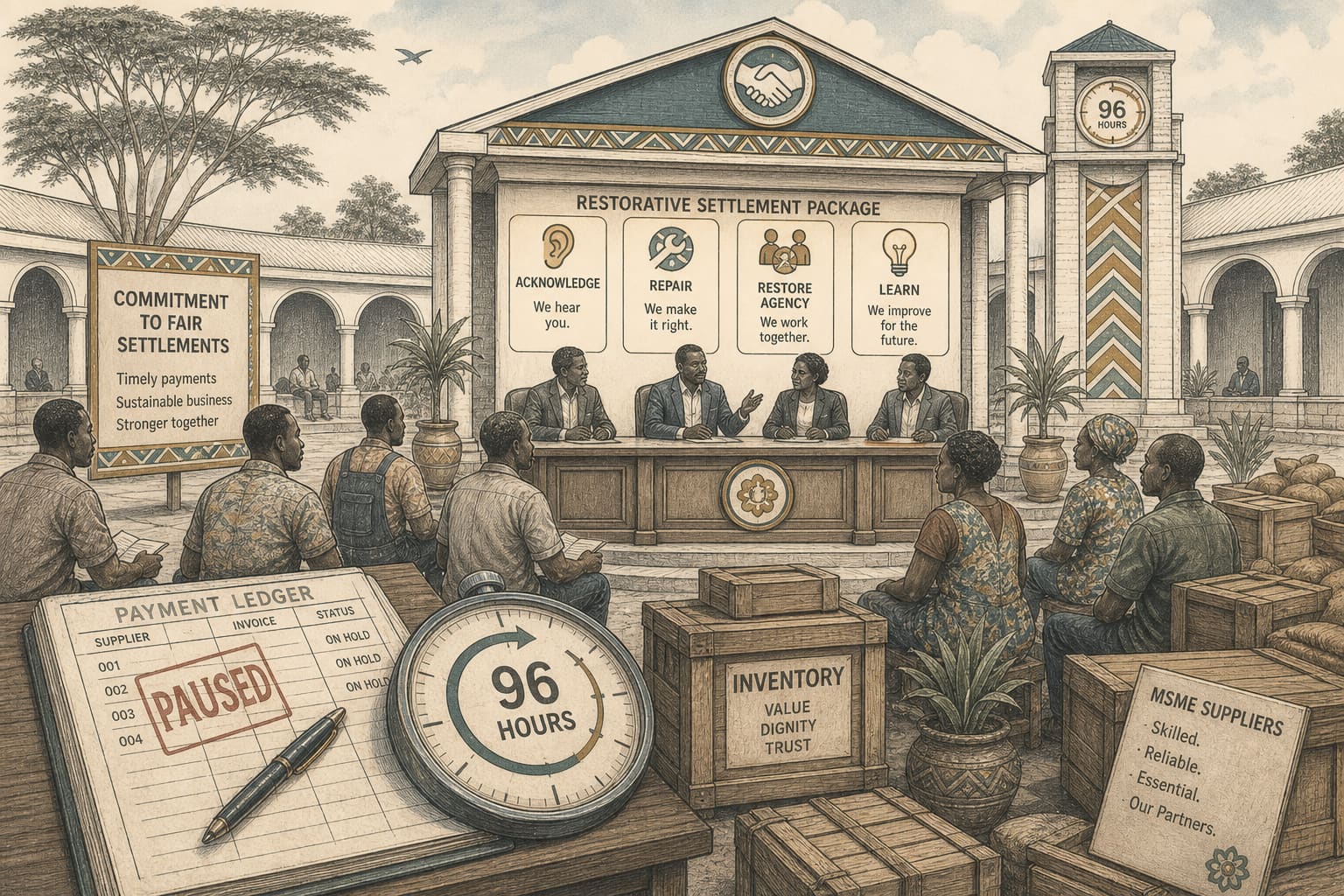
A settlement-file failure holds KES 17.6 million owed to 312 suppliers for 96 hours. Seventy-four suppliers take emergency finance; eighteen report missed payroll or inventory commitments. The contract allocates settlement liability to a payment partner; supplier associations publicly hold UmojaLink responsible for the promise; UmojaLink has KES 8 million immediately available for provisional relief. Legal allocation of liability does not settle the relational allocation of responsibility. Recovery should be restorative: acknowledge the failure, repair material harm, restore agency and learn.
Courtyard scene with a paused payment ledger and a clock. Four steps labelled Acknowledge, Repair, Restore agency, Learn. Dignity preserved. Educational fiction only.
Decision Journal, conditions and reopening triggers
Record initial assumptions, pre-vote, evidence received, inject decisions, resolution, dissent, mitigation owners, review dates, reopening triggers and post-decision outcomes. Open the Decision Journal. Quality scores are workflow signals, not certification.
A resolution template, not a verdict
No proposal may receive a passing score if it depends on:
- Dark patterns or deception
- Forced or inferred consent
- Group endorsement replacing individual permission
- Hidden fees or material risks
- Weakened KYC, privacy or consumer-protection controls
- Uncompensated community labour
- Uncorrectable consequential data
- Coerced renewal or obstructed portability
- Treating platform-created dependence as retention
- Concealing a material service failure
Require transparent, revocable data permissions; human review and appeal for consequential finance decisions; correctable and portable histories; contracted compensation and voice for associations; buyer payment-performance monitoring; no finance cross-sell caused by an unresolved platform payment delay; recovery service levels and pre-authorised incident funding; and monthly multi-sided value and relationship-health reporting.
| Dimension | Points |
|---|---|
| Journey and Demand Play diagnosis | 15 |
| CLV calculation and accounting controls | 20 |
| Coupled platform analysis | 15 |
| Strategic judgement and uncertainty | 10 |
| Governance process, dissent and ownership | 10 |
| African philosophies translated into operating choices | 15 |
| Data rights, fairness and appeal | 8 |
| Recovery and voluntary renewal | 7 |
| Total | 100 |
Journey and Demand Play diagnosis
- Points
- 15
CLV calculation and accounting controls
- Points
- 20
Coupled platform analysis
- Points
- 15
Strategic judgement and uncertainty
- Points
- 10
Governance process, dissent and ownership
- Points
- 10
African philosophies translated into operating choices
- Points
- 15
Data rights, fairness and appeal
- Points
- 8
Recovery and voluntary renewal
- Points
- 7
Total
- Points
- 100
Cap the score at 60 if a team counts registrations or contracts as active customers; ignores an indispensable platform side; double-counts community or network value; uses Ubuntu to override individual rights; treats coerced retention as CLV; or conceals the settlement failure.
Facilitator reveal and debrief questions
Participants should calculate before opening the reveal. The control below is a spoiler control for facilitation, not a security boundary.
Facilitator reveal, open after deliberation
Side-level three-year CLV (KES ’000): A: Anchor 163, Supplier 20.0, Finance 865; B: 294 / 39.8 / 1,350; C: 293 / 38.5 / 1,283.
Supplier density: A falls below the eight-supplier floor from Y2 (9.00 → 7.50 → 6.25). B remains viable (14.00 → 12.41 → 11.00). C remains viable with the strongest Y3 density (13.00 → 12.09 → 11.25).
Board-level coupled three-year NPV (KES millions): A 30.61 (after a cross-side liquidity penalty of about 1.15); B 55.83; C 72.51. Coupled NPV per active anchor: A 0.255; B 0.744; C 0.725. Common downside (M₁ −15%, retention −10pp each side): A 13.81m; B 33.49m; C 45.41m.
These outputs are not audited forecasts. A defensible reading is that C produces the highest absolute modelled value, while B may be preferable when operating capacity is binding. A sophisticated resolution may stage C using B-style capacity gates. A spreadsheet does not supply the board’s verdict.
- Where did Choose become Use, and why?
- Did the board optimise signed demand or completed promises?
- Which side financed another side’s convenience?
- Was community treated as a constituency or merely as cheaper CAC?
- When finance revenue grows because buyers pay late, what conflict arises?
- Did Sankofa mean responsible learning or indefinite platform memory?
- Was retention earned or manufactured through friction and lock-in?
- Did recovery restore cash only, or dignity, agency and voice?
- Which assumption would most change the decision?
- Would the resolution remain defensible if read aloud to affected suppliers?
Sources and simulation status
| Kind | Status |
|---|---|
| Published research and external context | Cited near claims; paraphrased; not treated as endorsement of the fictional case. |
| Fictional case facts | UmojaLink, people, injects, funnel tables and board options are simulation data. |
| Model assumptions | Discount rate, horizon, retention, expansion, density floors and haircuts are editable assumptions. |
| Calculated estimates | CLV and coupled NPV follow the stated formulas; rounding may differ slightly from display tables. |
| Board judgements | Approve, reject, hybrid or stage, with conditions, are deliberative acts, not model outputs. |
| Unresolved uncertainty | Fairness causality, partner capacity, association elite capture and recovery funding remain open. |
Published research and external context
- Status
- Cited near claims; paraphrased; not treated as endorsement of the fictional case.
Fictional case facts
- Status
- UmojaLink, people, injects, funnel tables and board options are simulation data.
Model assumptions
- Status
- Discount rate, horizon, retention, expansion, density floors and haircuts are editable assumptions.
Calculated estimates
- Status
- CLV and coupled NPV follow the stated formulas; rounding may differ slightly from display tables.
Board judgements
- Status
- Approve, reject, hybrid or stage, with conditions, are deliberative acts, not model outputs.
Unresolved uncertainty
- Status
- Fairness causality, partner capacity, association elite capture and recovery funding remain open.
- Winning Through Platforms (Emerald)
- Demand Plays chapter
- Lemon and Verhoef on customer journey
- Gupta et al. on customer lifetime value
- Rochet and Tirole on two-sided markets
- Global Findex mobile-money brief
- Kenyan mobile-money experimental evidence
- Ramose on Ubuntu
- African ethics (Stanford Encyclopedia)
- Gyekye, moderate communitarianism
- Ubuntu and business ethics
- Harambee
- Sankofa
Calls to action
Run the platform journey simulation in the Corporate Console, or return to the Corporate Participation Portal. Optional Web3 attestation, if used at all, may attest process completion only, not truth, competence, decision quality or certification.
The strongest platform does not merely acquire customers efficiently. It preserves the conditions under which every indispensable participant can choose, use, recover and freely choose again. A platform worth building keeps becoming worthy of the next choice.
From reading to civic action
UmojaLink is a fictional platform case on Choose and Use journeys, coupled lifetime value, consent, community reciprocity and restorative recovery. Run the labelled educational simulation, or return to the Corporate Portal. Outputs support deliberation; they do not automate a board verdict.
Improve this article
Ask a question, suggest a correction, submit a source, share experience, or propose a topic. Contact details stay private. Publicly consequential allegations need editorial review.